Key takeaways:
- The Supreme Court is seeking $228.4 million for the next fiscal year, including $14.6 million in additional funding for Supreme Court Police and building security.
- Amy Coney Barrett told lawmakers she was recently the target of a swatting incident at her Virginia home and previously had to explain a bulletproof vest to her child after the 2022 Dobbs leak.
- Elena Kagan said the Supreme Court Police anticipates a 38% increase in threats in 2026, while Democrats also pressed the justices on ethics rules and the emergency docket.
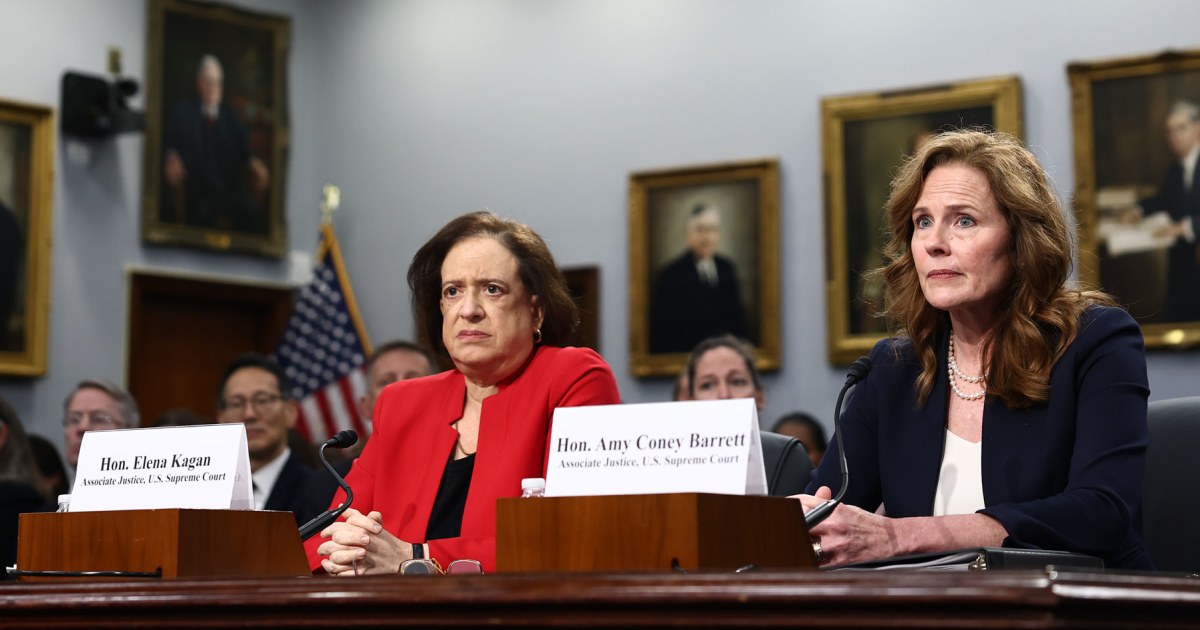
Supreme Court Justices Elena Kagan and Amy Coney Barrett urged lawmakers Tuesday to approve a major increase in court security funding, telling Congress that threats against judges have intensified and, in some cases, reached their homes.
The rare testimony before a House appropriations subcommittee came as the Supreme Court seeks $228.4 million for the next fiscal year, an increase of about $20.5 million over the previous year. The justices were also scheduled to appear before a Senate panel later Tuesday.
Kagan said recent increases in the court’s budget have gone “almost entirely” toward security since the Supreme Court Police took over protection at justices’ homes from the U.S. Marshals Service.
“For some of us, those threats have come very close, and all of us live with the knowledge that they may again materialize,” Kagan said. “But, as the chief justice has said, all members of the court continue to do their jobs as they believe legally right, adjudicating cases without fear or favor.”
Barrett described a recent “swatting” incident at her home in Fairfax County, Virginia, in which police responded to a false report of gunshots and raised voices.
“One of my teenage sons opened the door to go out with friends and saw in our street, it was full of police cars,” Barrett said. She said Supreme Court police stationed outside her home intercepted local officers and explained that the report was false. “The police did not actually attempt to enter our home,” she said.
Barrett also recalled being sent home with a bulletproof vest after the 2022 leak of the draft opinion overturning Roe v. Wade. “I didn’t expect that performing this service was going to put me in the position of explaining to my children what a bulletproof vest was and why I had to wear one,” she said.
Each justice is currently assigned between four and eight officers as part of a security detail, Barrett said. Kagan said the court would like to increase that staffing over time, and CBS News reported that budget documents call for funding that would allow six additional agents per justice. Barrett said details can expand during periods of heightened threat or when justices participate in more public events.
The court’s request includes $14.6 million in additional funding for the Supreme Court Police and security at the court building, $6.5 million for a new visitor screening facility on court grounds and $2.3 million for cybersecurity. NBC News reported the court expects to spend $40 million protecting justices from physical threats and $18 million on cyber threats.
Kagan said the Supreme Court Police anticipates a 38% increase in threats in 2026. CBS News reported that the U.S. Marshals Service recorded a 57% rise in “security incidents of significant concern” involving federal judges in fiscal year 2025. As of July 1, there had been 370 threats to judges this fiscal year and 512 Marshals Service investigations, according to agency data cited by CBS News.
Lawmakers from both parties signaled support for more security funding. Rep. Dave Joyce, R-Ohio, who chairs the House subcommittee, said judicial officers “must be able to do their jobs without fear for their safety or their family’s safety.” Rep. Steny Hoyer, D-Md., the panel’s top Democrat, said that “with a deeply divided country and increasingly violent rhetoric being directed at judges, Congress must provide sufficient funding to ensure the safety of all judicial personnel.”
Democrats also pressed the justices on ethics and transparency. Rep. Rosa DeLauro, D-Conn., said the court needs “increased financial disclosure requirements and a binding, enforceable code of ethics,” calling the code adopted in 2023 “woefully insufficient.” The scrutiny follows reports that Justice Clarence Thomas accepted luxury travel, private jet flights and vacations from Republican donor Harlan Crow without reporting them on annual financial disclosures.
Kagan reiterated support for an enforceable ethics code but said designing one is a “difficult question” because it must protect judicial independence. Barrett said she was “less certain” than Kagan about an enforcement mechanism made up of retired judges.
The justices also addressed the court’s emergency docket, sometimes called the “shadow docket.” Kagan said the court has tried to provide more process in important cases, including by requesting additional briefs, holding arguments and issuing fuller opinions. She cited the recent case involving President Donald Trump’s attempt to fire Lisa Cook from the Federal Reserve.
Tuesday’s House hearing marked the first time sitting justices had answered questions there since 2019. Justices once appeared before congressional panels regularly, but such testimony has become less common in recent years.










Be First to Comment