Key takeaways:
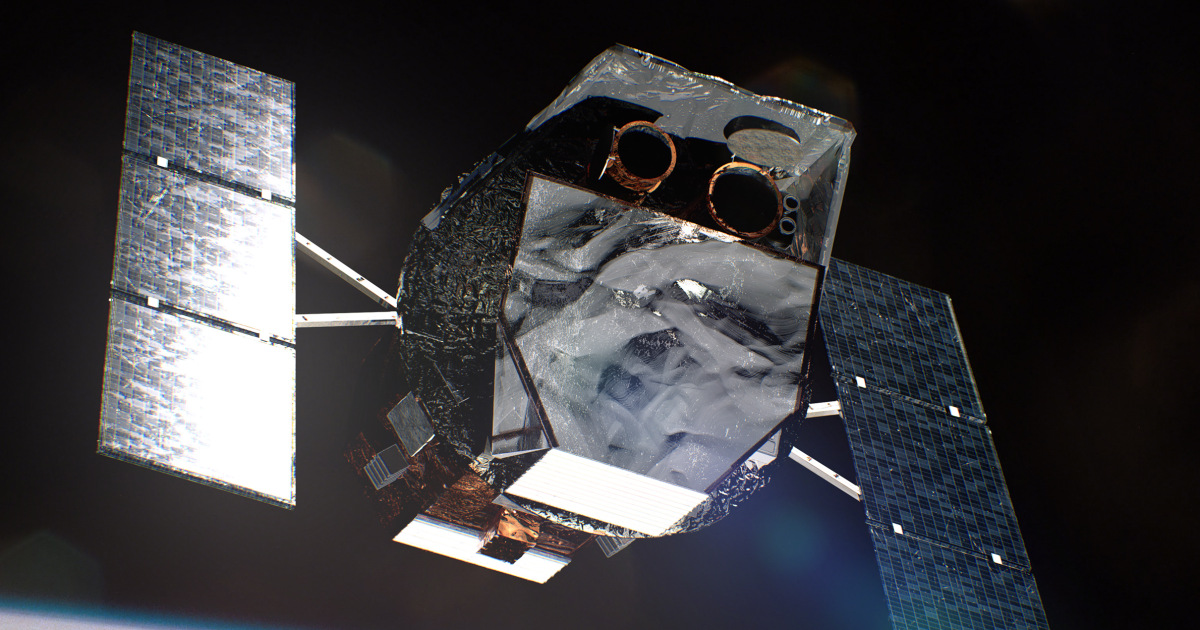
- NASA plans to launch a Katalyst Space Technologies robotic spacecraft as soon as Tuesday to boost the Neil Gehrels Swift Observatory into a higher orbit.
- Swift could drop below a critical 185-mile altitude in October after increased atmospheric drag linked to intense solar activity.
- The $30 million mission aims to restore a telescope launched in 2004 that has helped study more than 1,400 gamma-ray bursts and other high-energy events.
NASA is preparing to launch a robotic rescue mission as soon as Tuesday to keep one of its veteran space telescopes from falling back to Earth.
The agency hired Katalyst Space Technologies for a $30 million operation to boost the Neil Gehrels Swift Observatory into a higher, more stable orbit, extending the life of a spacecraft that has spent more than two decades studying some of the most powerful explosions in the universe. Swift is losing altitude more quickly after a period of intense solar activity, and NASA models suggest its orbit could drop below a critical 185-mile threshold in October.
The launch is planned from the Marshall Islands, where Northrop Grumman’s Stargazer aircraft is expected to carry a Pegasus XL rocket aloft before releasing it at about 40,000 feet. NBC News reported the takeoff is scheduled no earlier than Tuesday at 6:17 a.m. ET. CBS News reported liftoff could occur as early as Tuesday from an atoll in the Pacific.
The rocket will carry a robotic spacecraft built by Katalyst. CBS News identified the spacecraft as Lift, while NBC News identified it as LINK. According to NBC News, it is a 6-foot, 880-pound spacecraft; CBS News described it as roughly the size of a small kitchen refrigerator with a 40-foot solar wingspan and three robotic arms, each with finger-like gripping tools.
Once in orbit, the spacecraft will attempt to rendezvous with Swift, capture it and raise its orbit over several months. CBS News reported the plan is to lift Swift from about 224 miles to 373 miles, with a rendezvous expected after about a month and the orbit-raising effort taking another couple of months.
“This is the first American space robot to go up and do anything like this,” Katalyst Space CEO Ghonhee Lee told The Associated Press, according to CBS News. “NASA has all these big senior observatories … all of them can benefit from a service like this. So what we’re proving with this mission is this is a new play in the playbook that’s available.”
Swift launched in 2004 on what NBC News described as an original two-year mission. It has since helped scientists study more than 1,400 gamma-ray bursts and other high-energy events, including the most distant one ever detected, from an exploding star about 13 billion light-years away. Gamma-ray bursts are among the universe’s most powerful explosions and can be triggered by events such as black hole births and collisions between ultra-dense stars.
NASA turned off Swift’s scientific instruments in February to slow its descent, CBS News reported. If the rescue succeeds, Lee said Swift could return to work by September.
“It is a swift observatory that can quickly pivot across the night sky to find things that go boom in the night,” Shawn Domagal-Goldman, director of NASA’s astrophysics division, said during a June 17 news conference, according to NBC News. “So we decided, yeah, we want to go save this one this time because of how special it is.”
Swift was not designed to be serviced in orbit, making the mission difficult. It lacks thrusters to raise its own orbit or meet another spacecraft. Katalyst officials said there is no guarantee the rescue will work.
“I have to be honest. No one thought it was going to be possible. No one thought we would get as far as we’ve already gotten today,” Domagal-Goldman said, according to CBS News.
NASA science chief Nicky Fox said the agency does not currently have the budget to replace Swift. “If we let Swift reenter, we would lose that telescope. We would lose a lot of capability,” she said, according to CBS News.
Katalyst says the mission could demonstrate a broader market for repairing, repositioning and upgrading satellites in orbit. The company’s next-generation robotic rescuer is scheduled to fly next year, CBS News reported, and could eventually be used on larger spacecraft, including the Hubble Space Telescope. Hubble, now 36 years old, is also losing altitude and could receive a Katalyst boost in 2028, according to CBS News.
“It’s a national treasure,” Fox said. “People love Hubble.”









Be First to Comment