Key takeaways:
- Unitree shares closed up 460% on Shanghai’s STAR Market after rising more than 620% intraday, according to Al Jazeera; NBC News reported an intraday peak of 629%.
- Unitree unveiled its new “Superman” humanoid robot this week, saying it can jump more than 6.5 feet and reach speeds above 28 miles per hour.
- The United States accounted for about 13% of Unitree’s $250 million in revenue last year, but new U.S. restrictions bar imports of Chinese-made humanoid robots.
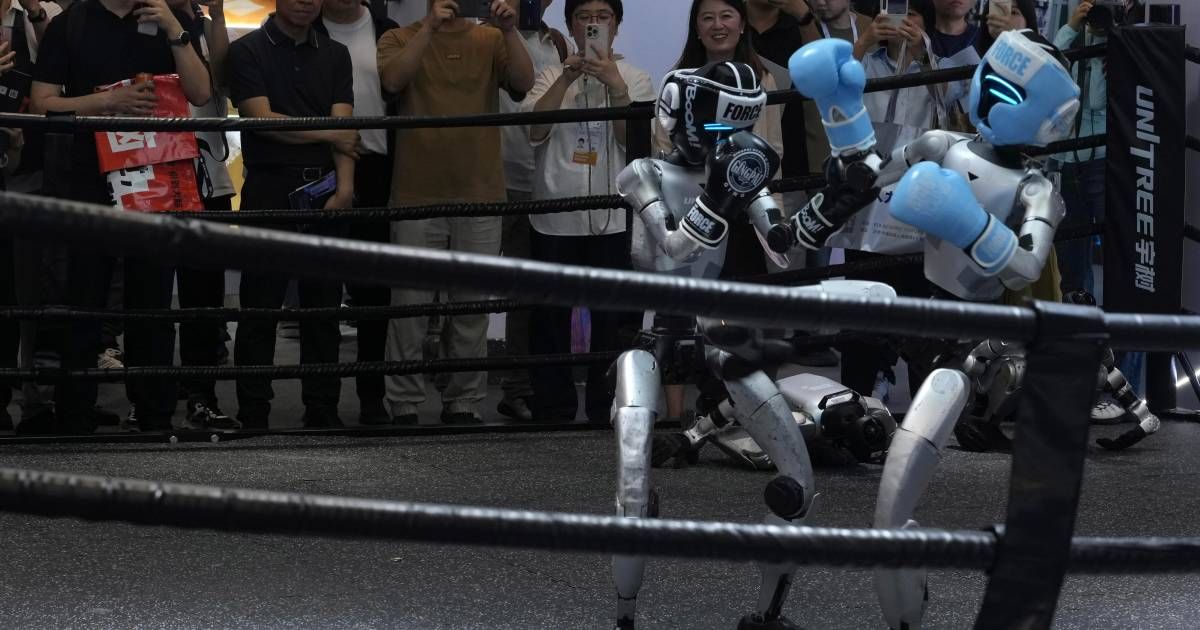
Unitree Robotics, the Chinese company behind humanoid robots that dance, flip and perform martial arts, surged in its Shanghai market debut Wednesday, underscoring investor enthusiasm for China’s fast-growing robotics industry.
The Hangzhou-based company became the first humanoid robotics maker to list on a mainland Chinese exchange. Its shares closed up 460% on Shanghai’s tech-focused STAR Market, after climbing more than 620% during the session, Al Jazeera reported. NBC News reported the stock rose as much as 629% intraday before closing at 845 yuan, or $125.40, valuing the company at about $50 billion.
The reports differed on the initial public offering price. NBC News reported Unitree’s shares were initially priced at 150.8 yuan, or $22, while Al Jazeera reported the IPO price was 50.8 yuan per share, giving the company an initial valuation of about 61 billion yuan, or $9 billion.
The debut is a major windfall, on paper, for founder and CEO Wang Xingxing, an engineer who started the company in 2016. Wang owns about a fifth of Unitree, leaving him with paper wealth of more than $12 billion, according to Reuters as cited by NBC News.
Unitree has drawn global attention with humanoid and quadruped robots that can run, dance, do backflips and perform kung fu. On Monday, the company unveiled a new humanoid model called “Superman,” which it says can jump more than 6.5 feet, or two meters, and reach a top speed of more than 28 miles per hour. Al Jazeera reported the company markets the robot as capable of running 12.66 meters per second.
Unitree is one of China’s leading humanoid robotics companies. Al Jazeera reported that it shipped more than 5,500 humanoid robots to customers worldwide last year. NBC News, citing Singapore-based market research firm Omdia, reported that Unitree and Chinese rival AgiBot together accounted for more than 70% of the approximately 13,000 humanoid robots shipped globally last year.
Rinat Mirzaitov, founder of Humanoid Analytics, told Al Jazeera the investor excitement reflects Unitree’s position in a sector with few major competitors. “It is one of the few companies in humanoid robotics with genuine revenue, profitability and meaningful production volume,” he said. But he added that Unitree does not dominate the entire market. “Its main challenge is turning hardware and manufacturing leadership into application and workflow leadership,” Mirzaitov said.
NBC News reported that, although Unitree is profitable, its products are mainly sold to universities and research institutions rather than being used commercially. The company reported $250 million in revenue last year, with the United States accounting for about 13%, according to its IPO prospectus cited by NBC News.
That U.S. business faces new limits. Last month, the administration of President Donald Trump announced a ban on imports of Chinese-manufactured humanoid robots, citing national security risks, Al Jazeera reported. NBC News reported the ban applies to new foreign-made robots and cuts Unitree off from the U.S. market, though existing models can still be sold.
In June, the U.S. Defense Department added Unitree to a list of Chinese military companies, describing it as a “contributor to the Chinese defense industrial base,” NBC News reported. The designation does not impose sanctions, and Unitree says its robots are for civilian use only, but it bars the U.S. military from contracting directly with the company.
Unitree’s debut came as hundreds of Chinese companies displayed new products at the World Robot Conference in Beijing. China has made artificial intelligence and advanced robotics a national priority, with its latest five-year plan pledging to “target the frontiers of science and technology.”
Analysts say the offering could become a test case for a young industry. “Chinese retail buyers tend to be more driven by hype,” said Lian Jye Su, chief analyst at Omdia. “But the most important thing about the IPO is the fact that this is going to be the bellwether for the humanoid robotics industry.”
“The industry is still in a very nascent stage,” Lian said. “The first thing I’m seeking an answer for is sort of how real is the demand?”






Be First to Comment