Key takeaways:
- NASA and Katalyst Space Technologies abandoned a $30 million attempt to raise the Swift Observatory to a higher orbit after LINK suffered attitude control problems.
- LINK launched July 3, later spun at about 9 degrees per second and continued to have pointing and positioning issues despite efforts to slow its tumble.
- Swift launched in 2004 to study gamma-ray bursts and is expected to reenter Earth’s atmosphere later this year after losing altitude amid increased solar activity.
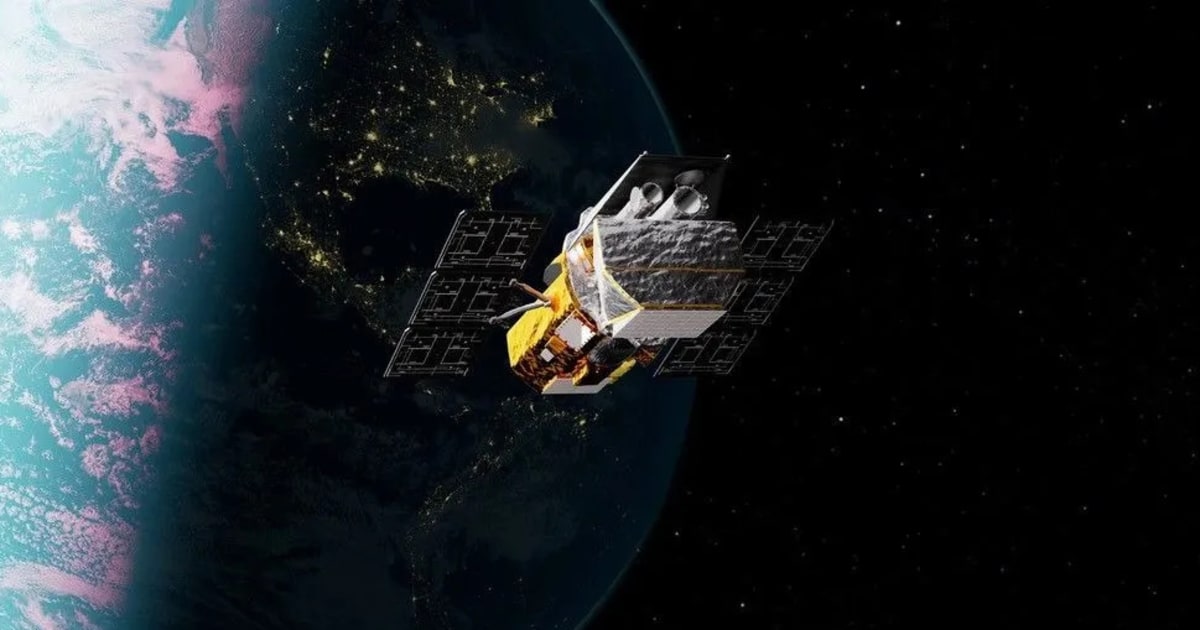
NASA has abandoned a first-of-its-kind attempt to save its Neil Gehrels Swift Observatory, leaving the aging space telescope on course to break apart in Earth’s atmosphere later this year after more than two decades of tracking some of the universe’s most powerful explosions.
The agency and Arizona-based Katalyst Space Technologies announced Wednesday that Katalyst’s LINK spacecraft will not try to capture Swift and push it into a higher, safer orbit. The decision follows weeks of trouble controlling LINK after its July 3 launch aboard Northrop Grumman’s Pegasus XL rocket.
“This is not the outcome we were working toward, but it does not change why this mission was worth attempting,” NASA Administrator Jared Isaacman said in a statement.
Swift launched in 2004 for what was designed as a two-year mission. It became known for studying gamma-ray bursts, immense cosmic explosions associated with events such as the births of black holes and collisions between ultra-dense stars late in their lives. Shawn Domagal-Goldman, director of NASA’s astrophysics division, told CBS News in June that “nothing pinpoints gamma-ray bursts” like Swift.
“A nuclear weapon going off doesn’t even compare to the magnitude of energy that comes out of these things and it’s literally the biggest explosions in the universe,” Domagal-Goldman said.
The observatory has been losing altitude for years because of atmospheric drag in low Earth orbit. That descent accelerated during a period of intense solar activity that began affecting the spacecraft in 2024. Solar storms can heat Earth’s atmosphere, causing it to expand and increase drag on satellites. Swift has no thrusters to counteract the pull.
NASA awarded Katalyst a $30 million contract in 2025 to build LINK and attempt the rescue on a rapid timeline. The plan called for LINK to rendezvous with Swift, capture it and raise its orbit over several months so the telescope could continue operating.
The mission ran into trouble soon after launch. NASA said teams established communications with LINK, but less than two weeks into the flight, problems emerged with the spacecraft’s orientation. On July 15, NASA said engineers had addressed early communications and attitude control issues. By July 28, the agency said LINK’s attitude control systems had malfunctioned, causing the spacecraft to spin and resulting in sporadic communications. NASA said LINK was rotating at about 9 degrees per second.
Flight controllers later used LINK’s thrusters to slow the spin, but problems with pointing and positioning persisted. Katalyst said the spacecraft will not attempt the boost because of those control issues.
“We took on this high-risk, high-reward challenge and are proud of the milestones we reached along the way,” Katalyst CEO Ghonhee Lee said in a statement. “We have already learned a tremendous amount, and now our job is to turn those lessons into something durable — building a repeatable playbook to inform future rendezvous and proximity operations and satellite servicing.”
NASA said Katalyst will continue operating LINK near Swift to demonstrate technologies that could be used in future rescue and servicing missions. Isaacman said the agency will study the rendezvous attempt and apply the lessons to future flights.
“NASA should be willing to move quickly and take smart risks when the potential return is worth it, and that is exactly what we did,” Isaacman said.
Swift’s science instruments were turned off earlier this year to slow its descent, CBS News reported. The telescope was orbiting about 216 miles above Earth as of last week and is predicted to reach 186 miles in October. NASA expects it to plunge through the atmosphere later this year.
CBS News reported that NASA’s Hubble Space Telescope, now 36 years old, could also benefit from an orbital boost and had been next in line for a rescue attempt if the Swift mission had succeeded. Hubble is also losing altitude because of recent solar activity and is expected to reenter the atmosphere in the 2030s if no action is taken, though it was not immediately known how the failed Swift mission would affect any Hubble plans.











Be First to Comment