Key takeaways:
- Warsh said inflation remains above the Fed’s 2% target, with CPI up 3.4% in the 12 months ending in July and the Fed’s preferred measure at 3.7%, according to NPR.
- Investor expectations for a September rate hike rose from about one in three before Warsh’s speech to above 50% afterward, NPR reported.
- Warsh said the Fed should become “quieter” in its communications and argued that forward guidance adopted during the 2008 financial crisis has “overstayed its welcome.”
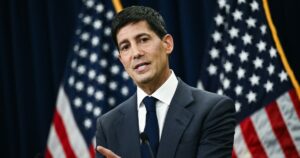
Federal Reserve Chair Kevin Warsh warned Friday that inflation remains above the central bank’s target, prompting investors to raise their bets that the Fed could lift interest rates as soon as next month.
In his first major speech as chair, delivered at the Fed’s annual symposium in Jackson Hole, Wyoming, Warsh did not say where interest rates are headed. But he made clear that the central bank is still focused on prices, even as he described the economy as resilient.
“The Fed’s predominant focus right now should be on prices,” Warsh said, noting that inflation remains above the Fed’s 2% target. “None of these measures are perfect. But they all tell a similar story: Inflation is running above our 2% target.”
The consumer price index rose 3.4% over the 12 months ending in July, while the Fed’s preferred inflation measure was 3.7% over the same period, NPR reported. The Guardian reported that inflation had cooled from a three-year high of 4.2% in May but remained about 1 percentage point higher than levels seen last year.
Warsh said the labor market is stable, investment is strong and consumer spending is resilient. He also said the economy “appears to have strengthened” as it has weathered shocks, including higher oil prices brought on by the war in Iran, according to The Guardian.
“On that score, both Main Street and Wall Street have been resilient,” he said.
Markets interpreted the remarks as a sign that the Fed may move toward another rate increase. Before Warsh spoke, investors put the odds of a September rate hike at about one in three; afterward, the likelihood rose above 50%, NPR reported. The Guardian reported that two-year and 10-year Treasury yields rose slightly after his opening remarks, while the 30-year Treasury was little changed. The S&P 500 was flat, and the Dow Jones edged lower.
The Fed left rates unchanged at its July meeting, with the benchmark rate sitting in a range of 3.5% to 3.75%, according to The Guardian. Three of the 12 voting members favored a quarter-point increase, the first time in a decade that so many board members dissented on a policy position.
Warsh also used the speech to argue for less explicit signaling from the central bank. He said the Fed’s practice of “forward guidance,” adopted during the 2008 financial crisis, had “overstayed its welcome.”
“A quieter Fed, more purposeful in its communications, is better able to meet its objectives,” Warsh said. “And we can be held accountable for delivering on our remit — the only true test of our credibility. To borrow a line from General Chuck Yeager, ‘At the moment of truth, there are either reasons or results.’”
The stance may put Warsh at odds with President Donald Trump, who has repeatedly called for lower interest rates, The Guardian reported. Economists have warned that cutting rates could worsen inflation, according to the outlet.
Warsh also addressed artificial intelligence, calling it a “hinge point in history.” He said AI could eventually boost production and lower costs, while acknowledging questions about who benefits and what it means for workers. In the near term, he said heavy investment in AI data centers is adding to inflation by pushing up construction costs and prices for memory chips.
Warsh said a Fed task force studying AI will not affect immediate rate decisions. “Their recommendations will come later and have no bearing on decisions we make in the current policy conjuncture,” he said. “But I believe that for future policy challenges, this intellectual investment today will leave us far better prepared.”

Be First to Comment