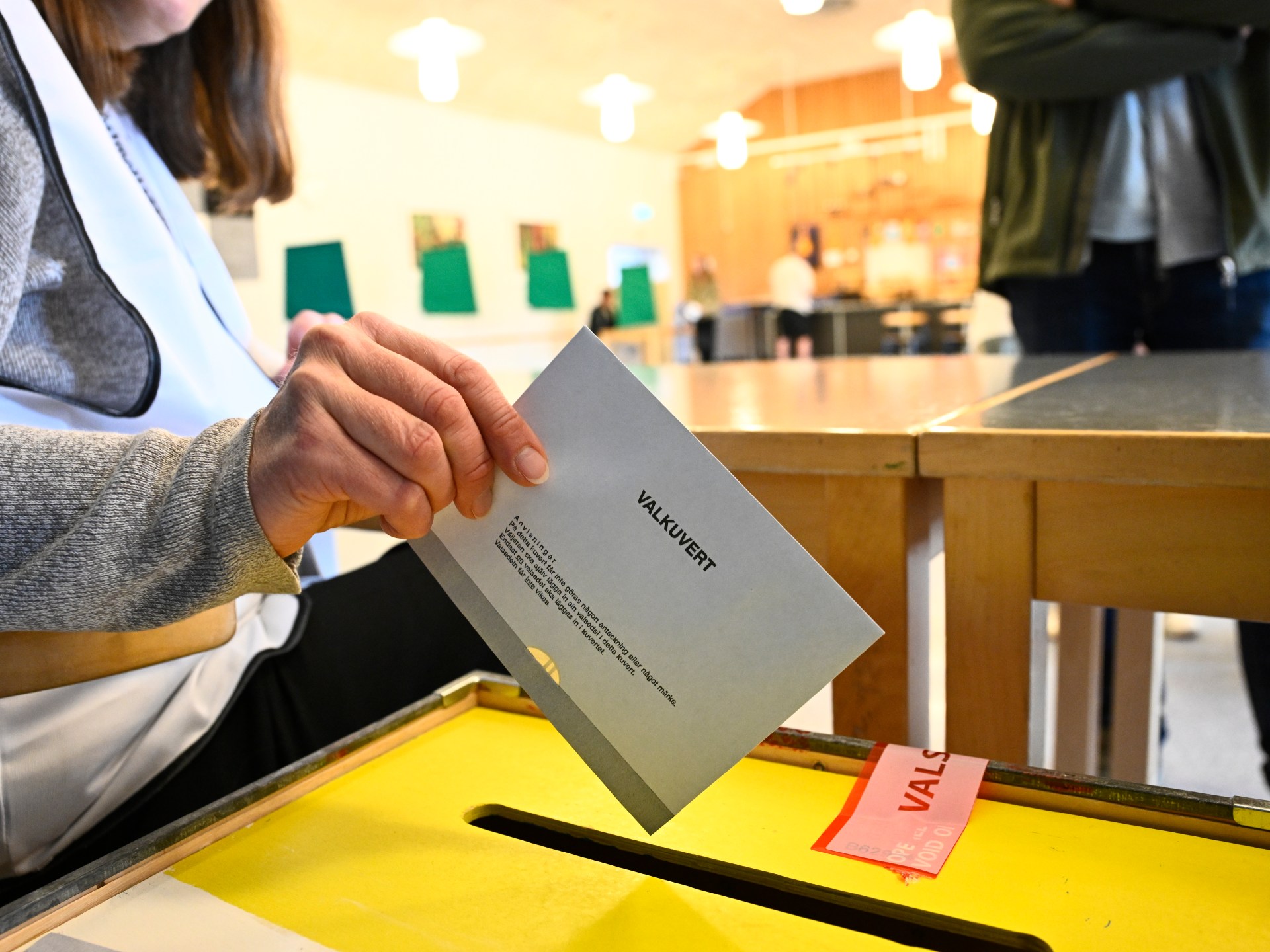
Key takeaways:
- An Indikator Opinion poll conducted Sept. 2-10 put Sweden’s center-left coalition at 50.8 percent and the right-wing coalition at 47.6 percent.
- Kristersson has said the Sweden Democrats would receive Cabinet posts if the right-wing bloc wins, though he would remain prime minister.
- Police figures cited in the sources show shootings in Sweden fell from 391 in 2022 to 158 in 2025.
Swedes voted Sunday in a tightly fought general election that could bring the far-right Sweden Democrats into government for the first time, marking a possible turning point for a country long known for liberal immigration policies, a generous welfare state and low crime.
The contest pits Prime Minister Ulf Kristersson’s center-right alliance against a center-left bloc led by former Prime Minister Magdalena Andersson and her Social Democrats. Polling stations opened at 8 a.m. and were due to close at 8 p.m., when exit polls were expected. The first reliable results were expected several hours later.
About eight million people are eligible to vote in Sweden, a country of 10.6 million where turnout regularly tops 80 percent. Al Jazeera reported that about half of voters had cast ballots in advance.
Pre-election surveys showed the race narrowing in the campaign’s final days. An Indikator Opinion poll conducted Sept. 2-10 put the center-left coalition at 50.8 percent and the right-wing coalition at 47.6 percent.
Andersson, 59, who became Sweden’s first female prime minister in 2021, voted with her husband at a school in Nacka, south of Stockholm. “It is now up to the Swedish people to decide which direction our country should take,” she told reporters. “Should we have a government entirely dominated by the Sweden Democrats? Something that has never happened in Sweden before? Or should we have a government led by me, which will steer Sweden in a new spirit of cooperation?”
Her party has pledged to strengthen the welfare state and help households struggling with the rising cost of living.
Kristersson, who has led Sweden since 2022, is seeking a second four-year term. His three-party center-right minority government has depended on outside support from the Sweden Democrats for a parliamentary majority. If the right wins again, Kristersson has said the Sweden Democrats would receive Cabinet posts, though he would remain prime minister even if they are the stronger party.
“We want to use our new and far better preconditions to improve the lives of ordinary people … to make Sweden great again,” Kristersson told AFP before the vote.
The Sweden Democrats, led by Jimmie Åkesson since 2005, entered parliament in 2010 and won 20.5 percent of the vote in 2022, becoming Sweden’s second-largest party and the biggest party on the right. The party traces its roots to Sweden’s extremist fringe and acknowledges that figures in its early history had connections to neo-Nazi and white supremacist movements. Under Åkesson, it has sought to expel extremists, soften its image and present itself as a mainstream right-wing party.
For years, Sweden’s established parties kept a political firewall around the Sweden Democrats. As recently as 2018, Kristersson assured Holocaust survivor Hédi Fried that he would not cooperate with the party, according to Reuters.
The party’s platform includes deporting people in the country illegally, tightening citizenship laws, requiring strict assimilation of newcomers and restricting social security to citizens. Andreas Önnerfors, a professor of intellectual history at Linnaeus University, told CBS News the party has broadened its appeal by blending right-wing positions with policies aimed at working-class voters. “They have merged typical right-wing positions with typical Labour or Social Democratic positions — social security and benefits and things like that. That makes sense among ordinary people,” he said.
Immigration and crime have dominated Swedish politics in recent years. Sweden received about 163,000 asylum applications during the 2015 European migration crisis, among the highest per-capita rates in Europe. Integration, segregation and a surge in gang shootings and bombings later became major national issues.
The Swedish government says asylum immigration has fallen to its lowest level since 1985. Police figures show shootings fell from 391 in 2022 to 158 in 2025, with the decline continuing this year.
“Swedish politics has clearly moved in a more restrictive direction on issues such as immigration and crime,” Niklas Bolin, a political scientist at Mid Sweden University, told CBS News. “Importantly, this shift is not limited to the parties on the right. The Social Democrats, Sweden’s largest party, have also moved in this direction.”









Be First to Comment