Key takeaways:
- The official death toll from Venezuela’s June 24 twin earthquakes stands at 3,535, with 16,740 injured and 17,854 left without housing.
- At least 12,800 people are staying in 80 shelters across Caracas and La Guaira, while health experts warn of infections and disease risks in crowded conditions.
- Venezuelan authorities say more than 850 buildings were damaged or collapsed, while satellite data reported by NBC News suggests about 59,000 buildings were destroyed.
Venezuelans are holding candlelight vigils and searching through ruins for missing relatives nearly two weeks after twin earthquakes killed at least 3,535 people and left thousands more injured, homeless or unaccounted for.
The June 24 earthquakes, measured at magnitudes 7.2 and 7.5, struck within seconds of each other in and around Caracas and La Guaira, devastating coastal communities and parts of the capital. Lawmaker Jorge Rodriguez said Monday that the latest official tally showed 16,740 people injured and 17,854 left without housing. At least 12,800 people were staying in 80 shelters across Caracas and La Guaira, the areas hit hardest.
On Sunday evening, hundreds gathered in Caracas and Maracaibo to remember the dead and those still missing. At the Central University of Caracas, mourners lit white candles and arranged them on the ground in the shape of Venezuela. Similar vigils have taken place across the country as search-and-rescue efforts shift from finding survivors to recovering bodies. Acting President Delcy Rodríguez declared seven days of “national mourning” on Tuesday.
The grief has spread beyond Venezuela. Relatives abroad are using social media to seek help locating loved ones trapped in collapsed buildings. Valeria Veloz, who lives in Spain, has asked for a crane and other heavy equipment to search for her grandparents, Pedro Veloz Medina and Alejandrina Ramírez de Veloz, who lived in a seven-story building in Caraballeda. International rescue workers told the family that 10 large concrete slabs would need to be lifted.
“Without the crane, how the building collapsed, it will be impossible to be able to move everything as we should,” Pedro Veloz, a cousin in Orlando, Florida, told NBC News.
Ryan Ash, a rescuer with Pennsylvania-based Chazak Rescue, said his team has been working overnight shifts to recover bodies. “It’s a lot of hard work digging through the rubble in the middle of the day. It’s very hard to keep working in the hot sun. So, we started doing that at night and sleeping during the day,” he told Noticias Telemundo.
The scale of destruction remains contested. Venezuelan authorities have said more than 850 buildings were damaged or collapsed. NBC News reported that satellite data from NASA suggests the number of destroyed buildings is closer to 59,000, including hospitals and schools. Al Jazeera reported that an estimated 60,000 buildings were damaged or destroyed.
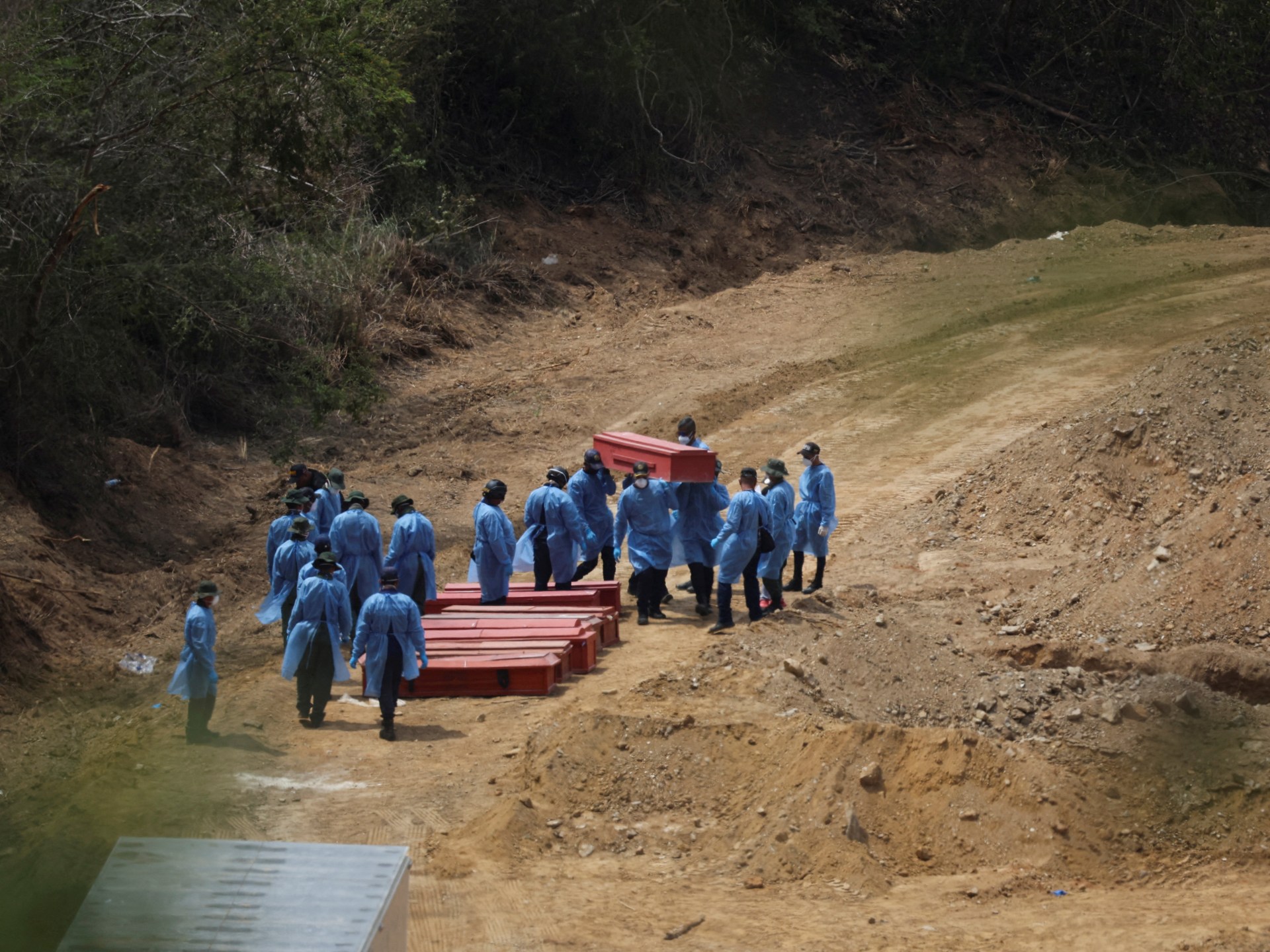
In La Guaira on Monday, witnesses told Reuters they saw trucks and forensic workers transporting coffins while machinery dug trenches in an open area marked by white crosses where authorities were burying bodies.
The government has begun reconstruction in Brisas de Maiquetia, a state-based residential complex in La Guaira. “They told us the reconstruction work will be finished in around three months or even sooner,” evacuated resident Ester Birrier told The Associated Press. “They promised to hand over the apartments once reconstruction is completed, and our building was the first one to start reconstruction.”
Health workers warn the disaster is becoming a medical emergency. Clínica Alfa, the only private clinic still operating in La Guaira, has limited staff after losing six doctors and five employees, owner Massimiliano Luca said. Doctors are relying on donated supplies and medicine as the health system struggles to treat the injured.
“Health conditions are worsening,” volunteer doctor Raxmara Godoy told Noticias Telemundo, warning that infectious disease risks are rising. Eugenio Cova, head of trauma at Hospital Jose Gregorio Hernandez in Caracas, told Al Jazeera, “The issue we foresee just around the corner is the infections that patients who have been exposed to the disaster for the longest time might bring.”
Frustration has grown in places where residents say official help has been slow. Carolina Jimenez, president of the Washington Office on Latin America, told Al Jazeera: “In a government in any other country, the first responder should be the state. In the case of Venezuela, the state has been the last responder.”






Be First to Comment