Key takeaways:
- The Supreme Court overturned Humphrey’s Executor, a 1935 precedent that allowed Congress to limit presidential removal of some independent agency officials.
- The case arose from Trump’s March 2025 firing of FTC Commissioner Rebecca Slaughter, who sued and initially won reinstatement in lower court.
- The court’s liberal justices dissented, warning that dozens of independent commissions could become effectively executive agencies.
The Supreme Court on Monday gave presidents broad new authority to fire leaders of independent agencies, ruling 6-3 that removal protections for Federal Trade Commission members are unconstitutional and overturning a 90-year-old precedent that had limited White House control over certain boards and commissions.
The decision in Trump v. Slaughter ends the force of Humphrey’s Executor v. United States, a 1935 ruling that allowed Congress to shield members of some multi-member agencies from being fired by the president at will. The ruling centered on President Donald Trump’s March 2025 dismissal of FTC Commissioner Rebecca Slaughter, who was told by email that her continued service would be “inconsistent” with the administration’s priorities.
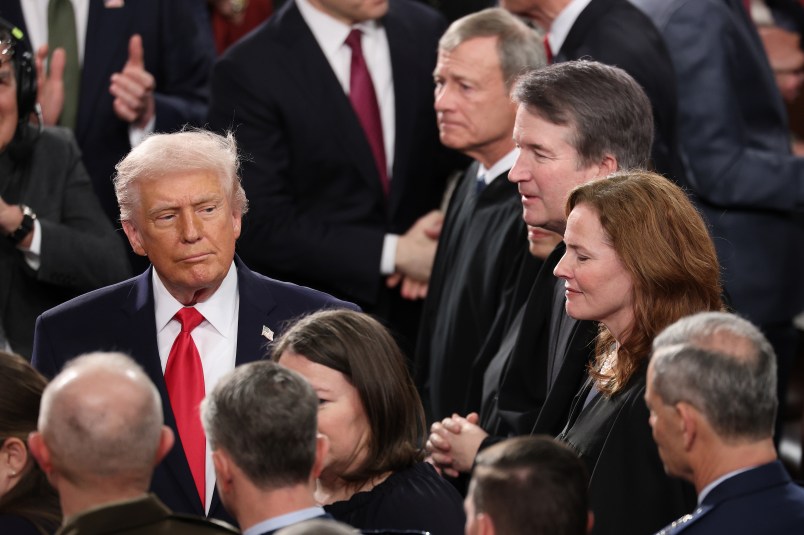
Chief Justice John Roberts wrote for the conservative majority, joined by the court’s other conservative justices. Roberts said restrictions on the president’s ability to remove officials who exercise executive power on his behalf violate the president’s constitutional authority.
“Although it is up to the Senate to decide whether to confirm those with whom the President would prefer to work, neither Congress nor the courts may saddle him with those with whom he cannot work,” Roberts wrote. “Subordinates who exercise the President’s power are subject to removal by him. Then, and only then, can they remain accountable to the President, and the President to the people.”
Justices Sonia Sotomayor, Elena Kagan and Ketanji Brown Jackson dissented. Sotomayor read a summary of her dissent from the bench, a rare step that signals strong disagreement.
“Today, this Court undoes centuries of political practice and concludes that all three branches of Government have been acting in open defiance of the Constitution all this time. Its conclusion is wrong,” Sotomayor wrote. In another passage, she warned that “dozens of independent commissions are now likely to become purely executive agencies, shifting tremendous power over broad swaths of American life into the President’s hands.”
The FTC enforces consumer protection and antitrust laws. It is structured as a five-member bipartisan commission, with no more than three commissioners from the same party. Under the law that created the agency in 1914, commissioners could be removed only for inefficiency, neglect of duty or malfeasance in office.
Slaughter sued after her firing, arguing Trump had removed her without cause in violation of that law. A federal district court ruled in her favor and ordered her reinstated. The U.S. Court of Appeals in Washington, D.C., also allowed her to remain in the job, writing that the administration was not likely to succeed because a ruling in its favor would have to defy binding Supreme Court precedent. The Supreme Court allowed Trump to remove her while the case continued, then used the case to overturn Humphrey’s Executor.
The ruling is expected to affect more than two dozen multi-member agencies whose leaders have had similar for-cause removal protections, CBS News reported. The court had previously allowed Trump to oust members of the National Labor Relations Board, Merit Systems Protection Board and Consumer Product Safety Commission while litigation proceeded.
The court has treated the Federal Reserve differently. In a separate decision discussed by Talking Points Memo and CBS News, the justices rejected Trump’s attempt to fire Federal Reserve Governor Lisa Cook while her case moved forward. The court has described the Fed as a “uniquely structured, quasi-private entity” with a distinct historical tradition.
Trump celebrated the Slaughter decision on Truth Social, calling it “long sought by United States Presidents, dating all the way back to the 1930s” and “one of the most important ever given with respect to Presidential Powers.”






Be First to Comment