Key takeaways:
- The NTSB said a fan blade broke in the No. 2 engine of Ryanair Flight 1879, sending debris into the fuselage and shattering a row 11 window.
- A Serbian passenger was seriously injured after being partially sucked into the damaged window before other passengers pulled him back inside.
- Investigators found bird remains in the failed engine and signs of metal fatigue at the base of the broken fan blade, but have not determined the cause.
Engine debris shattered a Ryanair passenger jet’s window shortly after takeoff from Greece last month, leaving a Serbian man partially sucked out of the aircraft, U.S. investigators said in a preliminary report that also found evidence of bird remains inside the failed engine.
The National Transportation Safety Board said Ryanair Flight 1879, a Boeing 737 operated by Ryanair subsidiary Malta Air, experienced a failure of its No. 2 engine during climb-out from Thessaloniki International Airport on July 10. The flight was bound for Memmingen, Germany, with 149 passengers and six crew members aboard.
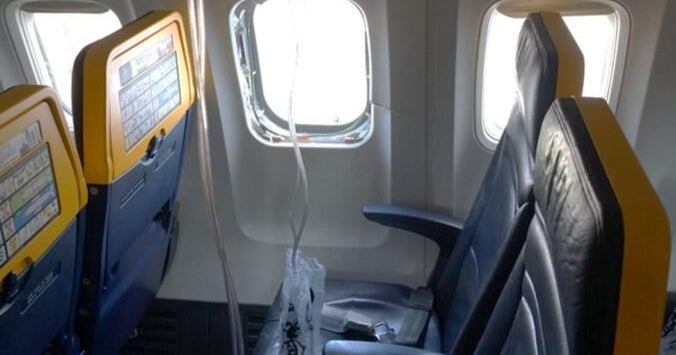
According to the NTSB, one of the engine’s fan blades broke off, sending fragments through the engine and into the fuselage. The debris damaged the aircraft in several places and shattered a passenger window in row 11.
“Engine fragments breached the fuselage and the cabin depressurized,” the NTSB report said.
The passenger seated by the broken window, identified by the BBC as Serbian national Ljubisa Karović, was seriously injured. The BBC reported that his head and right shoulder were sucked out through the opening. His wife, Svetlana Grković Maksimović, told BBC Serbia that she and two other passengers held on to his legs for several minutes.
A flight attendant told investigators that after the cabin depressurized and oxygen masks dropped, crew members saw the passenger in seat 11F “partially lodged in a damaged cabin window, and that the entire window was missing.” Other passengers pulled him back into the cabin, the NTSB said. He was moved to row 12, where a fellow passenger who was a doctor treated him.
Another passenger went to the forward galley and retrieved a “metal box” to try to block the broken window, according to the report.
The injured passenger later told The Guardian: “I don’t remember much and my head and neck still hurt but I am still alive. It could have been the seatbelt, the fact that I was still strapped in.”
The flight crew told investigators they received a “high vibration” alert from the engine during the climb and reduced power while carrying out checks. When the vibrations stopped, they continued climbing on autopilot. The vibrations then increased again, followed by a loud bang. The crew declared an emergency and returned to Thessaloniki, where the aircraft landed without further incident. No one else aboard was hurt.
Flight attendants reported hearing and feeling vibrations and seeing a small amount of smoke before the oxygen masks deployed, the BBC reported, citing the NTSB report.
Investigators found bird remains, including feathers, inside the failed engine. The NTSB said the aircraft had been involved in four reported bird strikes in the previous 12 months, with bird remains found in two of those cases. The newly discovered remains were deep inside the engine, and investigators said they do not yet know whether they came from the July 10 incident or an earlier event. Samples were sent to the Smithsonian Institution Feather Identification Lab in Washington, D.C.
The NTSB also found signs of metal fatigue at the base of the fan blade that broke off, despite recent inspections. The engine had undergone ultrasonic inspections in May with no faults found, the report said. Three loose fan blade fragments were recovered from the engine, and data recorders showed vibrations on the No. 2 engine were higher than those on the No. 1 engine near the end of takeoff.
The NTSB said engine updates required for U.S. airlines by 2028 had not been made on the aircraft. Ryanair, an Irish airline, is not subject to Federal Aviation Administration regulations.
Ryanair chief executive Michael O’Leary earlier suggested the incident may have been caused by “foreign object damage” to an engine, the BBC reported.
Greek authorities delegated the investigation to the NTSB. The agency’s final report is expected within 12 to 24 months. Boeing said it “continues to support the investigation led by” the NTSB and remains in contact with Ryanair and Malta Air.




Be First to Comment