Key takeaways:
- Iran said a presidential signing of the MOU by Masoud Pezeshkian and Donald Trump is under consideration, though earlier plans named JD Vance and Mohammad Bagher Ghalibaf as signatories.
- Senior U.S. officials read a 14-point framework that would give the sides up to 60 days, extendable by mutual consent, to reach a final deal.
- The draft calls for sanctions waivers, Iranian oil exports, no-charge commercial passage through the Strait of Hormuz for 60 days, and down-blending of enriched material under IAEA supervision.
Iran said it is considering whether President Masoud Pezeshkian and U.S. President Donald Trump should sign a memorandum of understanding that would open a 60-day window for negotiations on a final agreement, as U.S. officials outlined a 14-point framework covering military operations, sanctions, oil exports, nuclear material and shipping through the Strait of Hormuz.
The signing is expected in Switzerland, with Friday previously identified as the target date. Iran had earlier said Washington and Tehran would be represented by Vice President JD Vance and Iranian Parliament Speaker Mohammad Bagher Ghalibaf, who is also a top negotiator.
Iranian Foreign Ministry spokesperson Esmaeil Baghaei said Wednesday that Iran’s plans “for the Swiss summit have not changed.” He added: “Regarding the manner of signing the memorandum of understanding, one of the ideas is for it to be done by the presidents of the two countries, which is currently being considered.”
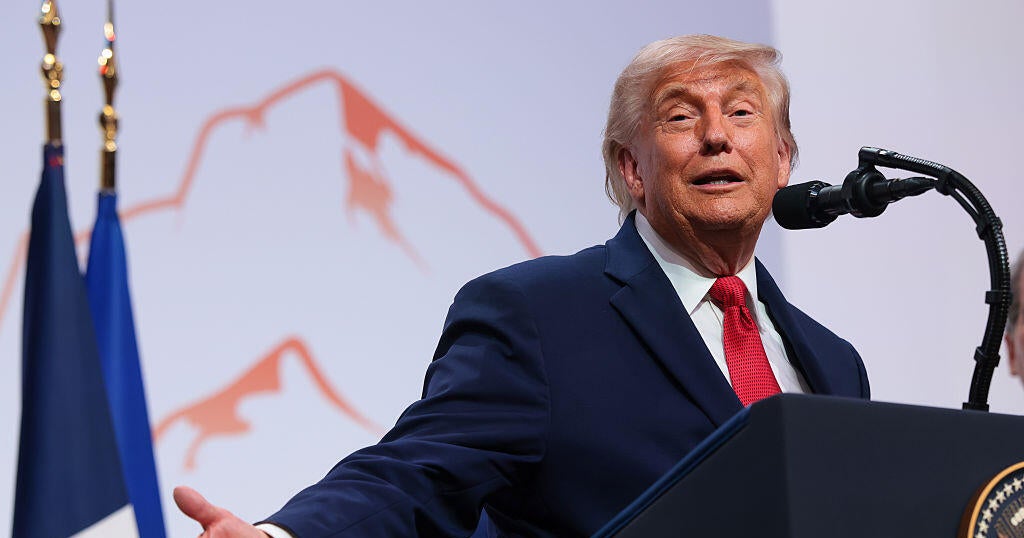
Speaking at the G7 summit in France, Trump said he expected the agreement with Iran to be signed “shortly.” He told reporters: “The deal we reached with Iran on Sunday will be signed shortly, tomorrow, maybe the next day.”
Senior U.S. officials, speaking on condition of anonymity, read the 14 points of the MOU to reporters Wednesday, CBS News reported. CBS said it had not seen the document directly. According to the officials’ reading, the United States, Iran and their allies in the current war would declare “the immediate and permanent termination of military operations on all fronts, including in Lebanon,” and agree not to initiate war or military operations against each other.
The MOU would give the sides up to 60 days to negotiate a final deal, with an extension possible by mutual consent. Trump, at the G7, said: “If it doesn’t get done in 60 days, that’s all right. We go back to bombing. I don’t want to do that, because it’s so good, but we might have to, because we’re never going to let them have a nuclear weapon.”
On nuclear issues, the draft text says Iran reaffirms that it “shall not procure or develop nuclear weapons,” while the sides agree to resolve the disposition of stockpiled enriched material. The minimum method would be down-blending on site under International Atomic Energy Agency supervision, according to the U.S. officials’ reading. The text also says the two sides would discuss enrichment and other matters related to Iran’s nuclear needs in the final deal.
Sanctions relief is a central part of the framework. The MOU says U.S. sanctions on Iran would be terminated on an agreed schedule as part of a final deal, linked to nuclear compliance. Pending that deal, Washington would not impose new sanctions, and Iran would maintain the status quo of its nuclear program. The text also says the U.S. Treasury would issue waivers for Iranian crude oil, petroleum products and related services immediately after the MOU is signed, and that frozen or restricted Iranian funds and assets would be made available for use.
A senior U.S. official told reporters Washington would move to waive, though not fully lift, some broad sanctions once the agreement is signed, Al Jazeera reported.
The framework also addresses the Strait of Hormuz. Baghaei said maritime traffic would be restored to normal within a defined timeframe and that outside powers would have no role. “This is our own task, and we alone will do it, and there will be no need for participation or intervention from other parties,” he said. He added that Iran and Oman would cooperate on a mechanism for managing the strait and consult other regional countries where necessary.
According to the MOU text read to reporters, Iran would use its best efforts to ensure safe passage of commercial vessels with no charge for 60 days only between the Persian Gulf and the Sea of Oman. The U.S. would begin removing its naval blockade immediately and fully end it within 30 days. The text also calls for the United States and regional partners to develop a reconstruction and economic development plan for Iran worth at least $300 billion, and says a final deal would be endorsed by a binding U.N. Security Council resolution.




Be First to Comment