Key takeaways:
- Rep. Barry Moore won Alabama’s Republican Senate runoff against former Navy SEAL Jared Hudson, according to projections by CBS News and NBC News.
- Moore and Hudson advanced to the runoff after no candidate received more than 50% in the May 19 primary; Moore had nearly 40% and Hudson had almost 26%.
- President Donald Trump endorsed Moore, held a tele-rally with him and called him “an America First Patriot who has been with me from the very beginning.”
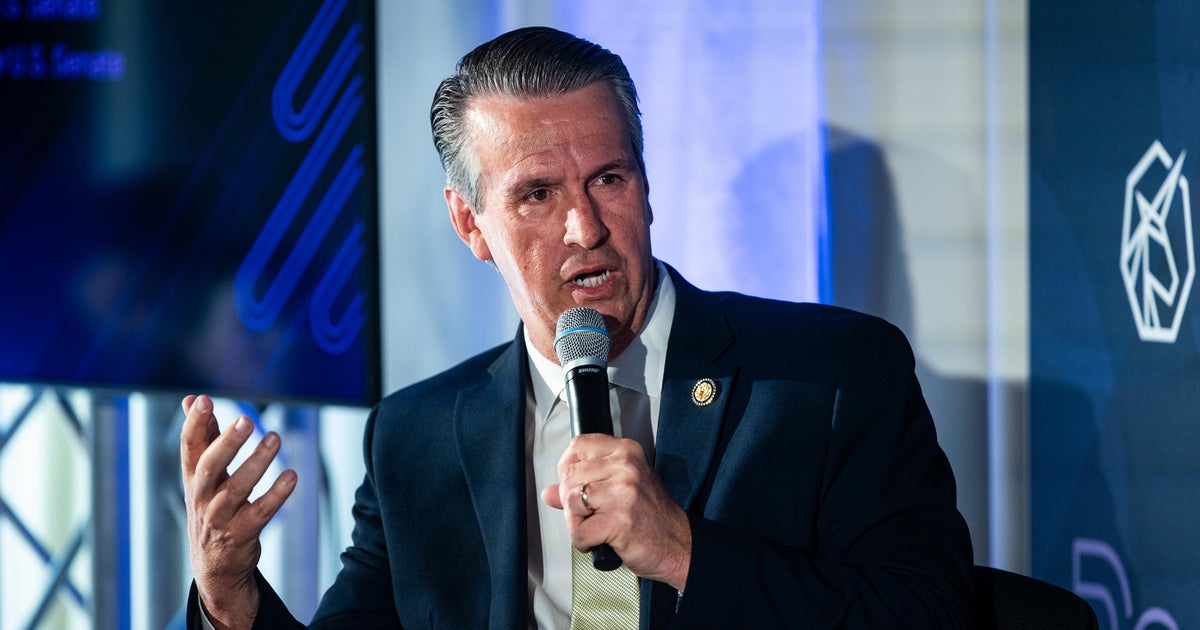
Rep. Barry Moore won Alabama’s Republican Senate runoff Tuesday, defeating former Navy SEAL Jared Hudson and putting the Trump-backed congressman in a strong position to succeed Sen. Tommy Tuberville this fall.
CBS News and NBC News projected Moore’s victory in the runoff, which followed a crowded May 19 primary in which no candidate won more than 50% of the vote. Moore led that contest with nearly 40%, while Hudson finished second with almost 26%. Alabama Attorney General Steve Marshall was eliminated.
Moore’s win makes him the heavy favorite in the general election in deeply Republican Alabama. Tuberville opened the Senate seat when he opted to run for governor. He easily won the GOP nomination for governor last month.
Moore, who has represented Alabama in the House since 2021, leaned heavily on his relationship with President Donald Trump. Trump endorsed him in the Senate race, held a tele-rally with him last week and reiterated his support Monday on Truth Social, calling Moore “an America First Patriot who has been with me from the very beginning.” Moore’s campaign featured the endorsement in multiple advertisements.
In his victory speech Tuesday, Moore said his connection to Trump would help Alabama.
“When I call [Trump], he takes my calls, and we can work together with the senators, that delegation and certainly the president of the United States to make sure that Alabama has an opportunity to bring the jobs back here that we need,” Moore said.
Moore is a member of the conservative House Freedom Caucus and a former state lawmaker who was first elected to Congress in 2020. He has described himself as an early Trump supporter, touting that he was the first elected official to endorse Trump in 2015. During the campaign, he positioned himself as a staunch Trump ally, a pro-gun advocate, a critic of “lawless Democrat sanctuary” cities and an opponent of allowing transgender women and girls to compete in women’s sports.
Hudson, a political newcomer in the Senate race, sought to cast himself as an outsider and a fighter aligned with Trump’s agenda. He is the CEO of groups that work with law enforcement to combat child trafficking and provide firearms instruction. He previously ran unsuccessfully for Jefferson County sheriff in 2022.
“I will deploy to the Senate to defend President Trump with the same ethos they taught us in SEAL training: I am never out of the fight and I will not fail,” Hudson said on his website.
The runoff campaign became contentious. An outside group aligned with Hudson accused Moore, who served in the Alabama National Guard and Army Reserve, of “stolen valor.” The accusation centered partly on a 2024 letter to Minnesota Gov. Tim Walz, then the Democratic vice presidential nominee, in which dozens of Republican lawmakers accused Walz of misrepresenting his military service. Moore was listed as a signer and identified as having served as a “staff sergeant.”
Records shared by Moore’s campaign indicated he was discharged with the rank of cadet. The campaign said his pay grade was “E-6 Staff Sergeant,” but added that “Barry has never called himself a retired Staff Sergeant, or even a Staff Sergeant nor did he retire from service — he was honorably discharged.”
Moore’s campaign also said the title line on the Walz letter was supplied by organizers of the coalition letter, saying, “He has never used that title and never affirmed it.”
Moore separately faced questions over a 2020 ad in which he said he had “been in those combat boots,” though he did not serve overseas or in combat. His campaign responded that “Members of the National Guard wear combat boots to train,” and Moore said in a social media video that he was “never in combat, and I never claimed to be.”
Alabama has rarely sent Democrats to the Senate in recent decades. Outside former Sen. Doug Jones’ victory in a 2017 special election, the state has not elected a Democrat to the Senate in the last three decades. Trump won Alabama by 30 points in 2024.

Be First to Comment