Key takeaways:
- Treasury Secretary Scott Bessent said the United States proposed a U.S.-China AI dialogue with a notification mechanism for AI-related national security incidents.
- President Donald Trump and Chinese leader Xi Jinping are due to meet Thursday in Washington, with AI and a tariff truce set to expire Nov. 10 among the key issues.
- U.S. officials said they are working to operationalize a Board of Trade process to consider lower tariffs on some non-sensitive goods.
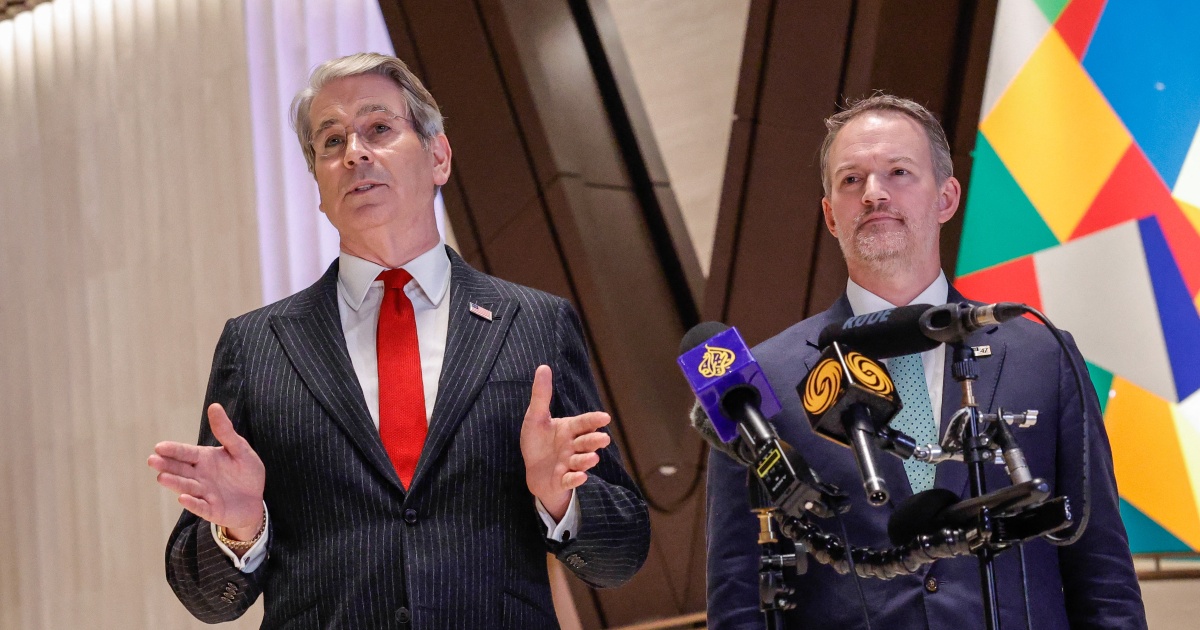
The United States has proposed a new system for Washington and Beijing to alert each other about artificial intelligence incidents that could affect national security, Treasury Secretary Scott Bessent said Sunday, putting AI safety on the agenda days before President Donald Trump and Chinese leader Xi Jinping meet in Washington.
Bessent described the idea after daylong talks in New York with Chinese Vice Premier He Lifeng and other Chinese officials. He said the two sides discussed creating a U.S.-China AI dialogue that would include a “notification mechanism” for incidents involving the technology.
“We think that, just like with any cross-border activity, that moving from opaque to more transparency between the number one and the number two AI powers in the world is very important,” Bessent told reporters after the talks. He said the two sides agreed to meet again on AI.
The discussions come as the United States and China compete to lead the fast-moving AI and technology industries, while researchers and some prominent industry figures warn that advanced AI could carry serious risks. AI is expected to be a major topic when Trump and Xi meet Thursday.
Trump has largely dismissed concerns that AI could pose an existential threat, calling them a “hoax,” while saying the United States must not let China overtake it in the global AI race. Earlier this month, he said, “whoever wins in AI, wins.”
Experts caution that the summit is unlikely to produce a major AI agreement because of deep distrust between the two countries. China has viewed calls to slow AI development as aimed at limiting its progress.
U.S. Trade Representative Jamieson Greer said the AI talks would not affect U.S. export controls on advanced chips and semiconductor manufacturing equipment, which have restricted Chinese AI companies.
Chinese officials did not speak to reporters as they left the talks at JPMorganChase headquarters. A Chinese readout published by the state-run Xinhua news agency did not mention the U.S. notification proposal, saying only that the two sides discussed AI. Xinhua said the delegations held “candid, in-depth and constructive exchanges on key economic and trade issues,” including work to implement previous trade understandings and promote bilateral trade and investment.
Bessent called the New York meeting “successful” and said in a post on X that the talks “help lay the groundwork for President Trump to advance America’s economic interests and deliver results for the American people.” The BBC reported that it contacted the Chinese embassy in the United States for comment.
Trade will also loom over the Trump-Xi summit. A fragile tariff truce between the world’s two largest economies is due to expire Nov. 10, and officials from both sides have been trying to determine whether it can be extended.
Bessent and Greer said the two governments agreed to operationalize a new “Board of Trade” announced during Trump’s visit to Beijing in May. The process is intended to identify possible tariff reductions on “non-sensitive” products.
Greer said those products could include Chinese consumer goods and low-tech items, as well as U.S. exports such as energy, agricultural goods and medical devices. He did not say whether tariffs on those goods would be lowered immediately or whether they might be exempted from future duties.
“There is a world where you have a relatively small subset of American and Chinese goods that can be traded in a balanced way that are non-sensitive,” Greer said. “Then in the future, as trade actions come up, we can consider them as a class unto themselves.”









Be First to Comment