Key takeaways:
- Xi Jinping said AI development should be “a symphony of global cooperation” and should not be dominated by a single country.
- China plans to provide 5,000 AI training opportunities to developing countries over the next five years and give 30 countries access to a Chinese AI meteorological early warning system.
- Twenty-nine countries, including Pakistan, Russia and Kazakhstan, signed an agreement with China to establish a Shanghai-based World Artificial Intelligence Cooperation Organization.
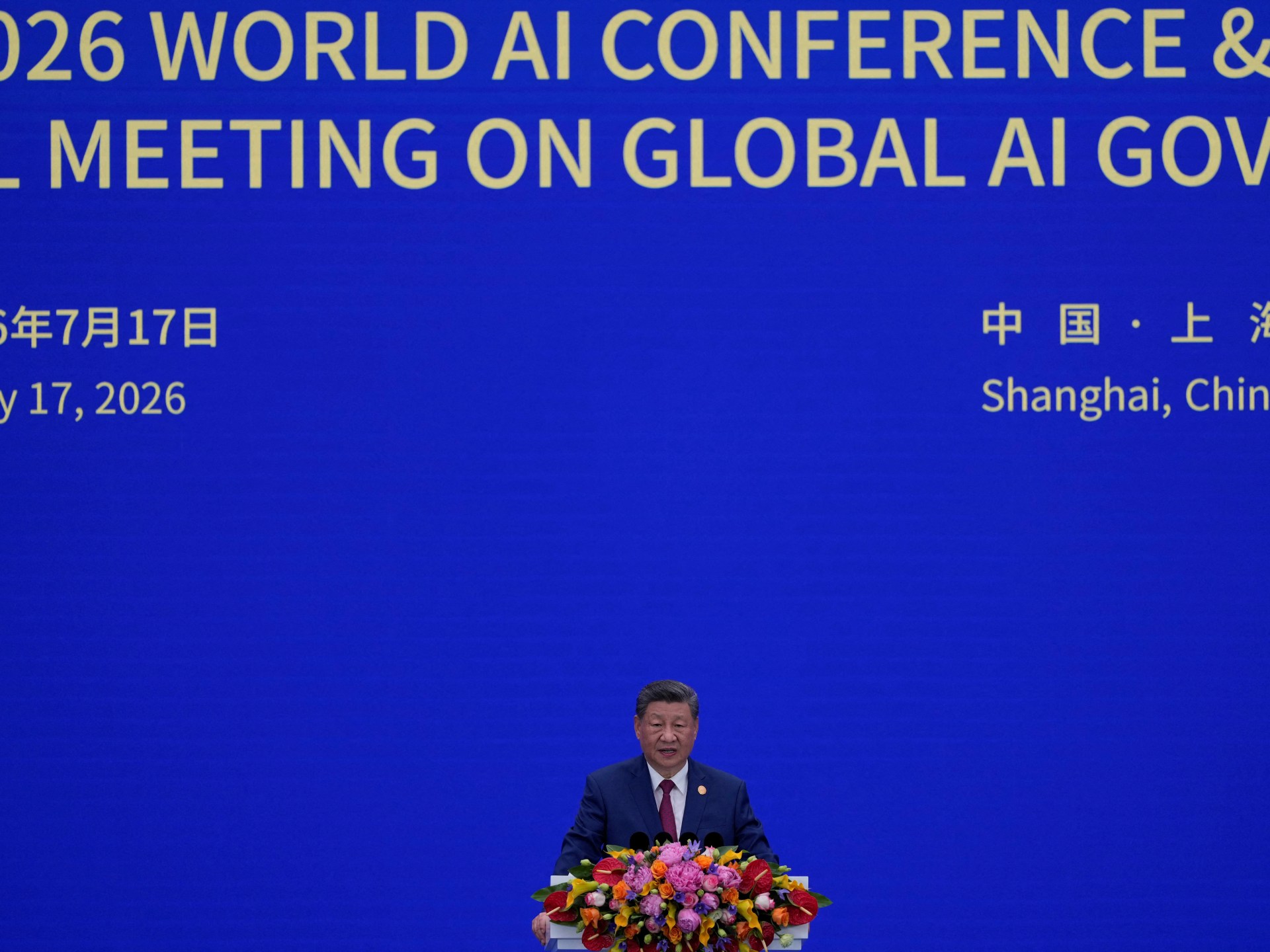
Chinese President Xi Jinping called Friday for a broader global effort to develop and govern artificial intelligence, warning that the technology should not be controlled by any single country as restrictions led by the United States continue to limit China’s access to advanced technology.
Speaking at the World Artificial Intelligence Conference in Shanghai, Xi said AI development should be shared internationally and tied to rules that keep people in control of the technology.
“The development of artificial intelligence should not be a solo performance by any single country but rather a symphony of global cooperation,” Xi said. “We should together oppose the practice of overstretching the concept of national security in the field of artificial intelligence, and of placing one’s own security above that of other countries.”
Xi also called for a “people-centred” approach to AI, saying governments should build legal, technical and emergency safeguards around the technology. “We should put in place laws and regulations, technological monitoring, early warning, and emergency response systems, in order to … ensure AI is always under human control,” he said.
The remarks came as China seeks to position itself as a major force in artificial intelligence despite U.S. and European restrictions on technology exports that officials say are needed for national security. The United States and European Union have imposed curbs on Chinese tech imports, and in May the U.S. Commerce Department issued guidance affirming that export licensing requirements for advanced AI chips apply to businesses headquartered in China or with a Chinese parent company, including subsidiaries outside China.
China has long objected to such measures, saying national security arguments are being applied too broadly. Xi repeated that criticism in Shanghai while presenting China as a partner for developing countries seeking access to AI tools and training.
Over the next five years, Xi said China will provide 5,000 AI training opportunities to developing countries. He said Beijing will expand AI cooperation with the Association of Southeast Asian Nations, the League of Arab States, the African Union, the Community of Latin American and Caribbean States, the Shanghai Cooperation Organization and BRICS countries. He also promised to provide 30 countries with access to a Chinese-developed AI meteorological system for early warnings.
A day before Xi’s speech, 29 countries, including Pakistan, Russia and Kazakhstan, signed an agreement with China to establish a World Artificial Intelligence Cooperation Organization. Chinese state media described it as an intergovernmental body headquartered in Shanghai that will promote global AI governance.
The conference has drawn more than 1,100 companies and 1,400 guests this year, state media said. Attendees included the leaders of Kazakhstan, Cambodia and Thailand, as well as U.N. Secretary-General António Guterres. Huawei is expected to showcase its Atlas 950 SuperPoD, a powerful AI computing system.
AI has become a strategic pillar of China’s industrial policy, supported by state investment in areas ranging from chip production to consumer applications. State media, citing officials, said daily consumption in China of “tokens,” an industry unit of AI usage, has increased a thousandfold over the past two years.
Chinese AI models have also gained users abroad, helped by lower costs. NPR reported that some technology analysts now see China as an AI innovator rather than a country merely trying to catch up with the United States. Open-source Chinese models such as DeepSeek have been viewed as appealing and often more affordable alternatives to largely closed-source U.S. models, especially in the developing world.
Al Jazeera reported that while China trails the United States in access to the most advanced semiconductors, it has an advantage in powering the large data centers needed for AI chips. Citing the International Energy Agency, Al Jazeera reported that a typical data center can use as much electricity as 100,000 households, while next-generation hyperscale facilities can consume as much power as two million homes.









Be First to Comment