Key takeaways:
- Carney told the European Parliament Canada is not seeking full EU membership but wants deeper cooperation with the EU on defense, energy, critical minerals, AI, digital trade and other sectors.
- Trump called the EU associate membership proposal for Canada “laughable” and said Europe could face “very heavy tariffs” depending on its intentions.
- Any EU associate membership arrangement for Canada would need approval from all 27 EU countries and has no current legal precedent in EU treaties.
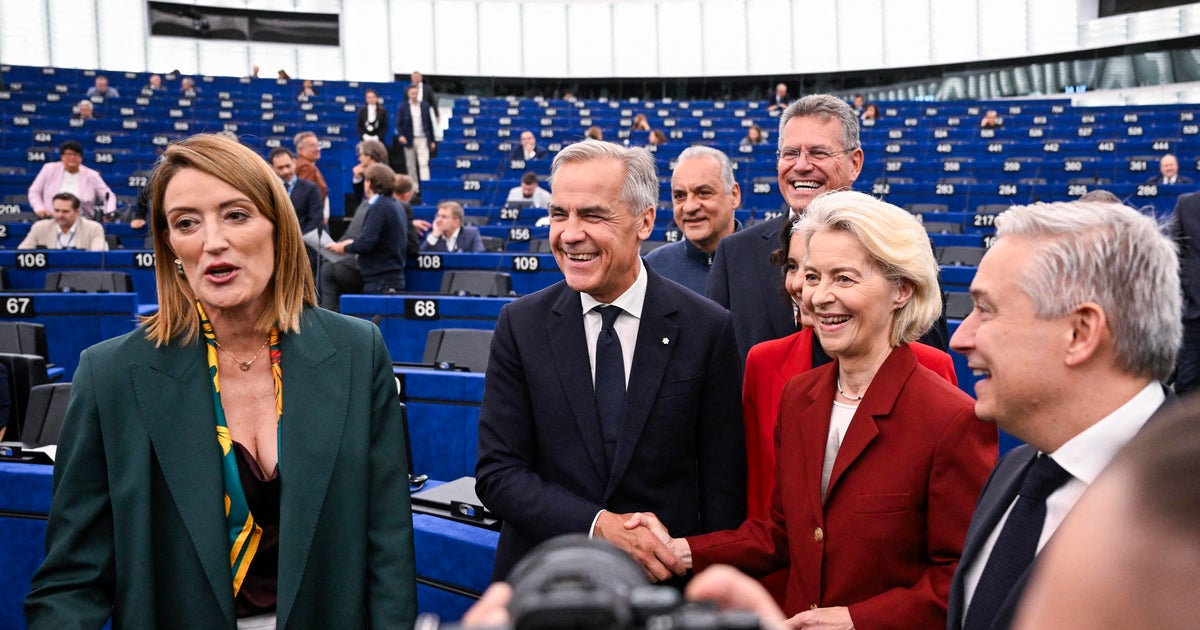
Canadian Prime Minister Mark Carney urged Canada and Europe to build a deeper partnership on trade, defense and technology Thursday, embracing a European Union proposal for closer ties even as President Donald Trump threatened “very heavy tariffs” if the plan advances.
Carney received a standing ovation at the European Parliament in Strasbourg, France, after laying out a vision for cooperation between what he called the world’s “middle powers.” The proposal, floated a day earlier by European Commission President Ursula von der Leyen, would make Canada the EU’s first “associate member,” though that status does not currently exist in EU treaties and remains undefined.
“We do not seek power to dominate others,” Carney told lawmakers. “On the contrary, we are pursuing resilience. So no one — no one — can control our open markets, impair our sovereignty, threaten our territorial integrity or undermine our freedoms, our democracies, our rule of law.”
Carney said Canada was not seeking full EU membership. “What matters is the substance,” he told reporters, stressing that Ottawa wanted cooperation across defense, energy, critical minerals, artificial intelligence, digital trade, research, space and financial services.
Von der Leyen described the effort as an “Alliance for the Future” and said Europe wants to take its relationship with Canada to “the highest level possible,” beyond the existing EU-Canada free trade agreement. “This is a partnership not against anyone else, but for our common strength,” she said.
Trump dismissed the associate membership idea Wednesday as “laughable” and called Canada a “terrible trade partner.” Speaking to reporters, he said, “If it’s a good intention, that’s fine. If it’s a bad intention, we’ll put very heavy tariffs on Europe.” The BBC reported that Trump also warned he may view such an agreement as a “hostile act.”
The push comes as Canada and the EU seek to reduce their dependence on the United States. Trump has imposed tariffs, demanded concessions and repeatedly spoken of making Canada the 51st state. He has also clashed with the EU on trade and threatened to take control of Greenland, Denmark’s autonomous Arctic territory.
The economic stakes are high. Roughly 70% of Canadian exports go to the United States, and Canada and the U.S. share a 5,525-mile border. The EU is Canada’s second-largest trading partner, and a 2017 free trade agreement eliminated most tariffs between them, though some barriers remain.
Canada has already moved closer to Europe on security. It signed a defense partnership with the EU in June 2025 and this year became the first non-European country to join the EU’s 150-billion-euro, or $173 billion, SAFE defense procurement program, giving Canadian companies access to joint purchasing as Europe increases defense spending. NBC News reported that Carney also announced Canada had applied to join the British-led Joint Expeditionary Force, a military coalition of 10 European NATO countries.
Still, the associate membership proposal faces major hurdles. Any arrangement would require approval from all 27 EU member states, and there is no legal precedent. German government spokesperson Stefan Kornelius said the idea was good but added, “we should reconsider the terminology — the label — associated with it.” Canada’s incoming ambassador to Brussels, Jonathan Wilkinson, also urged caution. “We’re not there,” he told reporters. “What we’re focused on is actually driving results.”
Carney is expected to host EU leaders at a summit in Montreal on Oct. 29 and 30, where the two sides are due to discuss the relationship in more detail. “The objective is not self-sufficiency,” Carney said Thursday. “It is collective resilience.”









Be First to Comment