Key takeaways:
- Nepal hopes to claim about $20 million from the UN Fund for Responding to Loss and Damage, the BBC reported.
- World Weather Attribution said warming, glacier retreat, thawing permafrost and geological instability contributed to the Langtang Lirung collapse.
- The combined toll in Nepal and China stands at 1,446 dead and at least 6,669 missing, according to Al Jazeera.
Nepal plans to use a new scientific study linking climate change to last month’s catastrophic Himalayan floods to seek money from a United Nations climate disaster fund, as the death toll across Nepal and Tibet rises above 1,400.
The BBC reported that Nepal hopes to claim about $20 million from the UN Fund for Responding to Loss and Damage, which was created to help countries hit by climate-related disasters. Nepali leaders have said the country needs about $5 billion to rebuild, while Al Jazeera reported Nepal’s estimated reconstruction bill at $4.78 billion.
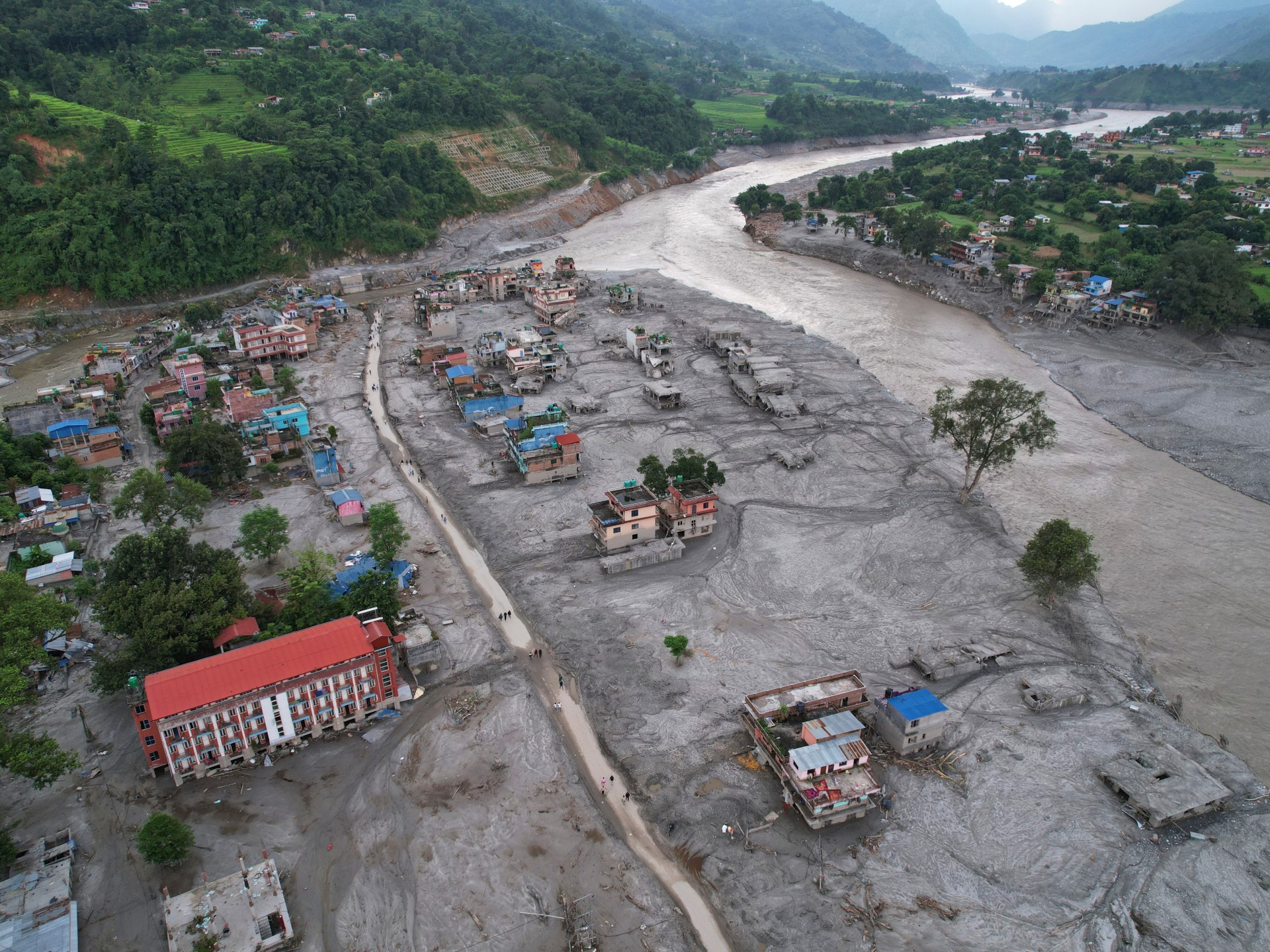
The floods followed the collapse of rock and glacier ice near the peak of Langtang Lirung, a mountain on Nepal’s side of the Himalayas, on August 26. A torrent of water, ice, rock and debris swept through border towns and villages in Nepal and Tibet, destroying homes, energy infrastructure and other communities downstream.
The combined toll in Nepal and China stands at 1,446 dead and at least 6,669 missing, Al Jazeera reported. Nepal’s disaster authority said Wednesday that 1,403 bodies had been retrieved and 6,150 people were missing after verification in affected districts. In China, state media reported 43 deaths and 519 people missing.
A report released Thursday by World Weather Attribution said the disaster was not caused by a single weather event, but by a “compound” crisis involving rising temperatures, glacier retreat, thawing permafrost and existing geological weaknesses. The group said climate change was a likely contributing factor in the rock-and-ice avalanche.
“There is no doubt that climate change is one of the drivers, and therefore obviously it needs to be discussed in the context of loss and damage,” Friederike Otto, a professor of climate science at Imperial College London and a report co-author, told reporters, according to Al Jazeera. The BBC quoted Otto as saying there was “absolutely no doubt that human-induced climate change played a role here in the preconditioning of the disaster.”
The report said warming has raised the freezing threshold in the high Himalayas, exposing ice and permafrost inside bedrock to longer and higher thaw temperatures. “Relentless warming has lifted the altitude of the freezing threshold on the high Himalaya, exposing ice and permafrost deep in the bedrock to higher and longer thaw temperatures, weakening mountain slopes,” it said, according to Al Jazeera.
Walter Immerzeel, a mountain hydrologist at Utrecht University and report co-author, said the region was undergoing “fundamental, irreversible shifts,” with glacier retreat and permafrost degradation undermining mountain stability.
The BBC reported that the study found July and August temperatures in the area were about 1.5 degrees Celsius warmer “due to human influence on the climate,” while Al Jazeera reported that the study found those months were the warmest locally recorded, about 5 degrees Celsius higher than normal. The BBC also reported that glaciers in the region have been thinning by about half a metre a year, potentially weakening fractures and increasing instability.
The study said heavy snowfall last October and November added to a large volume of meltwater early this year. It also noted that Nepal’s 7.8-magnitude earthquake in 2015 may have weakened the underlying rock mass, though it could not confirm the quake’s precise role in the latest disaster.
Nepal’s government says the WWA report will support its request to the UN fund. “It will be the main basis of our claim as it has detailed what role climate has played in this disaster,” Maheshwar Dhakal, spokesperson for Nepal’s Ministry of Agriculture, Forest and Environment, told the BBC.
Prime Minister Balendra Shah is expected to address the UN General Assembly in New York next week on the disaster and climate justice, his first foreign trip as Nepal’s leader. The BBC reported that nearly 120 countries have submitted claims to the UN fund totaling almost $3 billion, while the fund has less than $400 million available for disbursement. Officials responsible for the fund are scheduled to meet in December to decide which requests will be accepted and whether to make an urgent decision for Nepal.







Be First to Comment