Key takeaways:
- Japan launched the $350 million MMX mission aboard an H3 rocket from Tanegashima Space Center.
- A rover is expected to explore Phobos in early 2029 before the spacecraft attempts to collect at least 10 grams of soil around 2030.
- The samples are expected to reach Earth in 2031 and could show whether Phobos formed from impact debris or is a captured asteroid.
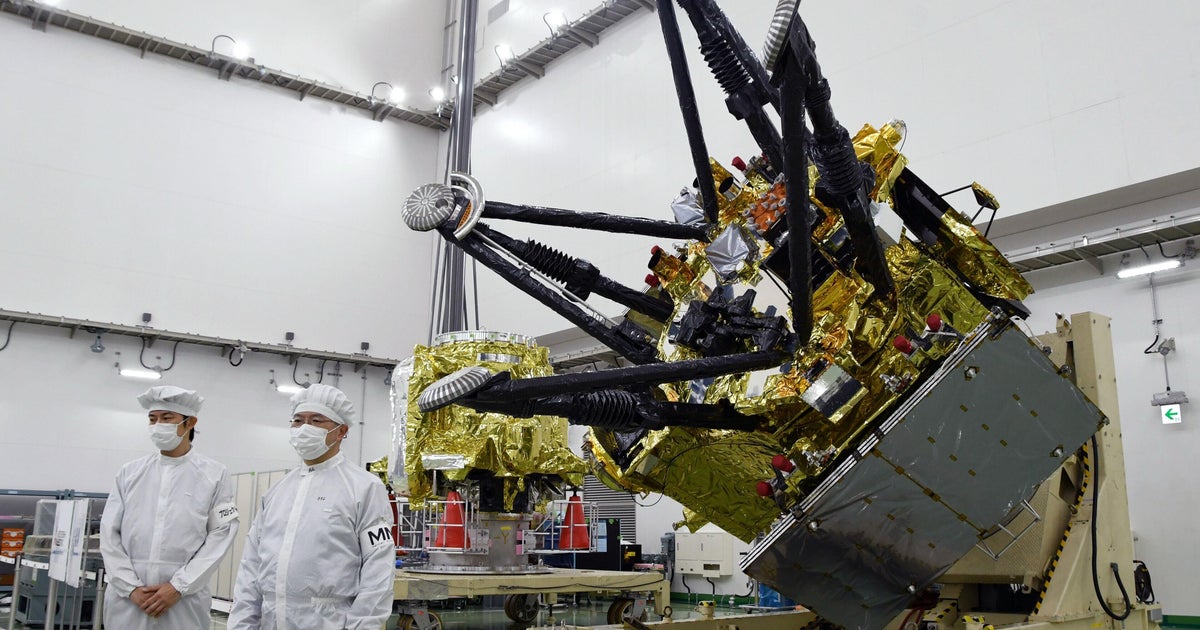
Japan has launched a spacecraft to collect soil from Phobos, the larger of Mars’s two moons, and bring it to Earth in 2031. If successful, the $350 million Martian Moons Exploration mission will deliver the first samples returned from the Mars system for study in laboratories on Earth.
The mission, known as MMX, lifted off Monday at 3:41 p.m. EDT, or 4:41 a.m. in Japan, aboard an H3 rocket from the Japan Aerospace Exploration Agency’s Tanegashima Space Center. The spacecraft separated from the rocket one hour and 11 minutes after launch, CBS News reported.
Its central question is how Phobos and the smaller moon Deimos formed. They may be remnants of a large impact on Mars early in its history, or asteroids captured by the planet’s gravity. Both moons are small and irregularly shaped, but their appearance alone cannot settle the question.
“One of the most intriguing questions about Phobos and Deimos is simply why these two little moons are there in the first place,” said Thomas Statler, who helped oversee development of two NASA instruments aboard MMX. Analysis of the returned material should show whether Phobos is made of asteroid-like material or debris from a collision involving Mars.
The BBC reported that MMX is scheduled to reach Phobos in August 2027. CBS News said the spacecraft is expected to enter orbit around Mars in September 2027, on a path that will let it circle the planet alongside Phobos. It will study the moons and their surroundings before attempting to land.
A 55-pound rover supplied by the German and French space agencies is expected to descend to Phobos in early 2029. With no braking rockets, it is designed to bounce onto the surface, right itself and begin exploring. Its instruments include cameras, a laser for examining minerals and a device that measures soil temperature. The rover will also help scout a landing site for the main spacecraft, the BBC reported.
Around 2030, MMX plans to touch down on Phobos once, and possibly twice, to collect soil with sampling devices supplied by JAXA and NASA, according to CBS News. The mission’s minimum target is 10 grams — less than half an ounce. After further observations of Deimos, the spacecraft will send the sample home in a heat-resistant capsule for recovery in South Australia in 2031.
“It’s a very small [amount] actually,” said Chrysa Avdellidou of Leicester University, who is working with the mission. But researchers can study individual grains, she told the BBC: “It’s worth every gram.”
Sara Russell of the Natural History Museum, the mission’s deputy for sample analysis, said the sample’s chemistry and minerals should distinguish between the competing origin theories. She said it might also contain grains blasted from Mars by impacts and deposited on nearby Phobos.
“There hasn’t yet been a successful mission to go to Phobos and bring a bit back to Earth,” Russell told the BBC. “I think this is an incredibly ambitious and fun mission.”










Be First to Comment