Key takeaways:
- Germany says police and intelligence findings proved Russia was behind a failed Aug. 4 drone attack at Leipzig/Halle Airport involving explosive-carrying drones.
- Kaja Kallas said the EU is preparing sanctions on an additional 1,600 individuals and entities linked to Russia’s military sector.
- Berlin plans to close the Russian consulate in Bonn and the Russian House cultural institution, while Moscow promised a “mirror-image” response.
European Union and NATO leaders vowed Wednesday to increase pressure on Moscow after Germany accused Russia of orchestrating a failed drone attack at Leipzig/Halle Airport, an incident European Commission President Ursula von der Leyen called “a new escalation on European Union soil.”
“Leipzig marks a new escalation on European Union soil directly attributed to Russia,” von der Leyen said after meeting NATO Secretary General Mark Rutte in Brussels. She said the attack involved “military-grade material carried out by Russian operatives on European Union soil.”
“We will not tolerate it,” she said. “We have to step up and that means being ready to respond to Russia’s recklessness faster and better.”
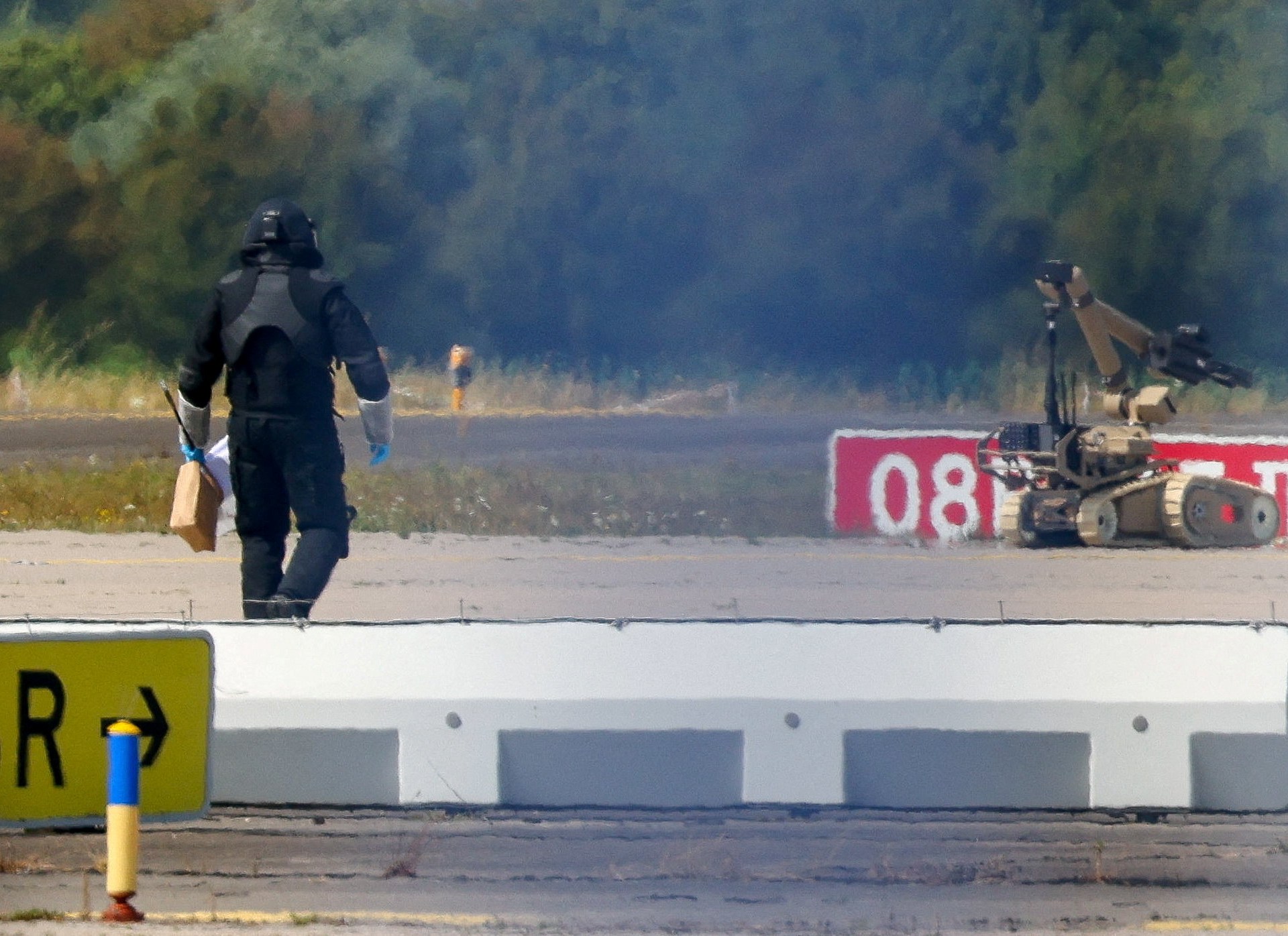
Germany said Tuesday that police investigations and intelligence findings had proved Russia was behind the attempted attack on Aug. 4. The BBC reported that one drone carrying explosives was defused by a robot at Leipzig/Halle airport, while a second drone is thought to have collided with another cargo plane. A third drone was reportedly found 10 days later at the airport, which is an important NATO hub and is regularly used by Ukrainian Antonov transport aircraft.
Al Jazeera reported that three drones carrying explosives were found in and around the airport on Aug. 4, temporarily disrupting air traffic.
German officials said the drone’s configuration, components, explosives and detonator were known from other Russian hybrid operations. The BBC reported that two suspects have been identified, including a Belarusian with a Russian passport who entered Germany on a tourist visa and another person with Latvian and Russian passports who arrived by plane in Berlin and left two days before the failed attack.
Russia has rejected the accusations. Its foreign ministry said Germany had offered no evidence and summoned German chargé d’affaires Bernd Finke to hear Moscow’s rejection of what it called “entirely unfounded accusations.” President Vladimir Putin has condemned Germany’s measures as a serious mistake that “clearly runs counter to the interests of the German people,” and, according to Al Jazeera, alleged that the evidence had been “planted.” Asked whether Moscow would be prepared to sever relations with Berlin, Russian Deputy Foreign Minister Alexander Grushko answered “maybe,” but said Russia was giving diplomacy a chance for now.
Berlin has said it will close the Russian consulate in Bonn and the Russian House cultural institution, which the BBC reported is widely suspected in Berlin of acting as a Kremlin propaganda outlet. The Russian foreign ministry promised to respond in “mirror-image” fashion.
Rutte said NATO, including the United States, stood “in full solidarity with Germany.” He said Europeans faced increased risk from drones and missiles crossing into countries on NATO’s eastern flank, as well as “malign activities targeting our territory directly,” including fires set in factories producing defense equipment for Ukraine and “the Russian hybrid attack in Leipzig.”
EU foreign policy chief Kaja Kallas called the attempted attack “state-sponsored terrorism” and said “attempts to intimidate Europe” would fail. “We are working on new proposals to tighten sanctions enforcement and we are moving ahead with more sanctions,” she said. In a post on X, Kallas said the EU was preparing to sanction an additional 1,600 individuals and entities linked to Russia’s military sector and was “ready to add more.”
Kallas said there was broad support among EU foreign ministers for banning former Russian military personnel from visiting the bloc and for stricter visa limits on Russian tourists. She also said Russia’s representative to the EU and Russian ambassadors in individual member states had been summoned.
Von der Leyen said EU officials were examining how “to cut deeper into Russia’s war chest.” France’s foreign minister, Jean-Noël Barrot, said action could be taken at the European level against Russia’s so-called “shadow fleet” of ships carrying oil and other cargo to avoid EU sanctions. Several EU countries, including Sweden, the Netherlands, Poland and Spain, are pushing for more than 193 billion euros in frozen Russian assets to be used to help Ukraine, though Belgium, where the money is held, has not changed its opposition because it fears financial liability in court.
The EU has already agreed to loan Ukraine 90 billion euros. Von der Leyen said Kyiv had asked for billions more to help pay for PAC-3 air defense missiles, and that work was underway on a joint Europe-Ukraine Freyja anti-ballistic missile defense project.






Be First to Comment