Key takeaways:
- Two drones were spotted Thursday night over a German military base in Mechernich, prompting a military police deployment and a police investigation.
- A drone carrying explosives was found and defused Tuesday at Leipzig/Halle Airport, a major freight and NATO logistics hub; U.S. officials told CBS News it is assessed as Russian in origin.
- Bulgaria said a drone exploded near the Kardam border crossing and about one kilometre from the Trans-Balkan gas pipeline’s compressor station, with no casualties reported.
Two drones were spotted over a German military base this week, days after a drone carrying explosives was found at a major cargo airport, while a separate drone exploded in Bulgaria near a gas pipeline and the Romanian border.
The German Armed Forces said security surveillance at the Bundeswehr base in Mechernich reported seeing two drones around 10 p.m. Thursday. The sightings were confirmed, military police were sent to the site and the Euskirchen police department opened an investigation, according to the German Joint Force Command. The military released no further details.
A spokesperson for the armed forces said personnel had been deployed to the base, in North Rhine-Westphalia about 35 kilometres from the Belgian border, and that police were investigating. German media reported that the Mechernich site includes a high-security underground storage facility for equipment and spare parts for military hardware and serves as a base for personnel responsible for maintaining U.S. Patriot air defences.
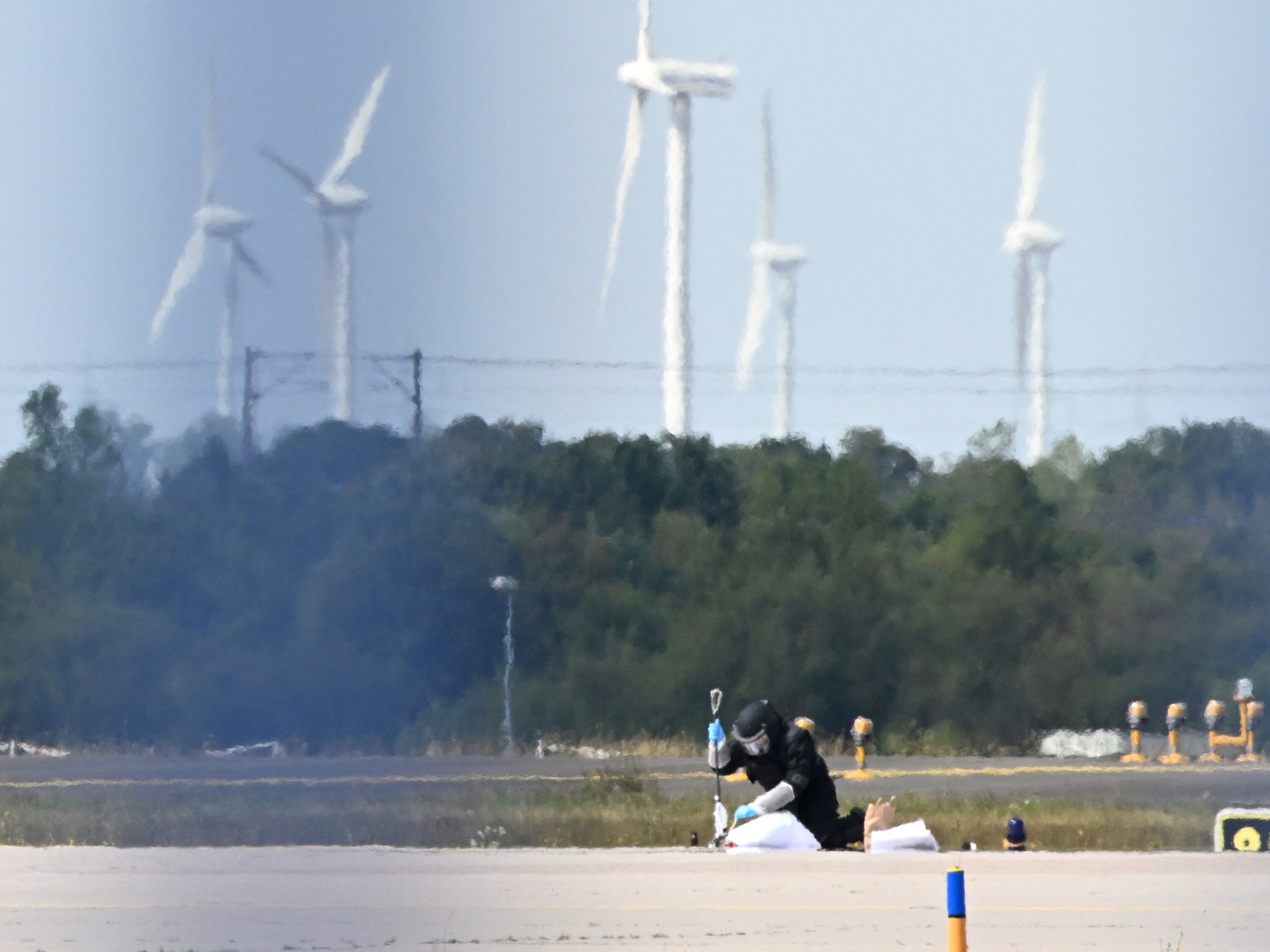
The German sightings came two days after a drone with explosives was found shortly before midnight Tuesday at Leipzig/Halle Airport, a major civilian freight hub that also supports NATO logistics. The device was defused. U.S. officials told CBS News the discovery is assessed by the United States to be of Russian origin.
The airport is home to NATO’s Strategic Airlift International Solution, or SALIS, which CBS News reported is operating almost every day to deliver equipment to NATO battle groups along the alliance’s eastern flank from Finland to Romania and to support European Union and allied missions. German media reported that the drone found at Leipzig/Halle was near several Ukrainian Antonov An-124 cargo transporters.
German government officials have not publicly blamed any foreign country for this week’s drone incidents. The Russian Embassy in Berlin rejected suggestions of Russian involvement, calling the Leipzig incident a “fabricated provocation” and, in a separate statement cited by CBS News, part of a “new wave of anti-Russian hysteria in Germany.”
In Bulgaria, a drone exploded near the Kardam border crossing with Romania and about one kilometre from a compressor station on the Trans-Balkan gas pipeline, which links Turkiye to Ukraine. Bulgarian Prime Minister Rumen Radev said in a government video that there were no casualties.
“The drone exploded in the immediate vicinity of the Kardam border crossing with Romania,” Radev said. He said the aircraft was not a “hobby drone” but a larger drone carrying what appeared to be a “significant amount of explosives.” It crashed in a sunflower field.
Bulgaria’s Defence Ministry said an initial analysis indicated the aircraft was most likely a Maya decoy drone, a type widely used by Ukrainian forces, and said there was no reason to suspect the incident was intentional. Ukraine said it was working with Bulgarian authorities to clarify what happened.
“We are in close contact with the Bulgarian side to clarify the circumstances. We can say with certainty that the Ukrainian Armed Forces did not intentionally direct any assets toward Bulgaria,” Ukrainian Foreign Ministry spokesman Georgiy Tykhyi said.
Bulgaria’s Foreign Ministry told AFP that the country’s foreign minister had summoned the Ukrainian ambassador, with a meeting expected Monday. Radev said neither Bulgaria nor Romania detected the drone before the blast. Bulgarian authorities have increased surveillance and said troops would be redeployed to border areas to detect drones and use countermeasures.
The incidents follow a rise in drone sightings over civilian and cargo airports and other European airspace. Western officials have accused Russia and its proxies of staging attacks, sabotage and cyber operations across Europe since Russia’s full-scale invasion of Ukraine. Russia has rejected those allegations.









Be First to Comment