Key takeaways:
- Alabama lawmakers passed and Gov. Kay Ivey signed a law enabling new primaries if courts allow use of a Republican-drawn congressional map.
- The current court-ordered map includes two Democratic-leaning majority-minority districts; the proposed 2023 map reduces this to one.
- The legislation follows a Supreme Court ruling narrowing Section 2 of the Voting Rights Act and is part of a broader southern GOP push to redraw districts before the 2024 midterms.
Alabama lawmakers passed legislation Friday allowing for new primary elections if courts permit the state to use a Republican-drawn congressional map ahead of the November midterms. The move, quickly signed into law by Republican Gov. Kay Ivey, aims to replace the current court-ordered map that includes two Democratic-leaning, majority-minority districts with a 2023 map favoring Republicans by reducing those districts to one.
The legislation would set aside the May 19 primary results for affected districts and authorize the governor to schedule special primaries if a court ruling enables new district lines. This effort follows a recent U.S. Supreme Court decision in Louisiana v. Callais that narrowed Section 2 of the Voting Rights Act, which had required states to create majority-minority districts in some cases.
Alabama’s existing map, drawn by a court-appointed expert in 2023 after earlier Republican maps were rejected for violating the Voting Rights Act, includes five GOP-leaning districts and two Democratic-leaning districts where Black voters are a substantial portion of the electorate. The new Republican-backed map reduces those Democratic-leaning districts to one.
Gov. Ivey said, “With this special session successfully behind us, Alabama now stands ready to quickly act, should the courts issue favorable rulings in our ongoing redistricting cases.” Alabama Attorney General Steve Marshall asked the U.S. Supreme Court on Friday to lift a lower court injunction that currently requires the use of the existing map until after the 2030 census. Justice Clarence Thomas requested a response from the opposing side by Monday. Meanwhile, the court that issued the injunction denied a request to stay its ruling.
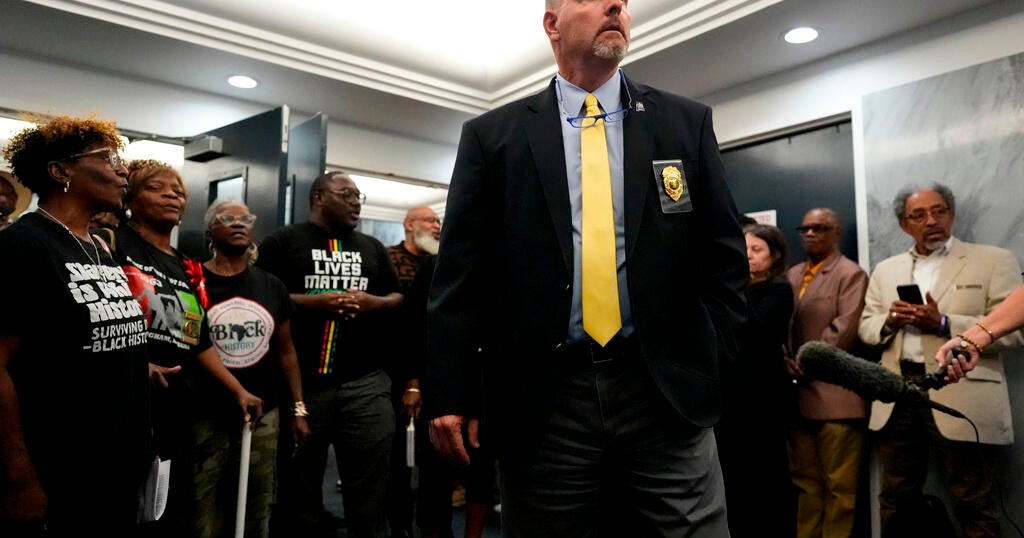
The legislative session was marked by protests and heated debate. Inside the Statehouse, one protester was forcibly removed, while outside demonstrators chanted slogans such as “fight for democracy” and “down with white supremacy.” Democratic lawmakers criticized the legislation as a regression to Jim Crow-era policies. State Sen. Rodger Smitherman said, “What happened here today is that we were set back as a people to the days of Reconstruction.” Senate Democrats vocally opposed the bill, shouting “hell no” and “stop the steal.”
Republican House Speaker Nathaniel Ledbetter described the current map as a “racially gerrymandered disgrace” and said the new law “guarantees that the Second Congressional District — which was wrongfully handed to Democrats on a silver platter by the courts — is flipped back to Republican control while also putting the Seventh Congressional District in play.” He acknowledged legal constraints from the Allen v. Milligan case prevented a more extensive redrawing like Tennessee’s.
The two Democratic-held districts in Alabama are currently represented by Black members of Congress, Reps. Terri Sewell and Shomari Figures. State Sen. Vivian Davis Figures, wife of Rep. Shomari Figures, stated, “Today we are not debating maps, we are debating democracy itself. We’re debating whether power matters more than principle.”
This development is part of a broader push by Republican-controlled southern states to redraw congressional maps following the Supreme Court’s ruling. Tennessee recently enacted a new map that divides its majority-Black, Democratic-held district, prompting a lawsuit from the state Democratic Party. Louisiana Republicans delayed their May 16 primaries to redraw districts after their map was struck down, and South Carolina Republicans are considering similar actions.
The redistricting battles come as control of the closely divided U.S. House of Representatives hangs in the balance ahead of the midterm elections. In Virginia, Democrats suffered a setback when the state Supreme Court invalidated a redistricting amendment placed on the ballot by Democratic lawmakers, citing procedural violations.




Be First to Comment