Key takeaways:
- SpaceX priced its IPO at $135 a share, raised $75 billion and began trading on Nasdaq under the ticker SPCX.
- The company’s market value topped $2 trillion in early trading, making Elon Musk the world’s first trillionaire on paper.
- Morningstar analysts valued SpaceX at $780 billion, while company leaders defended its long-term focus and track record.
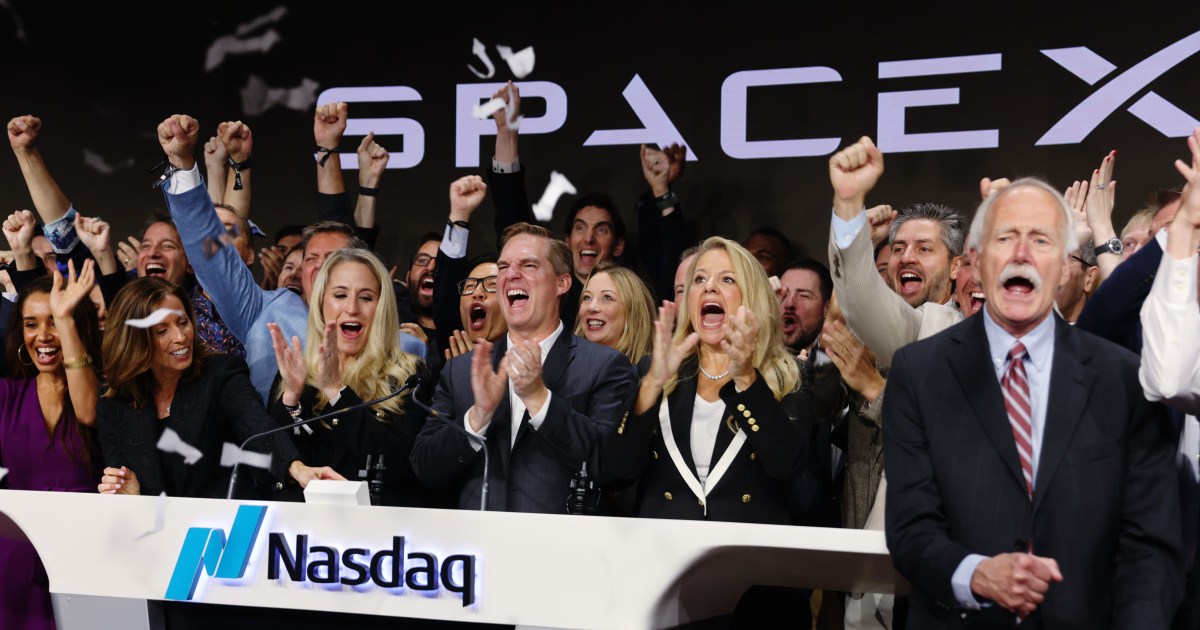
SpaceX surged onto the Nasdaq on Friday in the largest initial public offering ever, raising $75 billion and pushing Elon Musk’s paper fortune past $1 trillion for the first time.
The rocket and satellite company priced its IPO at $135 a share, giving it a value of $1.77 trillion before trading began. Shares opened at $150 and climbed in early trading, with reports placing the stock around $160 by midday and as high as $175 earlier in the session. The stock trades under the ticker SPCX.
At those levels, SpaceX’s market value topped $2 trillion, placing it among the most valuable companies in the United States. Al Jazeera reported that the debut put SpaceX on track to become the sixth-largest U.S. company by market value.
Musk, SpaceX’s chairman, CEO and controlling shareholder, marked the opening bell from the company’s headquarters in Starbase, Texas, alongside hundreds of employees, NBC News reported. SpaceX President and Chief Operating Officer Gwynne Shotwell and Chief Financial Officer Bret Johnsen were also part of opening-bell events at Nasdaq MarketSite in New York.
“I gave SpaceX a less than 10% chance of succeeding at all,” Musk said before the bell, according to NBC News. “Let me tell you, if people had told me this was gonna happen, I was like, man, you must be smoking some really good crack, because I think this company’s gonna fail.”
Musk also used the moment to emphasize SpaceX’s long-term ambitions. “We want to be able to take anyone who wants to go to the moon, anyone who wants to go to Mars, or anywhere in the solar system, and maybe beyond the solar system at some point” aboard a SpaceX rocket, he said, adding that he was “confident” the company “will do that.”
The IPO cements a dramatic paper gain for Musk. CBS News, citing Forbes, reported that Musk was worth an estimated $813 billion before the IPO, compared with $288 billion for Google co-founder Larry Page. CBS reported that pricing SpaceX at $135 a share lifted Musk’s net worth to just over $1 trillion, and that at an intraday high of $168.75, his fortune reached roughly $1.18 trillion. Future declines in the stock could push him below that threshold.
Musk owns 4.8 billion SpaceX shares, or about 42% of the company, and 350 million stock options exercisable at $8.39 per share, according to the company’s IPO filing cited by CBS. At the IPO price, his stake was worth $648 billion, while the options added $44.3 billion.
The offering was heavily oversubscribed, Reuters reported, and Bloomberg News said as much as 70% of allocated institutional shares went to long-only investors and sovereign wealth funds, including funds from Saudi Arabia and Kuwait.
The valuation has drawn scrutiny. Morningstar analysts wrote this week that SpaceX is “overvalued” given its financials and said they value the company at $780 billion, according to NBC News. The company has not generated a profit and produced roughly $19 billion in revenue last year, NBC reported. Al Jazeera reported that SpaceX posted a loss of nearly $5 billion last year and that Starlink drives as much as 80% of its revenue.
Shotwell pushed back on CNBC. “Look at our track record, look at our history,” she said. “We do really difficult things.” She added: “I do not want to focus on quarterly earnings. I’m not saying we’re not going to do right by our investors, but what folks who invest in SpaceX need to know is that what we’re doing is very futuristic.”
The debut also unfolded amid protests outside Nasdaq MarketSite over allegations involving Grok, part of xAI, which sources described as tied to SpaceX. Protesters said Grok allowed users to create non-consensual sexualized deepfake images before the IPO.
On the same day as its market debut, SpaceX launched a Falcon 9 rocket carrying 29 satellites from Cape Canaveral in Florida.









Be First to Comment