Key takeaways:
- The White House says about 200 additional entities have joined the non-binding Ratepayer Protection Pledge, covering companies that deliver 80% of U.S. power.
- Trump said 23 Republican governors and major utilities including NextEra and Duke Energy have signed on to the pledge.
- Critics, including the Sierra Club and Evergreen Action, said the voluntary pledge does not guarantee lower electric bills or enforce company payments.
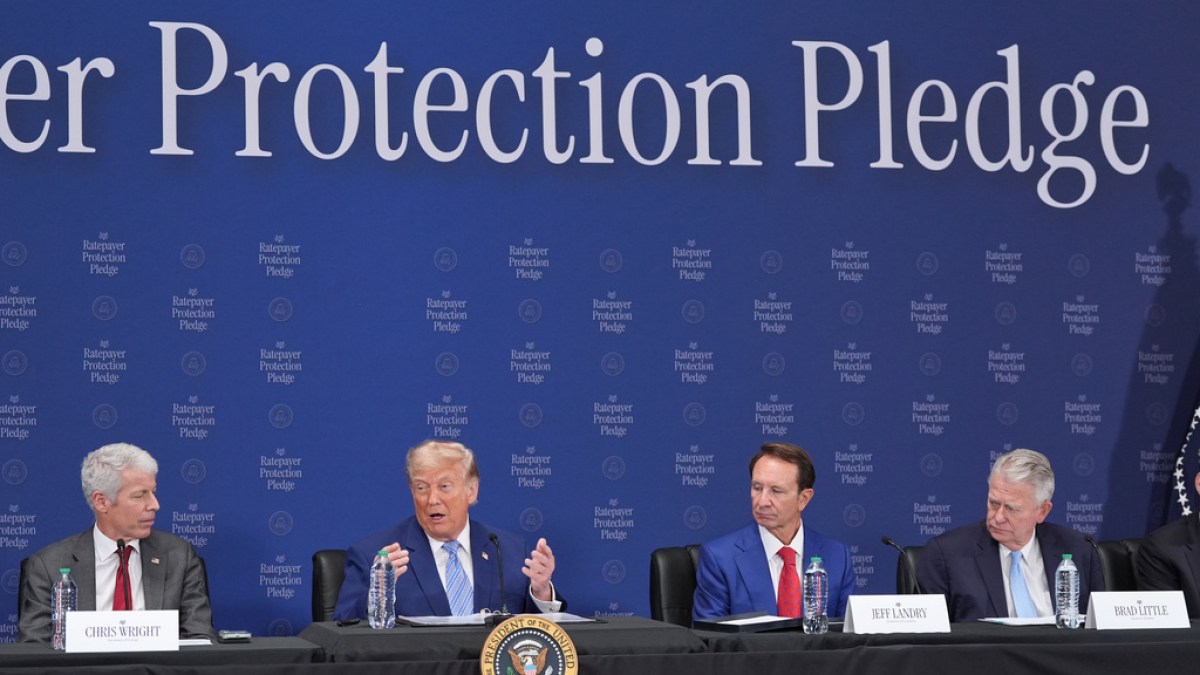
President Donald Trump said Thursday that about 200 additional entities have joined a voluntary White House pledge meant to prevent households and businesses from paying for the power demands of the nation’s rapidly expanding AI data centers.
Speaking at Environmental Protection Agency headquarters with EPA Administrator Lee Zeldin and Energy Secretary Chris Wright, Trump announced that the non-binding “Ratepayer Protection Pledge” now includes utilities, data center developers, electricity cooperatives and state governors. The pledge was first announced in March with seven tech companies: Google, Microsoft, Meta, Oracle, xAI, OpenAI and Amazon.
The White House called the expansion “historic” and said the agreement now covers companies delivering 80% of all power to U.S. homes and businesses. Trump said 23 Republican governors have signed on, including Brian Kemp of Georgia, Mike DeWine of Ohio, Spencer Cox of Utah, Jeff Landry of Louisiana and Greg Abbott of Texas. Major utilities including NextEra and Duke Energy have also joined.
“Electricity rates for 80% of the power distributed in America are now being kept in check by the plan,” Trump said. “We have kept rates down, way down.”
The pledge states that “hyperscalers, AI companies, and the utilities and data-center developers behind them will build, bring, or buy every kilowatt their facilities need — and cover every dollar of the infrastructure that delivers it,” according to the White House. It is a public commitment, not an enforceable rule.
Taylor Rogers, a White House spokesperson, told The Guardian the pledge will “ensure everyone involved in building and powering data centers covers their own costs instead of passing them on to American families.” Rogers said Trump’s action is “turning datacenters into engines of growth for local communities, while cementing America’s dominance in the global AI race.”
At the EPA event, Trump urged executives and governors to promote data centers in their communities, saying cities and towns that host them will be “rich.”
“You have to convince your community. You can’t fight it. You have to go with it,” Trump said. “If you don’t take all that money, somebody else is going to take it. You might as well do it yourselves.”
The announcement comes as AI data centers face growing resistance over electricity costs, water use, environmental effects and quality-of-life concerns. Utility prices were up 4% year over year in June, according to Bureau of Labor Statistics data cited by The Guardian. Al Jazeera reported that an analysis by consulting and technology services company ICF found increased electricity demand from AI data centers could raise monthly utility bills by 15% to 40% by 2030.
Public skepticism has also grown. A May Gallup poll cited by Al Jazeera found that seven in 10 people in the United States oppose AI data centers in their area, including about 48% who strongly oppose them. Slightly more than 25% said they favored such construction, and 7% strongly favored it. A June Johns Hopkins University poll cited by Al Jazeera found Americans strongly favor greater regulation of AI, with about 60% expecting the technology to increase inequality over the next decade.
Trump criticized opponents Thursday, saying “radical left communists” want to “shut down all new development, kill our most successful industries, destroy hundreds of thousands of jobs, and surrender the AI race to China.” But opposition has crossed party lines. More than a dozen states have considered moratoria on data centers, and New York became the first U.S. state to enact a temporary ban this month, The Guardian reported. Sen. Bernie Sanders and Rep. Alexandria Ocasio-Cortez have proposed a national moratorium. Abbott, who signed the pledge, also called Thursday for a ban on data center development in rural Texas.
Environmental groups criticized the pledge as too weak. Patrick Drupp, climate policy director at the Sierra Club, said families need “relief from soaring energy bills month after month,” not “weak pledges and empty promises.” Lena Moffitt, executive director of Evergreen Action, called the announcement a “photo op with big tech” that “won’t lower a single family’s electric bill.”












Be First to Comment