Key takeaways:
- El-Sayed, 42, will succeed retiring Democratic Sen. Gary Peters; no Republican has won a Michigan Senate race since 1994.
- El-Sayed campaigned on Medicare for All, affordability and reducing the influence of money in politics.
- Former primary rival Haley Stevens endorsed Rogers days before the election, citing objections to El-Sayed’s campaign associations and an outside group’s advertisement.
Democrat Abdul El-Sayed defeated former Republican Rep. Mike Rogers in Michigan’s closely fought Senate race, becoming the first Muslim elected to the chamber and keeping the seat in Democratic hands.
El-Sayed, 42, will succeed retiring Democratic Sen. Gary Peters. His victory extends a Republican losing streak in Michigan Senate elections dating to 1994. Rogers, 63, had also lost a Senate race in 2024.
The contest tested whether El-Sayed’s progressive campaign could prevail in a state that voted for President Donald Trump twice. A former public health official who led health departments in Detroit and Wayne County, El-Sayed focused on the cost of living, Medicare for All and reducing the influence of money in politics. He described his message as “Money out of politics, money in your pockets and Medicare for All.”
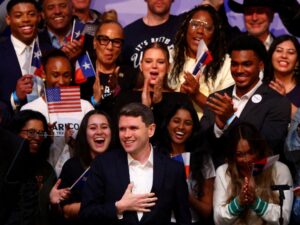
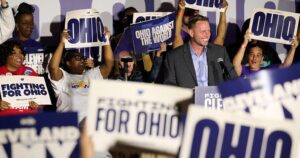
In a victory speech early Wednesday, El-Sayed addressed the attacks on his faith that had marked the campaign. “To all the parents who struggled to explain why the president openly mocks someone for their name or how they pray, let them know tomorrow that the bad guys lost,” he told supporters.
Trump called El-Sayed a “jihadist” and a member of the Muslim Brotherhood. Rogers also accused him of ties to the organization. El-Sayed denied the allegation, telling Fox News: “I have never been a member of the Muslim Brotherhood, I never will be a member of the Muslim Brotherhood.” El-Sayed accused his opponents of using Islamophobic rhetoric rather than addressing voters’ economic concerns.
His criticism of Israel and opposition to U.S. military aid for it were another flash point. NPR reported that some Jewish voters were alienated by his positions, including comments he made after a truck-ramming attack at a synagogue preschool in metro Detroit, for which he later apologized, and by his campaigning with streamer Hasan Piker.
El-Sayed narrowly defeated Rep. Haley Stevens in the Democratic primary, despite her support from Peters and Gov. Gretchen Whitmer. A group affiliated with the pro-Israel organization AIPAC spent more than $30 million trying to help Stevens win, NBC News reported. The Guardian reported that spending on general-election advertising by both parties had exceeded $220 million by mid-October.
Stevens initially pledged to support the Democratic ticket but endorsed Rogers on Sunday after appearing with him at a Detroit church. She had criticized an outside group’s advertisement linking U.S. military aid to Israel with grocery prices, calling it antisemitic. El-Sayed said his campaign had not made the ad and that he disagreed with it. Explaining her endorsement, Stevens cited what she called repeated hate and El-Sayed’s association with Piker.
Rogers portrayed himself as a common-sense alternative and criticized El-Sayed’s views on Israel and Iran. In the campaign’s closing weeks, he distanced himself from Trump’s broad tariffs and the war in Iran as voters faced rising prices. El-Sayed, in turn, cast Rogers as too closely aligned with the president.
El-Sayed returned to his economic message in his victory speech, saying voters wanted tax dollars spent on schools, health care and infrastructure at home. “We showed that in a battle between the money and the many that the many can win,” he said.


Be First to Comment