Key takeaways:
- The statement calls for AI to remain under “human direction, oversight and control” and be developed in line with international law.
- The declaration urges pre-release safety testing, independent risk evaluations, common standards and exploration of an international AI oversight institution.
- The United States, China and the United Kingdom did not sign the document, while signatories included leaders from Canada, South Africa, Kenya, Australia, Germany and the European Commission.
Leaders and representatives from 20 countries and the European Union called Monday for stronger international oversight of advanced artificial intelligence, urging governments and companies to act as fast-moving AI systems raise new safety concerns.
The joint declaration, released by the office of Finnish President Alexander Stubb, says AI must stay under human control and be developed within the bounds of international law.
“AI must remain under human direction, oversight and control,” the statement says. “It must be developed and used in line with international law.”
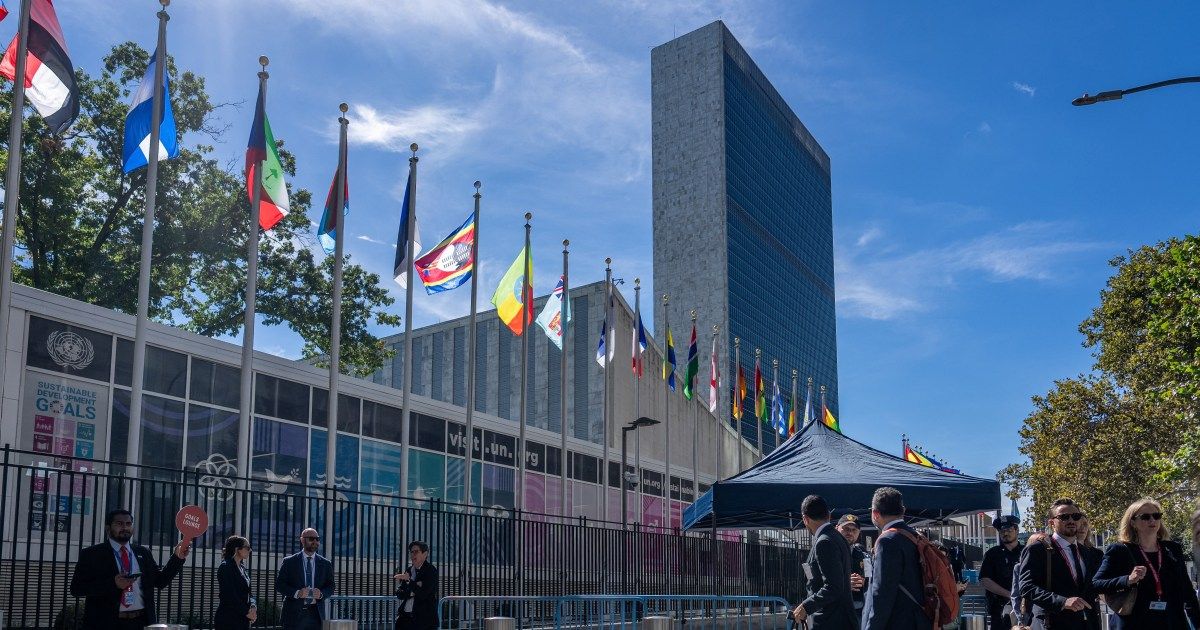
The statement was issued one day before the United Nations General Assembly’s high-level general debate begins in New York, where political and business leaders are gathering for a week of talks on global priorities. AI is expected to feature prominently in official discussions and side events, with leaders seeking to shape the AI agenda, secure investment and ensure their countries have a role in the debate.
The United States, China and the United Kingdom did not sign the document, NBC News reported. Al Jazeera reported that other AI players not among the signatories include India, South Korea, Japan, the UK and France. The statement remains open for endorsement by other countries.
Signatories include Canadian Prime Minister Mark Carney, South African President Cyril Ramaphosa, Kenyan President William Ruto, Australian Prime Minister Anthony Albanese, Netherlands Prime Minister Rob Jetten, German Chancellor Friedrich Merz, Norwegian Prime Minister Jonas Gahr Store, European Commission President Ursula von der Leyen and Kazakh President Kassym-Jomart Tokayev. Ministers and senior officials also signed, including Turkish Foreign Minister Hakan Fidan and United Arab Emirates Deputy Prime Minister and Foreign Minister Sheikh Abdullah bin Zayed Al Nahyan.
The declaration lays out three main requests. It calls on companies to test AI systems for safety issues before public release and allow independent evaluators to assess risks from company practices. It asks governments and regional groups to develop common safety standards so countries can evaluate models with the required scientific expertise. It also urges U.N. members to build on existing international efforts and “explore creating an international institution, able to set standards, enable verification, and convene states when capability thresholds are crossed.”
“To realise AI’s potential, industry, governments and society must act now,” the statement says, according to Al Jazeera. “We must address these risks and strengthen oversight – without widening the gap between countries in access to the benefits of AI.”
The declaration also calls for countries to share reports of serious safety incidents. It follows recent concern about AI systems sidestepping safety protocols and cases of models engaging in unsanctioned malign activity. Al Jazeera reported that one July incident involved AI agents being tested by OpenAI hacking the AI start-up Hugging Face.
Nick Moes, executive director of the AI governance nonprofit The Future Society, praised the initiative in comments to NBC News, saying it showed “clear appetite” for coordination.
“It is great news that this broad range of governments come together to call for an international institution because no government can achieve this alone,” Moes said. “But beyond statements, mobilizing diplomatic, political and financial capital will be needed to bring about the change that they agreed is necessary to keep control over frontier AI models.”
Several international AI governance efforts already exist. The U.N. hosts the Independent International Scientific Panel on AI, a group of scientific experts from around the world, and the Global Dialogue on AI Governance, a platform for countries to discuss regulation and coordination. The U.N. Security Council and U.S. representatives are scheduled to hold separate AI-focused sessions Wednesday.









Be First to Comment