Key takeaways:
- U.S. officials told CBS News there are no new or novel negotiations planned with Iran, despite Trump’s claim that talks would begin Monday.
- U.S. Central Command said the military has redirected 44 commercial vessels, disabled two vessels and boarded two others under the blockade against Iran.
- Iran says it is not holding direct talks with the United States and is working with Oman on a temporary route for safe navigation through the Strait of Hormuz.
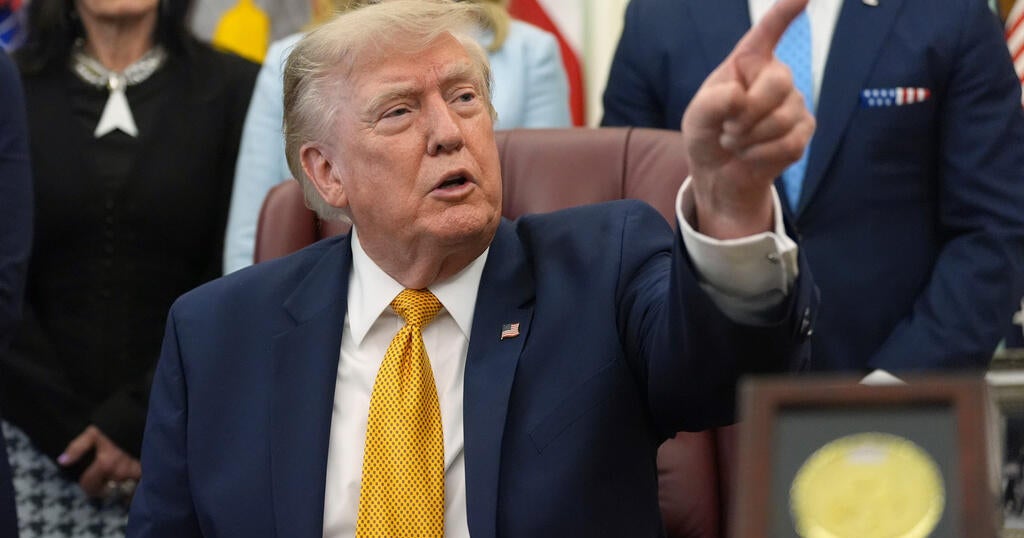
President Donald Trump warned Iran on Monday that it had one “last chance” to reach a deal before possible U.S. strikes, even as U.S. officials told CBS News that no new or novel negotiations with Tehran were planned.
The mixed messages came as Washington tightened pressure on Iran through a naval blockade and as traffic through the Strait of Hormuz remained sharply constrained. Trump has said talks would begin Monday, but Iran said it was not holding direct negotiations with the United States.
“I want to give them every last chance before decapitation,” Trump told reporters in the Oval Office. “Very tough to do what we have planned, still planned. We’ll see what happens.”
Trump said the discussions would move quickly and would first focus on reopening the Strait of Hormuz, followed by Iran’s nuclear program. “I mean they’re going to go quickly, one way or the other. It’s not very complex,” he said. “We’re talking about the strait, the opening of the strait, having it open, literally by tomorrow. Completely open. And that’s phase one, and phase two is we then will talk about the nuclear capacity … the denuclearization of Iran.”
Iran’s Foreign Ministry said Tehran was pursuing diplomacy through Oman, regional countries and others outside the region, but was not currently holding direct talks with Washington. Spokesman Esmail Baghaei said Oman’s focus was on establishing a temporary route for safe navigation through the waterway. “As long as the maritime siege and US actions continue, nothing significant will change in the Strait of Hormuz,” he said, according to Al Jazeera.
Trump accused Iran’s leadership of being “unbelievably duplicitous” after Tehran denied that direct talks were underway. On Truth Social, he said Iran had asked for talks to end the war and then said it was only dealing with Oman. He also said nothing would get through to Iran “unless a Deal, or Total Surrender, is accomplished.”
The U.S. military said on X that it had redirected 44 commercial vessels under its blockade against Iran. U.S. forces have disabled two vessels and boarded two others, according to U.S. Central Command.
Trump described the blockade in the Strait of Hormuz as a “Wall of Steel” and said the United States had the ability to enforce freedom of navigation. Asked whether Iran would return to fully free navigation of the strait, he said the waterway “has to be” free. “I am not going to let them charge. If anybody is going to charge, we’ll charge …. We have total control,” he said, according to Al Jazeera.
The president said Sunday that he had called off strikes that would have been “the biggest attacks since World War II” after appeals from Saudi Arabia, the United Arab Emirates, Qatar and Iran. He said a “deal is imminent, having to do with the Hormuz Strait and also, ultimately, the denuclearization of Iran.”
Shipping data firm Kpler said traffic through the Strait of Hormuz and Bab el-Mandeb “remains constrained.” It said Hormuz recorded nine confirmed transits Sunday, including two sanctioned and two shadow fleet vessels, and that seven used a route established by Iran. Kpler said shipping operators should treat both chokepoints as contested until U.S., Iranian and Omani signals produce clear navigation arrangements.
The disruptions have also affected energy markets. Trump urged U.S. oil companies to lower gasoline prices, saying Chevron and ExxonMobil had made “too much money” from higher oil prices during the war. “Chevron, too much money. Exxon Mobil, too much. Too much money,” he said. ExxonMobil declined to comment, and Chevron did not immediately respond to CBS News.
Diplomatic activity also continued elsewhere in the region. Pakistan said its deputy prime minister and foreign minister, Mohammad Ishaq Dar, spoke with Iranian Foreign Minister Seyyed Abbas Araghchi and invited him to visit Islamabad. Al Jazeera reported that Iran’s trade minister, Mohammad Atabak, traveled to Pakistan for talks that included easing transit bottlenecks and moving more Iranian containers through Pakistani ports during the blockade.






Be First to Comment