Key takeaways:
- U.S. Central Command said it completed a “heavy wave” of strikes on dozens of Iranian Revolutionary Guard targets after an Iranian attack on U.S. forces in Jordan.
- Iranian media reported at least three people were killed on Qeshm island; Al Jazeera reported the dead were a couple and their 2-year-old child.
- Jordan said it intercepted five Iranian missiles with no casualties, while Kuwait said an Iranian strike killed a worker at a Chinese company’s building.
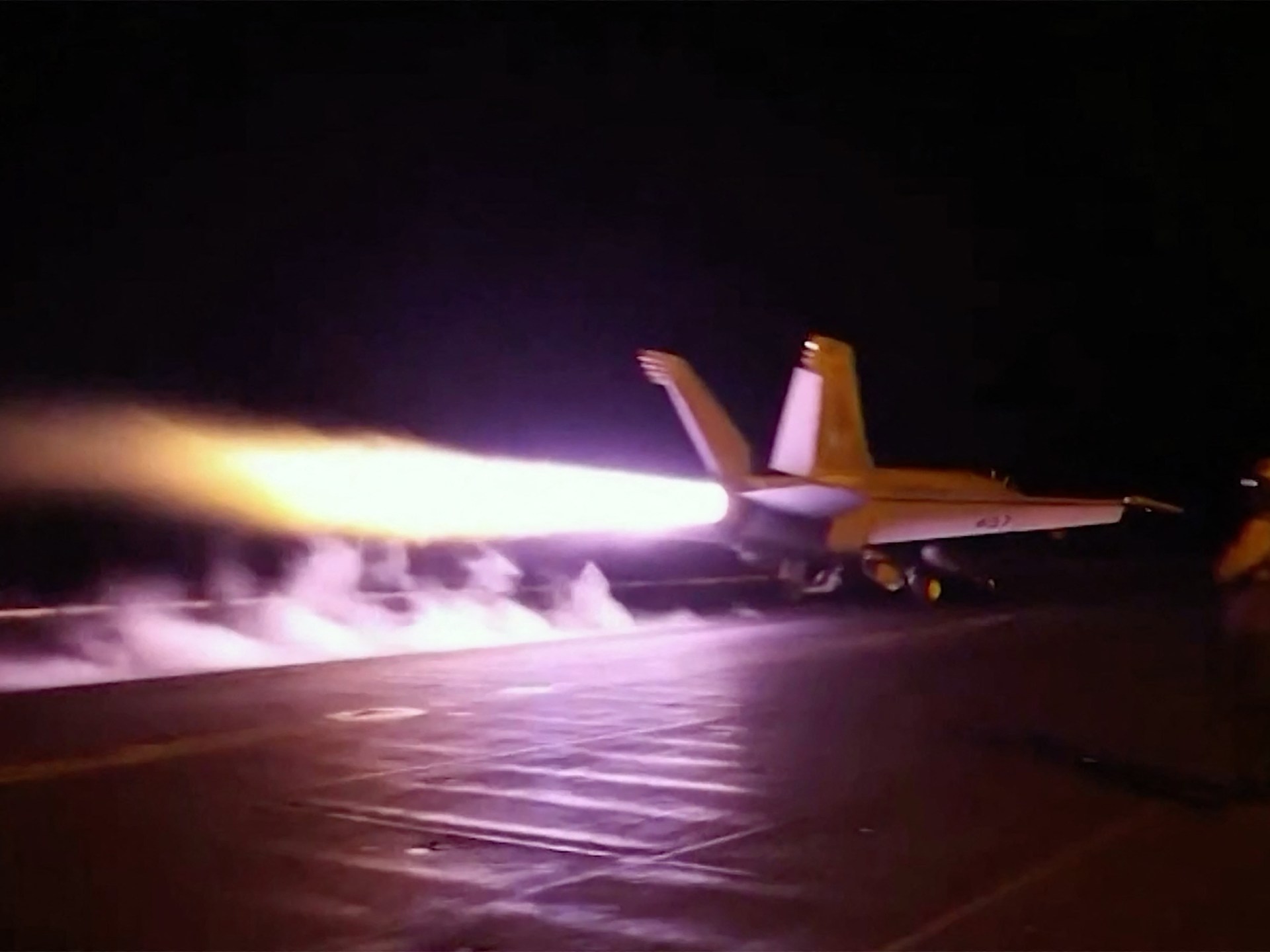
The United States launched a new wave of strikes on Iran after Iranian missiles targeted U.S. forces in Jordan, reigniting fighting across the region after several days of relative calm.
U.S. Central Command said it had “successfully completed a heavy wave of strikes against Iran” by 10 p.m. ET Wednesday, describing the operation as retaliation for an Iranian attack a day earlier on a U.S. base in Jordan. CENTCOM said the strikes hit dozens of Islamic Revolutionary Guard Corps targets, including “military command centres, missile and drone facilities, coastal surveillance and defence sites, and maritime capabilities.”
The attacks came hours after President Donald Trump said the United States would hit Iran “very hard.” Speaking at an Oval Office event, Trump said, “In the meantime, we’re going to be hitting them very hard because it’s our turn to hit them.”
Iranian media reported at least three people were killed in the U.S. strikes. Iran’s official IRNA news agency said three people were killed and two wounded in a strike on Qeshm island, off the Iranian mainland in the Strait of Hormuz. Al Jazeera reported that Iranian media identified the dead as a couple and their 2-year-old child killed when a residential building was struck.
Bombings were also reported in southwestern Iran, including Ahvaz and Abadan, and in Bushehr province and the cities of Kazerun and Farashband in Fars province, according to Al Jazeera. The semi-official Tasnim News Agency reported power outages in Ahvaz, located in Iran’s oil-rich Khuzestan province. A deputy security minister in Khuzestan told Iran’s state broadcaster IRIB that U.S. forces targeted “some locations in Abadan.”
Iran responded Thursday by targeting a U.S. airbase and command headquarters in Jordan, Al Jazeera reported. Jordan said its air defenses intercepted five missiles launched from Iran. No casualties were reported, Jordan’s state-run Petra news agency said, citing the armed forces spokesman.
Hours later, Kuwait’s military said an Iranian strike hit a building belonging to a Chinese company in northern Kuwait, severely damaging the structure and killing a worker. Kuwait’s defense ministry spokesperson also reported the strike on X.
The escalation followed a five-night pause in U.S. strikes on Iran, according to Al Jazeera, after nearly two weeks of continuous nightly attacks. The IRGC has said that as long as Washington’s threats continue, Tehran’s resistance will continue.
The latest U.S. barrage also came after the United States partnered with Saudi Arabia to strike Iran-backed militias in Iraq on Wednesday, killing at least 20 fighters and six Iranian advisers, NPR reported. Saudi Arabia had accused Iraqi militias of firing drones at its oil facilities in recent days. An umbrella group of Iraqi militias initially denied the allegations, while Yemen’s Iran-backed Houthi rebels said they had attacked Saudi energy facilities as part of a separate but related conflict.
British maritime security firm Ambrey said drone strikes on Wednesday ignited fires on two natural gas vessels at Egypt’s port of Damietta: a U.S.-owned floating storage facility and a Greek-owned tanker. No injuries were reported. The office of Egypt’s prime minister said initial investigations showed the fires were caused by a drone. It was not immediately clear who was responsible.
The fighting has raised concerns about a broader regional conflict and renewed threats to energy routes. The Strait of Hormuz, a crucial waterway for global energy supplies, has been effectively closed again by Iranian attacks, NPR reported. The U.S. Treasury Department announced new sanctions Wednesday on two Iranian firms it said were part of an IRGC-backed scheme forcing commercial vessels to buy insurance to transit Hormuz.
“The United States will not allow Iran to hold global commerce hostage or use international shipping to finance the IRGC’s terrorism, aggression, and repression,” Treasury Secretary Scott Bessent wrote on X.
A regional official told NPR that mediators are “still trying with both sides” to restore calm and revive a ceasefire track, but gave no details on progress.








Be First to Comment