Key takeaways:
- Brent crude fell below $88 to $90 a barrel Monday after rising above $100 last week, while U.S. crude dropped to around $83 a barrel.
- U.S. Ambassador to the U.N. Mike Waltz said the pause in attacks was meant to give talks “some space,” but Iran said it had no negotiations with the United States at present.
- Shipping through the Strait of Hormuz and Bab el-Mandeb remained extremely limited over the weekend, with Kpler data showing fewer than 10 commodity vessels passed through Hormuz.
Oil prices dropped sharply Monday after the United States and Iran paused attacks, easing immediate fears that the conflict would again widen across major Middle East shipping routes.
Brent crude, the international benchmark, fell below $88 a barrel, according to the BBC, after climbing above $100 last week for the first time since May. NBC News reported Brent sank below $90 Monday morning, while U.S. crude dropped to around $83 a barrel, with both down about 7%. The BBC reported a fall of more than 9%. Global markets were mostly higher, and U.S. stock futures surged.
The price move followed comments from U.S. Ambassador to the United Nations Mike Waltz, who said the halt in strikes was intended to allow diplomacy to proceed. “What the president is doing right now, as we’ve seen all along, is giving some talks some space,” Waltz told NBC News’ “Meet the Press” on Sunday. He said talks were “ongoing,” while adding there was “internal fighting” on the Iranian side. Waltz also dismissed reporting that U.S. weapons stockpiles are depleted.
The pause came after 13 consecutive nights of attacks that shattered an earlier agreement to end the war and threatened new pressure on the global economy. The BBC reported that an Iranian army spokesperson said Sunday that Tehran had halted “retaliatory” attacks in the region. The U.S. and Iran had refrained from attacks for three days by Monday, NBC News reported.
Tehran, however, offered limited support for the idea that formal negotiations were underway. “Mediators may convey messages from the American side to us concerning regional developments, but at the present time we have no negotiations with the American side,” Iranian Foreign Ministry spokesman Esmaeil Baghaei said Monday. He said Iran would “never allow America to determine the timing of war and peace” and would “continue to defend ourselves for as long as our interests and considerations require.”
Baghaei added that “whenever we feel that we can use diplomacy as a tool to safeguard our national interests, we will certainly use it as an instrument.” He also maintained that the Strait of Hormuz was “closed.”
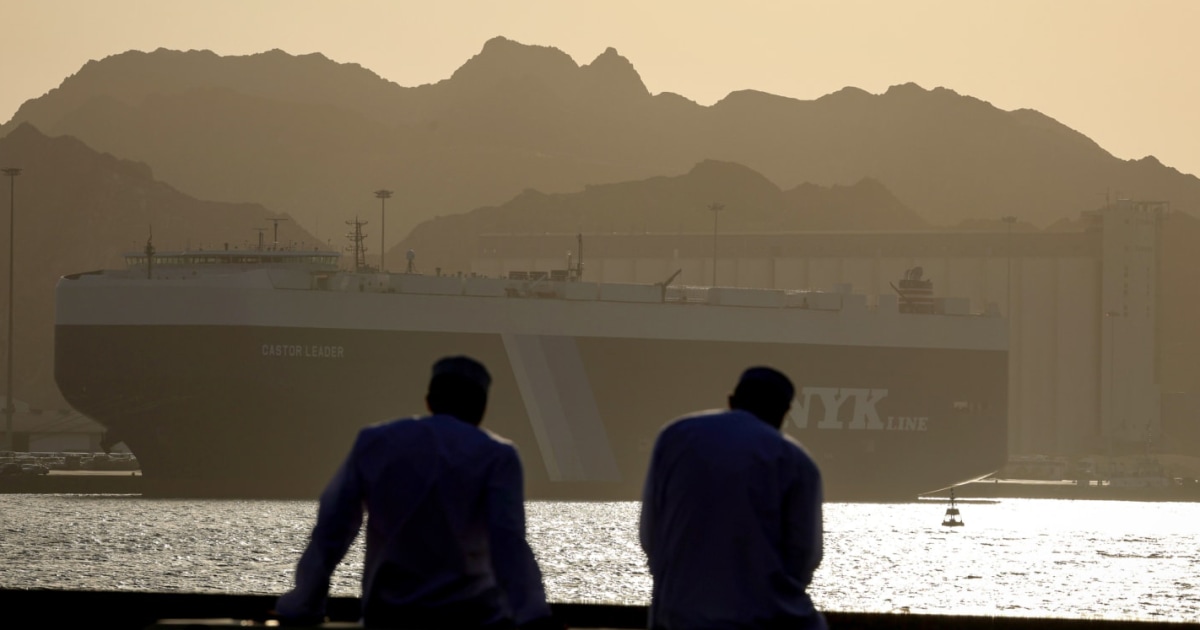
The war has repeatedly disrupted the Strait of Hormuz, a key route that usually carries about 20% of the world’s oil and liquefied natural gas, according to the BBC. NBC News reported that before the war, about 20% of the world’s oil moved through the strait. The conflict has also spread pressure to the Red Sea, where Iran-backed Houthi rebels have attacked shipping and Saudi oil installations.
Shipping through both Hormuz and the Bab el-Mandeb chokepoint was extremely limited over the weekend. Citing Kpler shipping data shared with Reuters, NBC News reported that just 11 commodity vessels passed through Bab el-Mandeb on Sunday, the lowest level in months. Fewer than 10 commodity vessels passed through the Strait of Hormuz over the weekend, according to Kpler.
The semiofficial Iranian Tasnim news agency reported Monday that six vessels tried to pass through Hormuz “by switching off their navigation and position systems.” It said one vessel “suffered an incident,” while the others were returned to the Persian Gulf “under Iran’s decisive management.”
Analysts warned that the market remains fragile. “The market seems to be forever seeking good news from an arena that really is not providing any,” PVM analyst John Evans said. Susannah Streeter, chief investment strategist at Wealth Club, said markets remained “cautious given the twists and turns during this conflict,” adding that “there is still significant uncertainty baked into these prices and a reticence about whether negotiations will lead to a lasting breakthrough.”
The conflict has already raised fuel costs such as petrol and diesel in many countries, the BBC reported, with potential knock-on effects for prices including food. Separate shipping tensions have also emerged outside the Middle East: Iran accused Ukraine over the weekend of attacking an Iranian commercial vessel in the Caspian Sea, killing one sailor and injuring another, while Ukrainian President Volodymyr Zelenskyy said Kyiv had noted Russia was passing satellite observations in the Middle East to Iran to help direct strikes.







Be First to Comment