Key takeaways:
- More than 100 million people in the United States were affected by wildfire smoke drifting south from Canadian fires, with some cities recording AQI readings above 200 and parts of the Midwest reaching the 300s.
- Public health officials in New York, Philadelphia, Michigan and other areas issued advisories or changed operations, including mask distribution, pool closures and recommendations to stay indoors.
- Experts warned that wildfire smoke contains fine particulate matter that can penetrate the lungs and bloodstream, posing heightened risks for children, pregnant people, older adults and people with heart or respiratory conditions.
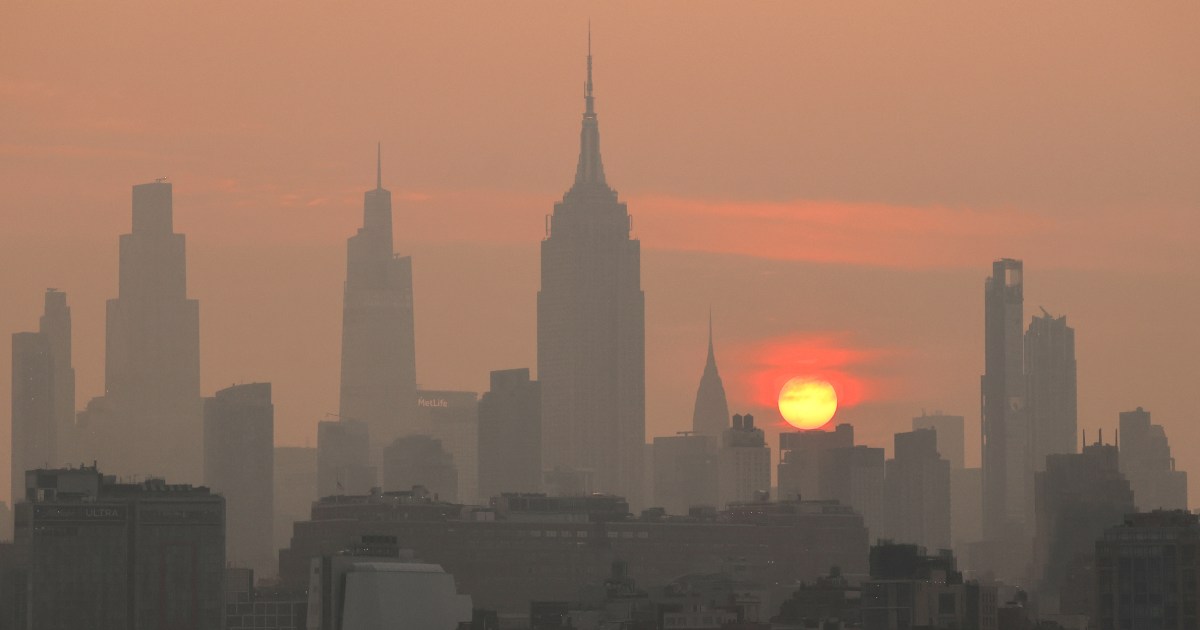
Wildfire smoke from Canada spread across a vast stretch of the United States on Friday, leaving more than 100 million people under unhealthy air and prompting officials to urge residents in major cities to stay indoors, limit activity and use high-quality masks if they must go outside.
The smoke, driven south from hundreds of fires burning in Canada, shrouded areas from the Upper Midwest to the Mid-Atlantic and Northeast. The Guardian reported that about 109 million people were affected across the Midwest, Mid-Atlantic and Northeast. NBC News reported that more than 800 wildfires were active across Canada as of Thursday, including large clusters in Ontario near the Minnesota border.
Air quality readings reached dangerous levels in several cities. Chicago, Detroit, Milwaukee, Pittsburgh and Washington recorded Air Quality Index values above 200 on Friday, according to NBC News, citing IQAir data. Parts of Michigan, Ohio and Wisconsin had readings in the 300s, a level at which experts advise avoiding outdoor activities.
Detroit’s air was among the worst reported. The Guardian said the city’s AQI reached a “hazardous” 361, while NPR reported that Detroit had an AQI of 435 on Friday morning, the worst for any major city in the world. Baltimore and Washington had “very unhealthy” readings of 281 and 247 at 6 a.m. Eastern, according to The Guardian. New York City, which had been blanketed by smoke since Tuesday, had an “unhealthy” reading of 184 early Friday before improving to 124, a level considered unhealthy for sensitive groups.
Public health officials responded with advisories and service changes. New York launched emergency operations Wednesday, offering free KN95 masks and opening shelter space, NBC News reported. Philadelphia suspended trash pickup and closed public pools Friday because of deteriorating air quality. Michigan officials recommended closing windows, minimizing door openings and using HVAC systems rated MERV-13 or higher. “If you must be outdoors for short periods of time, an N95 or P100 respirator marked with NIOSH is recommended,” the state alert said.
Doctors and air quality experts warned that wildfire smoke poses risks beyond ordinary haze. The smoke contains microscopic particulate matter, ash and trace minerals. PM2.5 particles are especially dangerous because they can be inhaled deeply into the lungs and enter the bloodstream.
“No particles are good to breathe, but wildfire particles seem to be more toxic than regular urban particles themselves,” Suzanne Paulson, director of the Center for Clean Air at UCLA, told NBC News. “Whatever the [AQI] color is, consider that it’s the next color up if there’s a lot of wildfire smoke.”
May-Lin Wilgus, a pulmonologist and professor at UCLA, told NPR that when AQI levels reach 100 to 200, exposure to fine particulate pollution can be “similar to smoking a quarter to half a pack a day.” She said emergency room visits for respiratory conditions such as asthma and COPD can rise sharply during smoke events. NPR reported that asthma-related emergency visits rose nearly 20% during the Canadian wildfire smoke event in 2023.
The smoke came mainly from roughly 200 out-of-control wildfires in Canada, according to The Guardian. Canada’s largest fire, near Ontario’s remote Wabakimi Provincial Park, covered 787,802 acres, the Canadian Interagency Forest Fire Center reported. Nearly 6 million acres have burned in Canada, less than a quarter of the land burned during the 2023 fires that also sent smoke across the United States. Fires in northern Minnesota have burned more than 63,000 acres.
Mark Parrington, a senior scientist at the Copernicus Atmosphere Monitoring Service, said wildfire activity in Canada had intensified in recent weeks. “Smoke from major fires — particularly in Ontario — [is] already having severe air quality impacts across cities in the Great Lakes region and the north-eastern United States,” he said.
Officials were also watching whether smoke could affect the World Cup final in East Rutherford, New Jersey. The Guardian, citing sources familiar with the situation who spoke to ABC News, reported that authorities were monitoring possible smoke impacts, though air quality was expected to improve after a storm system passes late Saturday.
President Donald Trump blamed Canada for the smoke and threatened additional tariffs, accusing the Canadian government of “willful negligence” in forest management. “We are holding Canada responsible for the fact that they are not properly maintaining their Forests, and Brush therein,” he wrote on Truth Social, saying the United States was being “invaded by filthy, polluted, and unhealthy air.”








Be First to Comment