Key takeaways:
- Mullin said DHS preliminarily identified more than 250,000 noncitizens on voter rolls in California, New Jersey, Nevada and Pennsylvania.
- A federal judge has blocked use of the DHS SAVE database for the voter roll effort over rules on disclosure of Social Security records.
- Pennsylvania Secretary of State Al Schmidt said noncitizen voting is extremely rare and that voters in his state must verify their identity.
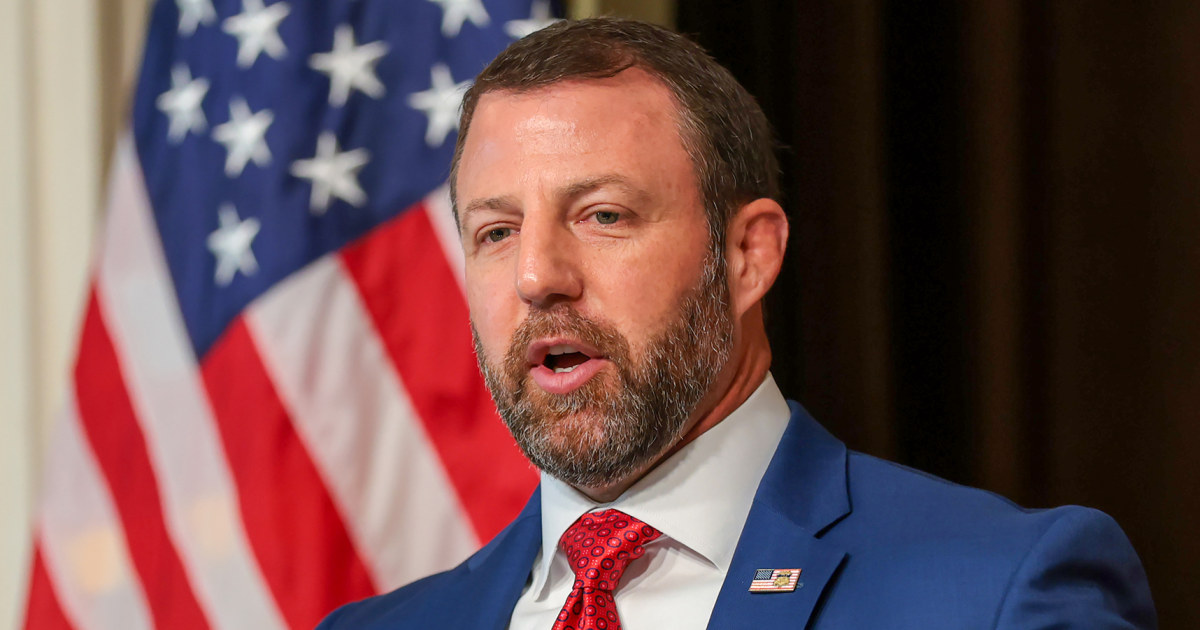
Homeland Security Secretary Markwayne Mullin warned state election officials Friday that they could face fines, loss of federal grants and possible prison time if they do not cooperate with Trump administration efforts to check voter rolls for noncitizens.
Speaking from the Eisenhower Executive Office Building next to the White House, Mullin said the Department of Homeland Security had preliminarily identified more than 250,000 noncitizens on voter rolls in California, New Jersey, Nevada and Pennsylvania. He demanded that states run voter lists through a DHS database used to verify citizenship and immigration status.
“We need to make sure that individuals that are legally able to vote are voting,” Mullin said. “If you’re illegal and attempted to vote, or you tried to vote illegally for someone else, we will find you and we will charge you.”
Mullin said illegal voter registration and illegal voting carry penalties of up to five years in prison and fines of up to $250,000. He added that election officials could also be held responsible if they fail to act after receiving information from the federal government. “Those individuals can also be held accountable by fines, by penalties, and even, depending on how far it goes, prison time,” he said.
The remarks came a day after President Donald Trump used a DHS memo to support claims that U.S. elections are vulnerable. “We can never watch a stolen election again,” Trump said Thursday, arguing that elections “were left vulnerable to being rigged and stolen, and the trust of the American people was lost.” Trump continues to call the 2020 election “dirty” and “rigged,” though multiple reviews found no widespread fraud and members of his own Cabinet said there was no widespread voter fraud.
Mullin said the effort is not aimed at changing past results. “This isn’t about rehashing the 2020 election,” he said, according to The Guardian. “This is just exposing what took place, and to make sure it never happens again.” He also said, “We’re not trying to change the outcome. We’re trying to make sure that American people can trust our voting system.”
Election experts and voting rights advocates have questioned the administration’s figures and methods. David Becker, executive director of the nonpartisan Center for Election Innovation and Research, said the administration has not been “transparent about the methodology” behind the 250,000 figure. Election law expert Rick Hasen wrote, “If his government had actual evidence of noncitizen voting, there would be indictments.”
The DHS tool at the center of the effort is the SAVE database, historically used to assess immigration benefits. DHS revamped it last year to make it easier for state and local officials to check citizenship status in bulk, including through access to Social Security numbers. DHS officials say the database does not itself determine whether someone is a noncitizen, but checks other government records and flags people for further review.
A federal judge has blocked the use of the database for this voter roll effort, ruling that repurposing it violated rules on disclosure of Social Security records. Voting rights groups say the system can be outdated and error-prone, often flagging newly naturalized citizens as noncitizens, and could lead to eligible voters being removed from rolls.
Mullin also said DHS had identified 28,000 noncitizens on voter rolls in 23 Republican-led states that worked with the administration through SAVE. Becker said that figure was plausible but represented 0.04% of the 68 million eligible voters in those states.
Pennsylvania Secretary of State Al Schmidt, a Republican, said voters in his state must verify their identity when registering, voting by mail or voting at a new polling place. “All evidence has shown that noncitizen voting is extremely rare across the country, including in Pennsylvania,” he said.
Mullin said DHS will continue reviewing election records before and after the midterm elections for ineligible votes from noncitizens and deceased people. He also said Trump directed the DHS cybersecurity team to release an updated election infrastructure plan within 30 days.





Be First to Comment