Key takeaways:
- U.S. crude rose more than 5% to above $75 a barrel, while Brent crude climbed about 5% to around $80 after Trump’s announcement.
- Trump said the U.S. would be “THE GUARDIAN OF THE HORMUZ STRAIT” and would seek reimbursement at “the rate of 20% on all cargo shipped.”
- Kpler data cited by The Guardian showed only six vessels crossed the Strait of Hormuz on Sunday, the fewest in five weeks.
Oil prices jumped more than 5% Monday after President Donald Trump said the United States would resume a blockade tied to Iran and charge a 20% fee on cargo shipped through the Strait of Hormuz, escalating tensions around one of the world’s most important energy routes.
U.S. crude rose 5% to more than $75 a barrel, while Brent crude climbed about 5%, reaching roughly $80 a barrel. The Guardian reported Brent at $79.37 a barrel after Trump’s announcement. The increase interrupted recent declines in U.S. gasoline prices and rippled across financial markets.
Stocks fell as traders reacted to the latest confrontation between Washington and Tehran. The S&P 500 dropped about 0.5%, while the Nasdaq, already sharply lower, hit its lowest point of the day, NBC News reported. The Guardian reported the Nasdaq down 1% and the S&P 500 down 0.4% in early afternoon trading. Asian markets had earlier fallen sharply, with South Korea’s Kospi down 8%, and Japan’s Nikkei 225 and China’s Shanghai Composite each down 2%. Shares of South Korean chipmaker SK Hynix fell 15%, while Samsung Electronics dropped 10%. Airline shares also declined on both sides of the Atlantic.
Trump wrote on social media that the United States would be known “from this point forward” as “THE GUARDIAN OF THE HORMUZ STRAIT” and said the arrangement would “begin immediately.” He said the United States would be “reimbursed” at “the rate of 20% on all cargo shipped” for “providing safety and security to this very volatile section of the world.”
It was not immediately clear how the charge would be imposed. Energy and shipping companies have rejected a similar proposal from Iran that would require ships to pay a toll to pass through the waterway. The U.S. Treasury Department has warned that anyone paying Iran for passage through the Strait of Hormuz could risk sanctions violations, calling such demands “maritime extortion.”
Trump also said the United States would reimpose what he called “THE IRANIAN BLOCKADE.” NBC News reported that the phrase appeared to refer to a recent U.S. naval blockade preventing ships from entering or leaving Iranian ports, but that blockade did not stop non-Iranian commercial vessels from transiting the waterway. The Guardian reported that Trump reinstated a U.S. blockade of Iranian shipping in the Gulf and said Iranian ships would no longer be able to travel through the Strait of Hormuz.
The announcement followed another round of U.S. strikes against Iran on Sunday evening, after Iranian forces hit multiple commercial vessels with projectiles and drones, including on Sunday night, NBC News reported. U.S. Central Command said on X that the strikes were intended “to continue degrading their ability to attack civilian mariners and commercial ships freely transiting the strait of Hormuz” and said Trump “has directed the strikes to hold Iranian forces accountable.”
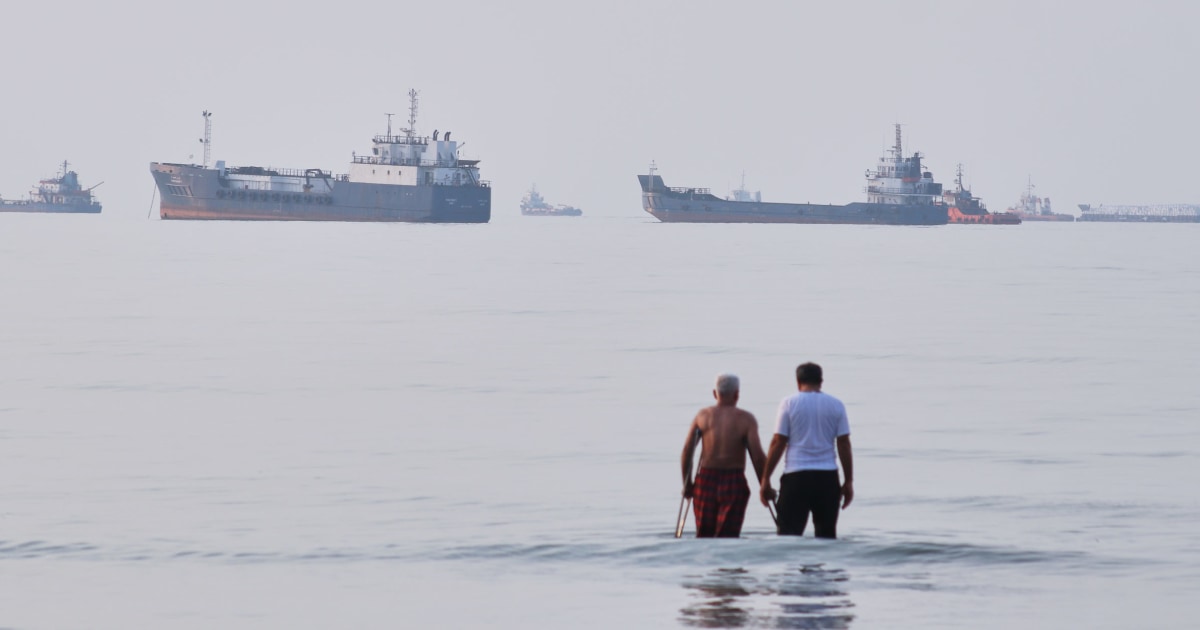
The Strait of Hormuz is a critical shipping channel through which about one-fifth of the world’s energy supplies normally pass. The latest escalation has raised new concerns about whether Gulf oil and gas flows can return to normal after months of disruption. The Guardian reported that oil traded at $72.48 a barrel before U.S.-Israeli strikes on Tehran in late February and reached highs of $120 in April.
Traffic through the strait has already fallen, according to data analyst Kpler. The Guardian reported that only six vessels crossed on Sunday, the fewest in five weeks. Kpler said tankers exiting included the very large crude carrier Humanity, carrying 2 million barrels of Iranian oil, and the Capetan Andreas, carrying about 500,000 barrels of Kuwaiti oil products. Three empty tankers entered the Gulf to load oil. Most tankers switch off their transponders when crossing the strait.
Trump said Sunday the shipping route was open to commercial traffic, while Iran said earlier it had closed the strait after a vessel traveled on an unapproved route. Iran’s Islamic Revolutionary Guard Corps said Monday that its navy stopped two ships in the strait Sunday by shutting down their systems, though it did not name the vessels.
Chevron CEO Mike Wirth told Bloomberg in May that his company would not pay a fee to Iran to move ships out of the region. “No, we wouldn’t,” he said. “Freedom of navigation through international waterways is a very well-established principle.” He warned that such fees could set a precedent for other waterways, including the Strait of Malacca in southern Asia.
Gold fell 1.4% Monday to $4,083 an ounce, The Guardian reported, as higher oil prices raised concerns that central banks might increase interest rates to combat inflation. Oil prices later pared some gains after OPEC cut its 2026 global demand growth forecast to 780,000 barrels a day, down from 970,000, its third consecutive downward revision. The International Energy Agency expects demand to decline in 2026 by 1 million barrels a day, according to The Guardian.









Be First to Comment