Key takeaways:
- Trump declared the ceasefire with Iran over at a NATO summit in Ankara, while saying U.S. negotiators still wanted to continue talks.
- Crude oil benchmarks rose sharply Wednesday, with NPR reporting gains of about 7% and The Guardian reporting Brent crude up more than 5% above $80 a barrel.
- The IMF cut its global growth outlook to 3%, warning that renewed Middle East conflict could extend commodity volatility, threaten supply chains and raise prices.
Oil prices surged and stock markets fell Wednesday after President Donald Trump declared that a fragile ceasefire with Iran was over, adding new uncertainty to a global economy already under pressure from inflation, tariffs and weaker growth forecasts.
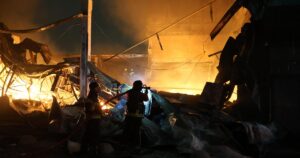
The market reaction followed renewed hostilities in the Strait of Hormuz. NPR reported that the U.S. military attacked dozens of targets along the Iranian coastline overnight in retaliation for what appeared to be Iranian attacks on vessels trying to transit the strait. The renewed fighting came only weeks after investors had welcomed the ceasefire between Washington and Tehran.
At a NATO summit in Ankara, Trump criticized Iran’s leadership, calling them “sick people,” and said he was “very upset” with the country’s military alliance with Spain, The Guardian reported. “As far as I’m concerned, it’s over,” Trump said of the ceasefire, though he added that U.S. negotiators wanted to continue talks.
Energy markets moved quickly. NPR reported that both U.S. and international crude benchmarks jumped about 7% Wednesday, while The Guardian said Brent crude, the global benchmark, rose more than 5% to top $80 a barrel. Prices remained below their spring peaks, but the increase revived concerns that higher energy costs could feed inflation after a recent easing in gasoline prices.
U.S. stocks also retreated. NPR reported that the Dow Jones Industrial Average fell more than 800 points, or 1.5%, after reaching a record high two days earlier. The Guardian reported that the Dow closed down 1.09%, or 500 points, while the S&P 500 posted a small loss and the Nasdaq edged higher. Global markets also weakened earlier in the day, with Britain’s FTSE 100 down 1% and Japan’s Nikkei off 2.1%, according to The Guardian.
The immediate effect on U.S. pump prices was limited. NPR, citing AAA, reported that retail gasoline prices rose less than a penny per gallon overnight, though they could climb in coming days as higher crude costs filter through. The Guardian reported that U.S. gasoline averaged $3.79 a gallon, 65 cents higher than a year earlier, according to AAA. It also reported that U.S. diesel futures rose 13% after Russia imposed a diesel export ban following a Ukrainian drone strike that hit key refineries.
The renewed conflict complicates the outlook for the Federal Reserve and its new chair, Kevin Warsh. NPR reported that the CME FedWatch tracking tool showed investors now saw a better than one-in-three chance of a Fed rate increase this month, up from about one-in-four before the ceasefire broke down.
Inflation is already running above the Fed’s 2% target. The Guardian reported that the annualized U.S. inflation rate reached 4.2% in May, a three-year high. Minutes from the Fed’s most recent meeting showed little discussion of cutting rates soon and indicated that some officials believed rates might need to rise before year’s end if inflation persisted. “Both total and core inflation were higher than their levels a year earlier,” the minutes said, citing factors including past tariff increases, higher energy and input costs from the Middle East conflict, and demand tied to AI infrastructure spending.
The International Monetary Fund also lowered its outlook. NPR reported that the IMF expects global growth of 3% in 2026, down from 3.5% last year. The Guardian reported that the IMF cut its global growth forecast to 3%, down from 3.1% in April, citing Middle East conflict and pressure from AI spending. “The possibility of renewed Middle East conflict looms large and could extend commodity price volatility, further threaten supply chains, raise prices, and weigh on financial conditions,” the IMF warned in its latest outlook.













Be First to Comment