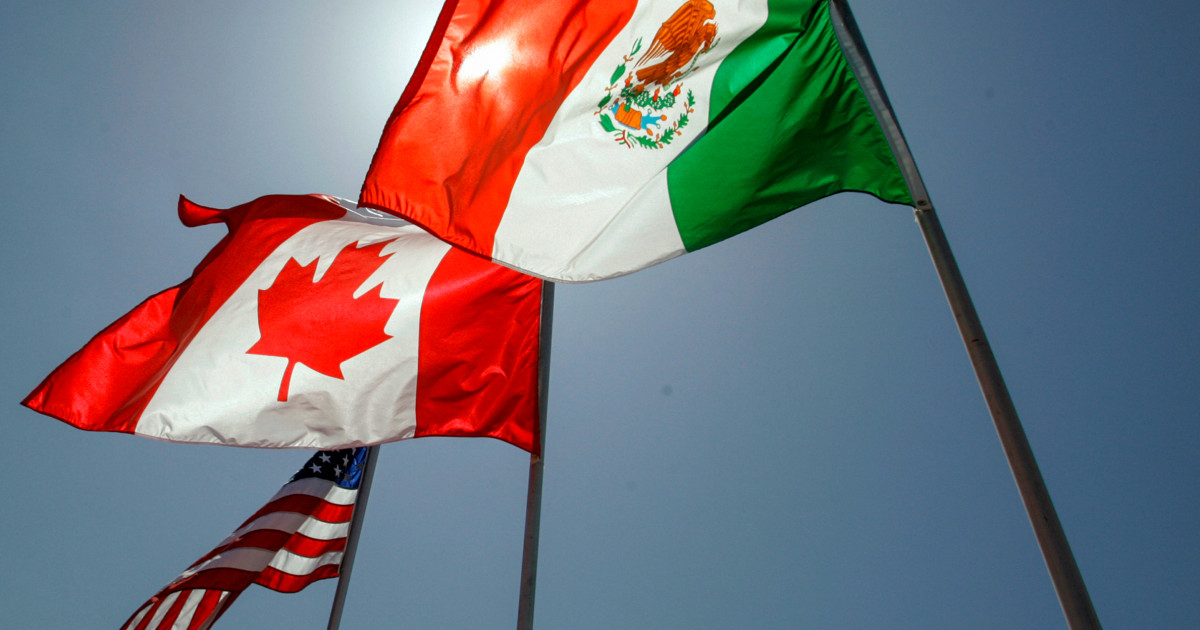
Key takeaways:
- The United States did not agree to renew the USMCA in its current form, but the pact remains in force and is set to expire in 2036.
- A senior Trump administration official said trade deficits with Mexico and Canada are the central reason Washington wants changes to the agreement.
- Intraregional goods trade under the USMCA rose from $1.07 trillion in 2020 to more than $1.63 trillion in 2024, according to Brookings Institution research cited by NBC News.
The Trump administration said Wednesday it will not renew the United States-Mexico-Canada Agreement on its current terms, choosing instead to keep the North American trade pact under annual review while it seeks changes to a deal President Donald Trump once called a landmark achievement.
The decision came on the deadline built into the agreement for the three countries to decide whether to extend the pact, which remains in force and is set to expire in 2036. Rather than committing to another 16-year renewal, U.S. officials said Washington will begin negotiations aimed at revising the agreement. One possible outcome, a senior Trump administration official told reporters, could be separate bilateral trade deals with Mexico and Canada.
“So in other words, the United States did not agree to renew the USMCA in its current form. So, as a result, the USMCA is not renewed,” a senior administration official said, according to The Guardian. The official said Trump “chose not to rubber stamp a USMCA renewal without addressing existing issues.”
U.S. Trade Representative Jamieson Greer said in a statement that the United States would “continue to engage with Mexico and Canada to address the Agreement’s shortcomings.”
The move marks a reversal for Trump, who negotiated the USMCA after pulling the United States out of the North American Free Trade Agreement. In 2019, he called the USMCA “the best and most important trade deal ever made by the USA,” according to NBC News. The Guardian reported that he also described it in 2020 as the “fairest, most balanced, and beneficial trade agreement we have ever signed into law.”
Administration officials now say the agreement modernized North American trade but failed to rebalance it in the way Trump intended. “The primary issues that the president’s been focused on with the world, and particularly with Canada, Mexico, is our trade deficit,” a senior Trump administration official said.
“When USMCA was adopted six years ago by a bipartisan majority, and the president’s approval, the idea is that we would modernize the agreement and it would also lead to rebalancing. The agreement did succeed in modernizing the agreement,” the official said. “But with respect to rebalancing, our trade deficits with both Mexico and Canada shot up during the Biden administration.”
“We’ve started to get it under control, but we believe that the USMCA did not operate to control the deficit like the president intended, so that’s really the heart of it,” the official added.
The pact will not end immediately. It will stay in force while talks continue, but it will now be reviewed every year rather than every six years. The senior Trump administration official said the White House does not want to stretch negotiations across the full decade before expiration, describing the review process as a feature meant to prevent the agreement from running “on autopilot over decades.”
Canada signaled support for preserving the pact. Dominic LeBlanc, the Canadian minister responsible for U.S. trade relations, said he met Wednesday with Greer and that Canada is “unwavering” in its support for the agreement.
“Canada approaches these discussions from a position of strength and with the goal of preserving and strengthening one of the most successful trading relationships in the world,” LeBlanc said. “At a time of global economic uncertainty, Canada is a stable, reliable and trusted partner.”
LeBlanc said the agreement “remains fully in force until 2036 and can be renewed at any time for another 16-year period.” NBC News reported that Mexico, which did not impose tariff retaliation measures against Trump’s tariffs, is in talks with the White House about the deal’s future.
The USMCA has been widely viewed as a stabilizing force for North American trade. Total intraregional trade in goods rose from $1.07 trillion in 2020 to more than $1.63 trillion in 2024, according to Brookings Institution research cited by NBC News. CNBC, cited by The Guardian, reported that the pact governs about $2 trillion annually in goods and services among the three countries.
Business groups urged a durable outcome. The American Automotive Policy Council said “North American economic integration enables enormous competitive benefits for the region,” while warning that U.S. automakers face disadvantages compared with imports subject to a flat 15% tariff and fewer comparable rules of origin. The Business Roundtable said the agreement has produced “significant economic benefits” and urged Washington to “strengthen and extend USMCA.”







Be First to Comment