Key takeaways:
- Emergency responders were called Sunday to Mineral Bottom in Grand County, Utah, after a BASE jumping attempt left two people dead.
- Authorities identified the victims as extreme athlete Andy Lewis and Danny Joe Kregle, 68, though The Guardian reported an earlier sheriff’s release described the second victim as an unidentified 50-year-old man.
- Lewis owned BASE Jump Moab and had won four straight competitive slacklining world championships from 2008 through 2011.
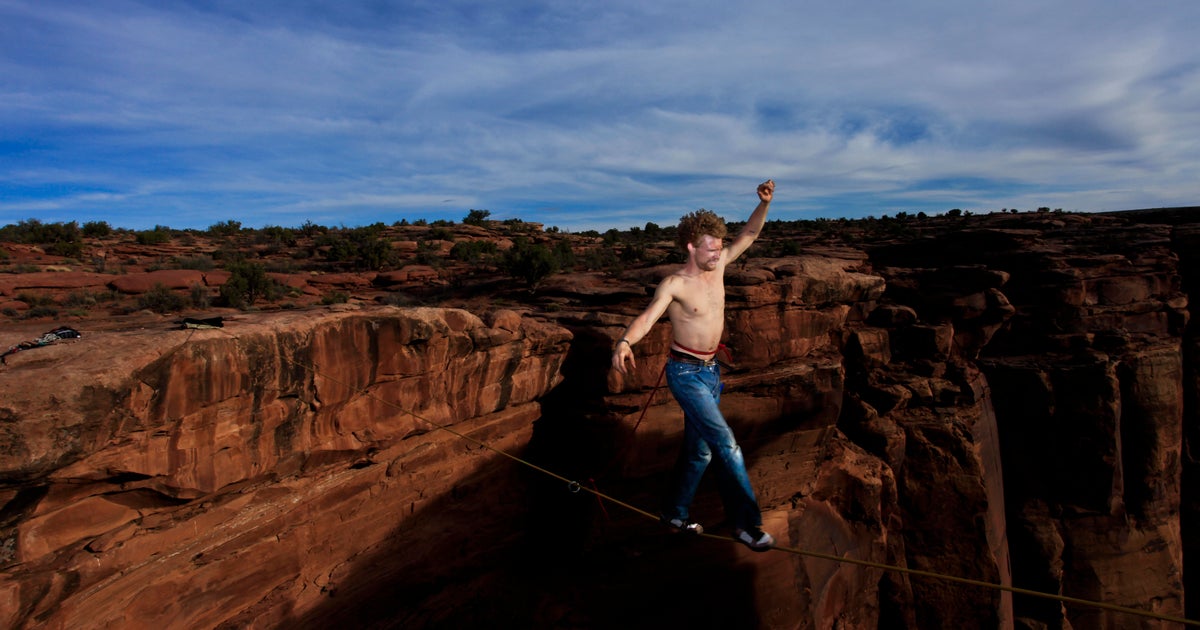
A tandem BASE jump in a remote Utah canyon killed two people over the weekend, including Andy Lewis, the extreme athlete who became widely known after performing slackline tricks during Madonna’s 2012 Super Bowl halftime show, authorities said.
Emergency responders were sent Sunday to Mineral Bottom, a desert area near the Utah-Colorado line, after a report of injuries during a BASE jumping attempt, the Grand County, Utah, sheriff’s office said. The office confirmed that Lewis died in the accident. Grand County Sheriff Jamison Wiggins also confirmed the second person killed was Danny Joe Kregle, 68, described by relatives as an Arizona businessman, father and grandfather.
The Guardian reported that an earlier sheriff’s office news release described the second victim as an unidentified 50-year-old man. Relatives later identified him as Kregle.
The two had been conducting a tandem jump, in which two people are harnessed together, according to a social media post by Aerial Arts Moab, an acrobatics company that called Lewis its “co-owner and best friend.” Lewis also owned BASE Jump Moab, a business that offered tandem jumps to inexperienced customers, who were attached to a guide wearing the parachute. Promotional videos on the company’s website show pairs stepping off high desert cliffs before their parachutes deploy.
No one immediately returned phone, text or Facebook messages left Monday for BASE Jump Moab.
Lewis was a major figure in BASE jumping, slacklining and tricklining, sports that combine balance, aerial acrobatics and high risk. BASE jumping involves parachuting from fixed objects such as buildings, bridges or cliffs. In slacklining and tricklining, athletes balance and perform tricks on a narrow line, sometimes high above the ground.
Lewis won four straight world championships in competitive slacklining from 2008 through 2011. In 2011, he set a Guinness World Record for slackline surfing above China’s Diaoshuilou waterfall, moving his feet in a rocking motion while keeping his balance. In 2014, he walked a slackline suspended between two hot air balloons more than 4,000 feet above the Nevada desert.
His national breakthrough came at the Super Bowl. Dressed in a Roman toga, Lewis bounced and flipped on an inch-wide line as Madonna performed behind him. “My phone actually rang itself to death three days in a row,” Lewis later said on Conan O’Brien’s late-night show.
Within BASE jumping, Lewis had a reputation for unusual athletic ability and a willingness to take risks, said John McEvoy, a BASE jumping instructor in Twin Falls, Idaho, who had jumped with him. “He had an incredible level of athleticism and skill that was developed over years of practice,” McEvoy said. “But then he would take an incredible amount of risk.”
Lewis had acknowledged the danger of the sport. “It’s weird to think about how many people are dead, because it’s like a normal thing,” he told documentary filmmaker Ella Warnick in an interview published last year.
There is no official worldwide count of BASE jumping deaths, but the website BASEaddict.com lists 540 fatalities since 1981, including 30 last year. A 2007 medical journal study focused on BASE jumping in Norway estimated that the risk of injury or death was five to eight times greater than skydiving.
McEvoy said tandem BASE jumping is controversial because it straps together two people, often including one who lacks experience, under a single parachute. He said such jumps tend to be among the most basic because they involve novices. “Within BASE, it’s a very controversial topic,” he said. “There’s a lot of people who say it’s the stupidest thing in the world and others arguing: ‘No, we’re giving people the experience of their lives.’”
Kregle’s relative Sydney Laverty told The Times-Independent that he had “a wonderful sense of humor and was always looking for ways to make people laugh.” She also said one of his greatest joys was performing magic tricks with his granddaughter. In an email cited by The Guardian, Laverty said, “We hope he can be remembered for the life he lived and the people who loved him.”















Be First to Comment