Key takeaways:
- Xi Jinping made his first visit to North Korea in seven years and met Kim Jong Un in Pyongyang on Monday.
- China and North Korea pledged to expand cooperation in areas including trade, agriculture, construction and technology, according to CCTV.
- Analysts said Beijing is seeking to reassert influence as North Korea strengthens ties with Russia and advances its nuclear program.
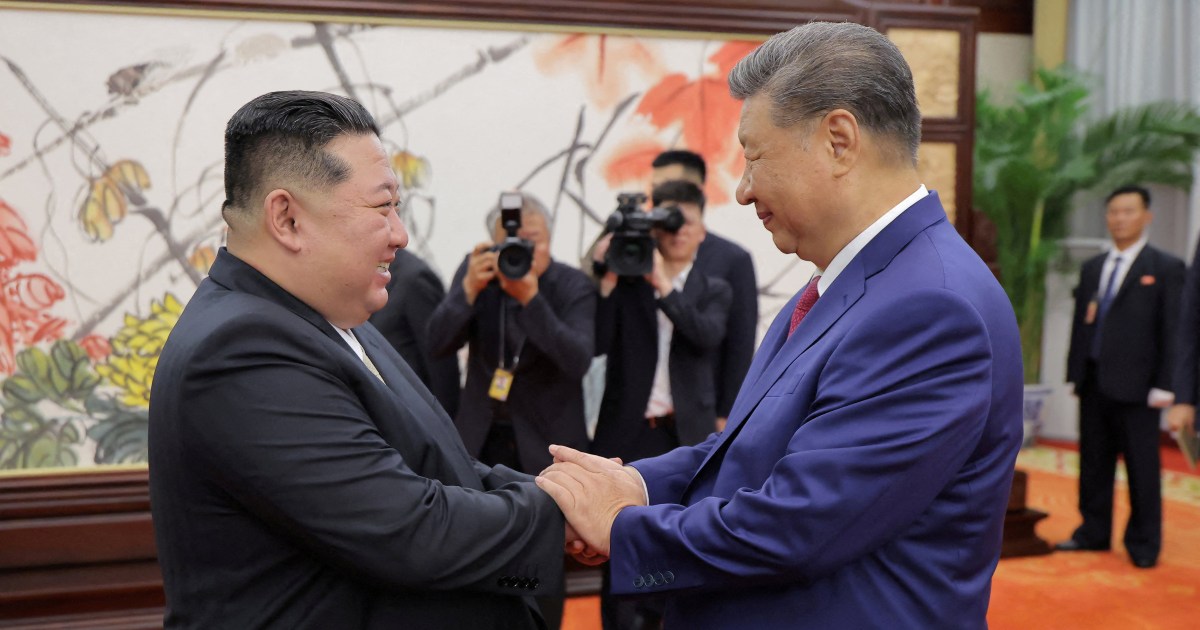
Chinese President Xi Jinping and North Korean leader Kim Jong Un pledged to deepen cooperation Monday during a rare summit in Pyongyang, a visit seen by analysts as Beijing’s effort to reassert influence over a neighbor that has moved closer to Russia.
Xi, making his first visit to North Korea in seven years, was met with a lavish welcome. Kim and his wife, Ri Sol Ju, greeted Xi and his wife, Peng Liyuan, at Pyongyang’s international airport. Crowds lined the streets from the airport to Kim Il Sung Square, where a military honor guard, children with balloons and banners in Korean and Chinese celebrated what the two governments called an “unbreakable” relationship. NBC News, citing official video released by China’s Xinhua news agency, reported that the welcome included a 21-gun salute and a military band.
At their summit, Xi said China was willing to expand cooperation with North Korea in trade, agriculture, construction and technology, according to Chinese state broadcaster CCTV. He also said the two countries should strengthen strategic coordination and safeguard their sovereignty and security interests.
Kim said Xi’s visit “clearly demonstrates how unbreakable” the relationship is, CCTV reported, and called consolidating a new era of friendship with China North Korea’s “unchanging strategic choice.” North Korea’s Rodong Sinmun newspaper described the visit as a demonstration of the “invincibility” of the relationship.
The trip comes as China and North Korea mark 65 years since signing their mutual defense treaty, the only formal defense treaty Beijing has with any country. Their relationship is often described by both sides as having been “forged in blood,” a reference to China’s role in the Korean War.
But ties have been strained in recent years. Beijing has opposed North Korea’s nuclear ambitions in the past, and Pyongyang has increasingly turned toward Moscow. After Russia’s invasion of Ukraine, North Korea expanded military cooperation with Russia and signed a mutual defense pact during President Vladimir Putin’s visit to Pyongyang in 2024. The BBC reported that about 2,300 North Korean soldiers have died fighting for Russia against Ukraine. NBC News reported that Kim is estimated to have sent as many as 14,000 troops to fight alongside Russian forces.
Analysts said China is unlikely to welcome Russia becoming the dominant foreign influence in Pyongyang. “China wants to ensure that its interests vis-a-vis North Korea are protected at a time of rapid convergence between Moscow and Pyongyang,” Ankit Panda, a nuclear policy specialist at the Carnegie Endowment for International Peace, told the BBC.
North Korea still depends heavily on China. Al Jazeera reported, citing the National Committee on North Korea, that China accounts for as much as 95% of North Korea’s trade. China’s exports to North Korea reached about $2.3 billion last year, the BBC reported, while Al Jazeera cited Chinese customs data showing bilateral trade of $2.74 billion. Direct flights and passenger trains between the two countries resumed earlier this year after being halted since the pandemic.
For Beijing, North Korea remains both a strategic buffer and a source of risk. China wants stability on its border and influence in Pyongyang, while avoiding crises triggered by North Korea’s nuclear program. More than 28,000 U.S. troops are stationed in South Korea, Al Jazeera reported.
Xi’s visit also comes as Kim continues to expand North Korea’s nuclear capabilities. NPR reported that Kim recently unveiled a new plant to produce nuclear materials and vowed to build up the country’s nuclear forces “at an exponential rate.” South Korean President Lee Jae Myung said Monday that North Korea is producing enough nuclear material annually for about 10 to 20 bombs and is close to perfecting intercontinental ballistic missile technology.
Leif-Eric Easley, a professor at Ewha Womans University in Seoul, told NPR that Chinese officials have avoided speaking publicly about denuclearization while still maintaining it as a long-term goal. “Kim appears to want Xi to accept North Korea as a nuclear neighbor,” Easley said.
For now, both leaders emphasized unity. But analysts said the summit also reflected hard calculations: Kim wants Chinese support without Chinese control, while Xi wants to keep North Korea close as Pyongyang’s ties with Moscow deepen.





Be First to Comment