Key takeaways:
- SpaceX reported second-quarter revenue of $7.8 billion and a net loss of $541 million, beating revenue expectations while remaining unprofitable.
- Starlink subscribers doubled to 12 million from 6 million a year earlier, helping the connectivity unit generate $4.3 billion in quarterly revenue.
- NBC News reported SpaceX’s xAI-related capital expenditures reached $15.8 billion, making up most of the company’s $18.4 billion in quarterly capital spending.
SpaceX reported stronger-than-expected revenue and a smaller loss in its first quarterly update as a public company, but investors focused on a surge in spending tied to artificial intelligence, sending shares lower after hours Tuesday.
The company posted second-quarter revenue of $7.8 billion, nearly double the year-earlier period and above analyst forecasts. CBS News reported analysts had expected $6.8 billion, citing FactSet. SpaceX recorded a net loss of $541 million, an improvement from a $1 billion loss a year earlier, though it remained unprofitable.
Starlink, SpaceX’s satellite communications business, remained its largest revenue source. The connectivity unit generated $4.3 billion in revenue, above FactSet estimates of $3.8 billion, as Starlink subscribers doubled to 12 million from 6 million a year earlier, CBS News reported. The company’s Starship division reported $962 million in revenue, while its AI unit booked $2.6 billion.
“All three of the main business units reported revenue ahead of the consensus, including Space, Connectivity and AI,” Adam Crisafulli, head of Vital Knowledge, said in a research note cited by CBS News.
But the earnings report also showed heavy capital spending. NPR reported SpaceX spent $18.4 billion in capital investments during the quarter. NBC News reported that capital expenditures tied to the company’s xAI unit, which runs the Grok AI service, reached $15.8 billion, above expectations of $13.09 billion according to Bloomberg News data and about double the previous quarter. That AI spending made up most of SpaceX’s overall capital expenditures, NBC News reported.
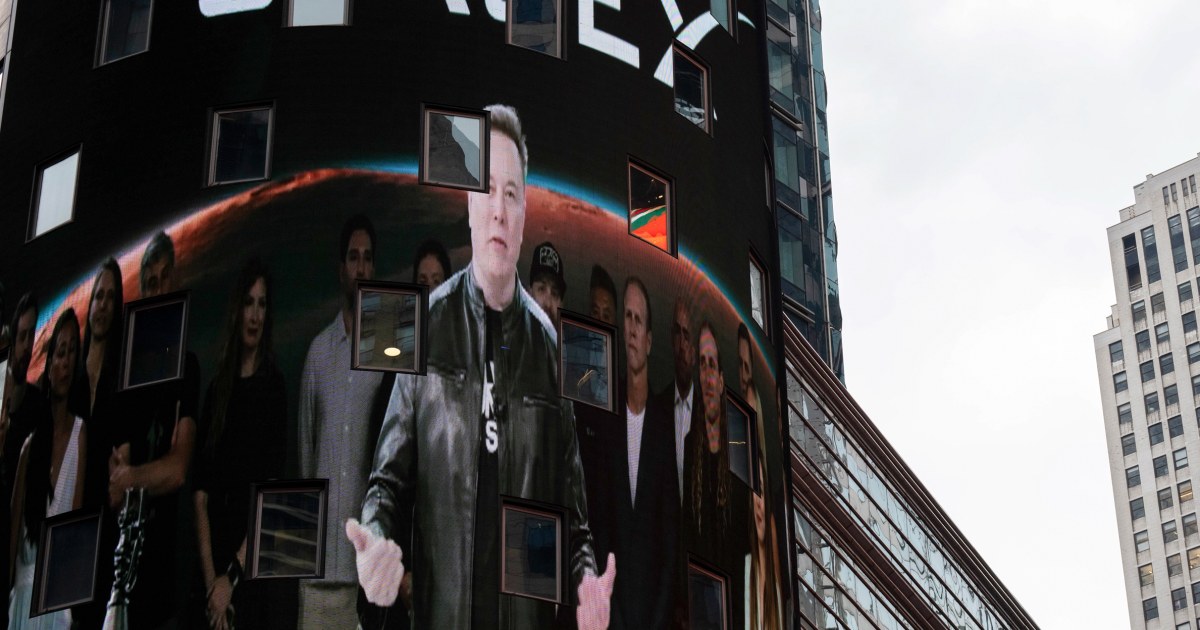
On a call with Wall Street analysts, Elon Musk defended the scale of the company’s ambitions, saying SpaceX is launching more satellites than the rest of the world combined and is moving toward orbiting AI data centers as soon as next year.
“This is not some far future, distant thing,” Musk said, according to NPR. “The SpaceX team is solving some of the hardest engineering problems in the history of humanity and I think the team is succeeding.”
Musk also said Starlink could become a dominant global internet provider. “It’s not out of the question that at some point, Starlink will deliver the majority of the world’s internet,” he said, according to CBS News.
The stock reaction was swift. SpaceX shares rose more than 9% during Tuesday’s regular session before falling after the earnings report. NBC News said the stock dropped about 6.5% after the closing bell, while CBS News reported a 7% decline to $116.40, below the IPO offer price of $135 per share. NPR reported shares closed Tuesday at $125.33 and said they had started trading at $150 after the IPO.
SpaceX raised about $75 billion in an early June initial public offering, NPR reported, making it the largest IPO on record. Shares later reached an intraday high of $225.64 in mid-June before sliding sharply. More than $1 trillion has been erased from SpaceX’s market value since that peak, though NBC News reported the company still has a valuation of more than $1 trillion.
Selling pressure could increase when a lockup period expires Thursday, NPR reported, allowing employees and other insiders to sell shares and more than doubling the supply of publicly tradable stock.
Analysts cited by NPR said investors are trying to judge a company with fast-growing revenue, large losses and major spending plans. Kathleen Curlee, senior research analyst at Georgetown University’s Center for Security and Emerging Technology, said SpaceX’s AI efforts are “basically eating up” any profits from Starlink. “We don’t know what the viability of these AI products will be. We don’t know if data centers will be functional in space, or worth it to put them in space,” she said. “It’s just a risky bet.”










Be First to Comment