Key takeaways:
- At least 13 people were killed after a magnitude 7.1 earthquake struck Kumamoto prefecture on Kyushu on Tuesday afternoon.
- Rescuers searched a partially collapsed Aeon shopping mall and a Nippon Paper Industries factory where people remained missing.
- About 36,900 homes were without electricity, 9,500 were without gas and more than 9,000 people were staying in over 500 shelters.
Rescuers in southwestern Japan searched through a collapsed shopping mall, damaged homes and a paper mill Wednesday after a magnitude 7.1 earthquake killed at least 13 people and left others missing in Kumamoto prefecture.
Prime Minister Sanae Takaichi said crews were racing to reach survivors after the quake struck Tuesday afternoon on Kyushu, Japan’s southern main island. “Even now, there are people waiting to be rescued, and this is a race against time,” Takaichi told reporters in Tokyo. “We will marshal all available resources on the ground to save and rescue as many people as possible.”
The earthquake struck at 4:30 p.m. Tuesday at a relatively shallow depth of about 6 miles, according to NBC News, prompting tsunami warnings and evacuations from coastal areas. The warnings were later lifted. The U.S. Geological Survey later revised its estimate of the quake’s magnitude to 6.8, Al Jazeera reported.
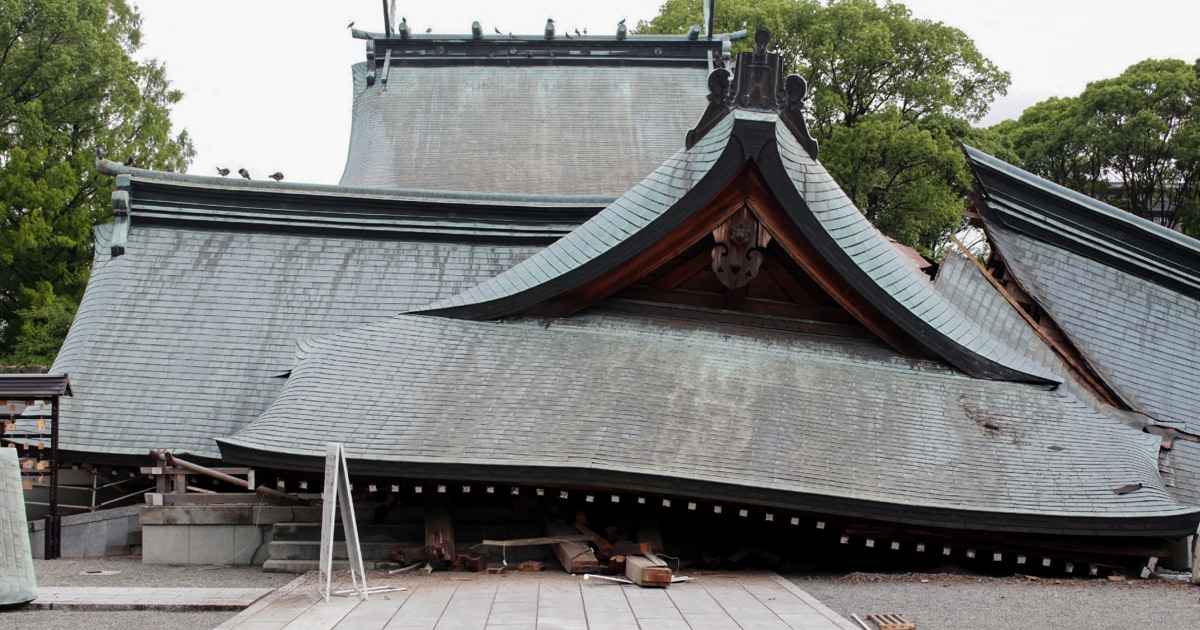
Damage stretched across Kumamoto prefecture. Roads ruptured, buildings collapsed and fires broke out in Kumamoto City, according to Al Jazeera. Bullet train service on the Kyushu Shinkansen remained suspended Wednesday, and some airport operations were still affected. Aso Kumamoto Airport was resuming operations after one runway was closed Tuesday, though officials said some flights could still be canceled.
At an Aeon shopping mall in the Kumamoto area, part of the second floor collapsed and an explosion tore through the complex. Authorities and mall officials were investigating whether a gas leak caused the blast. Two women in their 20s were killed there, NBC News reported, and eight people were pulled alive from the rubble. Mall officials said four people were still missing Wednesday.
At a Nippon Paper Industries factory in Yatsushiro, a chimney collapsed and trapped people beneath debris. Local officials said seven people were feared missing there. Two survivors and two bodies had been removed, according to NPR.
Thousands of soldiers from Japan’s Self-Defense Forces joined emergency workers in rescue operations across the region. Hospitals treated dozens of injured people. Al Jazeera, citing NHK, reported that one hospital received more than 50 patients, while another treated about 40 people, including 10 in serious condition.
Power, gas and communications outages complicated the response. Chief government spokesman Minoru Kihara said about 36,900 homes remained without electricity, 9,500 homes were without gas and communication networks were down in some areas. Kyushu Electric Power said about 35,000 households were still without power, NBC News reported.
More than 9,000 people had left their homes for more than 500 shelters, according to Kihara. Reuters reported that around 260,000 people had been instructed to go to evacuation centers, Al Jazeera said. Officials were adding power sources to shelters so they could run air conditioning as temperatures were forecast to exceed 32 Celsius, or 90 Fahrenheit. Takaichi urged residents and rescue workers to guard against heatstroke.
Historic sites were also damaged. Stone walls at Kumamoto Castle, a major tourist destination still being repaired after a deadly 2016 earthquake, were damaged, Kyodo News reported. “The shaking reminded me of the Kumamoto quake (10 years ago) and I was frightened,” said Hiroki Shimoda, an official at Mifune town hall, who saw roof tiles fall from nearby homes.
The Japan Meteorological Agency warned that strong aftershocks could continue for about a week, with the highest risk in the next two to three days. Officials also warned of increased landslide risks in the hardest-hit areas.
There appeared to be no damage to nuclear reactors in the region. Japan’s nuclear authority told the International Atomic Energy Agency that the Sendai nuclear power plant was not damaged. “The IAEA will continue to monitor the situation,” the U.N. watchdog said on X.



Be First to Comment