Key takeaways:
- A U.S. search and rescue team helped pull a mother and her 9-month-old baby from rubble; both had only minor injuries.
- Officials have confirmed at least 1,430 deaths and nearly 3,500 injuries after Wednesday’s twin earthquakes in Venezuela.
- The U.N.’s Tom Fletcher said 39 international search and rescue teams, nearly 2,000 people and 111 dogs had deployed to assist.
Rescue teams in Venezuela pulled several survivors from collapsed buildings over the weekend, including a mother, her 9-month-old baby and two 11-year-old boys, offering rare moments of relief as the death toll from Wednesday’s twin earthquakes climbed to at least 1,430.
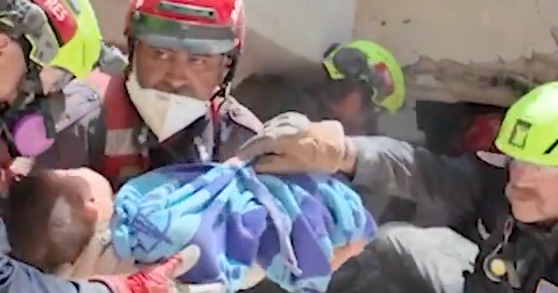
Videos shared by a U.S. search and rescue team and the State Department showed members of Virginia Urban Search and Rescue Task Force 1 helping free a woman from the wreckage of a collapsed building as neighbors cheered. Another video showed the baby being carried out wrapped in blue fabric, crying. The baby’s face was blurred.
“Against impossible odds, hope endures,” the State Department wrote, adding that “every life saved is a victory.” The Virginia team said both the mother and baby had “only minor injuries.” In its own post, the team wrote: “This is our why. The delivery of hope.”
The rescues came as Venezuelans and international teams searched through pancaked buildings, cracked streets and piles of concrete more than four days after two powerful quakes struck within seconds of each other. The BBC reported the earthquakes had magnitudes of 7.2 and 7.5 and struck within 39 seconds. CBS News reported they occurred within a minute, leaving many people without time to evacuate.
Officials have confirmed at least 1,430 deaths and nearly 3,500 injuries, according to NPR and the BBC. Tens of thousands remain missing. CBS News reported that online databases list about 51,000 people as missing, though the Associated Press said that figure likely includes people unable to contact relatives because of poor cellphone service and may include duplicates.
Two 11-year-old boys were rescued separately from rubble within hours of each other, the BBC reported. Video of the first boy, identified as Moises, showed rescuers pulling him from debris with his eyes covered to protect them from sunlight. Colombia’s National Unit for Disaster Risk Management said he had been buried under about 3 meters, or 9.8 feet, of debris, and that rescuers spent six hours carrying out “high-precision work” to reach him. Reuters reported that a rescuer was overheard on a walkie-talkie saying the boy was found near his sister and mother, who had died.
Hours later, Delcy Rodríguez announced another 11-year-old boy had been rescued in Caraballeda, posting video of him being carried down a mound of wreckage on a stretcher. “In these hours, every life is hope for Venezuela,” she wrote.
La Guaira, the coastal region where Caraballeda is located, has been among the hardest-hit areas. Residents described searching for missing relatives with shovels, hand saws and bare hands while waiting for heavy machinery. NPR reported rescue workers calling into the wreckage: “We are the rescue team. If you are alive please make any noise.”
Junior Laya and Jesus Gallardo sat in the shade covered in dust. “I have family members missing … my brother and some cousins,” Gallardo told NPR. “We don’t know anything about them. We’ve been looking for them for four days.”
Thousands of people are sleeping in cars or camping in open areas, including an airport and a golf course in Caraballeda that has become a makeshift hospital, donation center and helicopter landing area. Milagros González told BBC Mundo she fled there with her two young daughters and two elderly relatives after her building became uninhabitable. “But thank God we got out alive,” she said. “The building can’t be lived in. But we’re alive, which is what matters.”
The international response has expanded. A senior U.S. administration official told CBS News that nearly 250 specialized civilian rescuers had been deployed, along with aid planes, mobile hospitals and the USS Fort Lauderdale. Teams from Mexico, Spain, Qatar, the United States, the United Kingdom, Switzerland and El Salvador were also reported in the country. The U.N.’s Tom Fletcher said 39 search and rescue teams had deployed from around the world, totaling nearly 2,000 people, 111 dogs and medical teams using small drones to find survivors in buildings.
Rodríguez said emergency centers were operating in La Guaira and that “no one here is alone.” But frustration has grown in some hard-hit areas where residents say the government response has been too slow and debris removal has not begun.




Be First to Comment