Key takeaways:
- The Pentagon will conduct a six-month review of U.S. forces in Europe tied to how quickly European allies assume more defense responsibility.
- The United States has told allies it will no longer provide certain ships, refueling planes, fighter jets and other assets in a crisis.
- NATO’s Nuclear Planning Group issued its first statement in 19 years, reaffirming nuclear forces as the alliance’s supreme security guarantee.
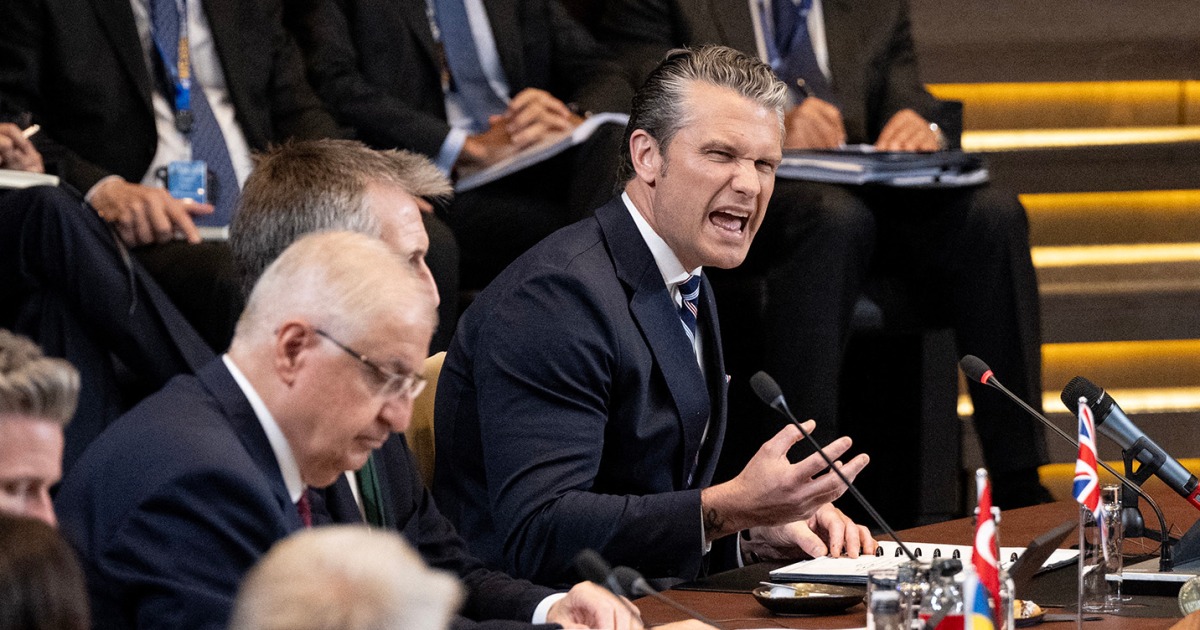
U.S. Defense Secretary Pete Hegseth announced a six-month Pentagon review of American forces in Europe on Thursday, telling NATO allies in Brussels that the outcome will hinge on how quickly Europe assumes greater responsibility for its own defense.
“This will be a real review,” Hegseth told NATO defense ministers. “It will be designed to ensure that NATO is moving fast and irreversibly toward Europe leading, stepping up to take primary responsibility for the defense of Europe.”
Hegseth called for a broad reset of the 32-nation alliance, describing the goal as a “NATO 3.0” built to deter threats with more conventional military strength on the continent. Speaking to reporters, he said the alliance must return to being “a real hard-line military alliance that has real military capabilities capable of deterring right here on the continent and taking the lead for the conventional defense of Europe.”
His remarks came weeks after the United States told allies it would no longer provide certain warships and aircraft in the event one of them comes under attack. NATO’s supreme allied commander, an American, is working on backup plans after Washington signaled on June 3 that it would no longer supply an aircraft carrier and support ships, aerial refueling planes, dozens of fighter jets and other military assets in a crisis. European allies and Canada are working to determine how to fill those gaps.
The Trump administration says it needs to plan for two simultaneous conflicts and wants more resources available if a conflict with China breaks out in the Indo-Pacific region. The United States has by far NATO’s largest armed forces and is scaling back how it might help if an ally invokes Article 5, the collective security guarantee in NATO’s founding treaty. Article 5 states that an attack on one ally is considered an attack on all, but it does not require members to provide military support, though many likely would.
Hegseth also criticized European allies for denying U.S. forces access to bases in Europe for attacks on Iran, calling it “shameful.” He said those countries “put America’s sons and daughters, our sons and daughters, at risk by denying them the predictable access, basing and overflight that never should have been in question at all.”
At the meeting, Hegseth also criticized migration and gender equality policies in Europe, saying, “Instead of tanks and fighters and air defenses, the focus has been on gender equity and climate change and defense austerity. Europe’s borders flew wide open, welfare states expanded, defense budgets cratered. Along with Europe’s belief in itself and its civilization.”
NATO Secretary-General Mark Rutte said Thursday that European allies and Canada spent $90 billion more on defense last year, a 20% increase over 2024, as they move to increase military spending and expand their armed forces.
Hegseth said the United States plans to invest $1.5 trillion in its own defense in 2027, calling it a message that America is building an “arsenal of freedom.” He said that arsenal “first and foremost protects America and American interests but also backstops the strength of NATO and our allies.”
The United States does not intend to withdraw its nuclear weapons from Europe, which remain central to NATO deterrence. NATO’s Nuclear Planning Group issued its first statement in 19 years after meeting Thursday, saying “the strategic nuclear forces of the Alliance remain the supreme guarantee of Allied security and underpin NATO’s extended deterrence architecture.” Ministers also agreed to continue modernizing NATO’s nuclear capabilities, strengthening nuclear planning and adapting to meet security interests.








Be First to Comment