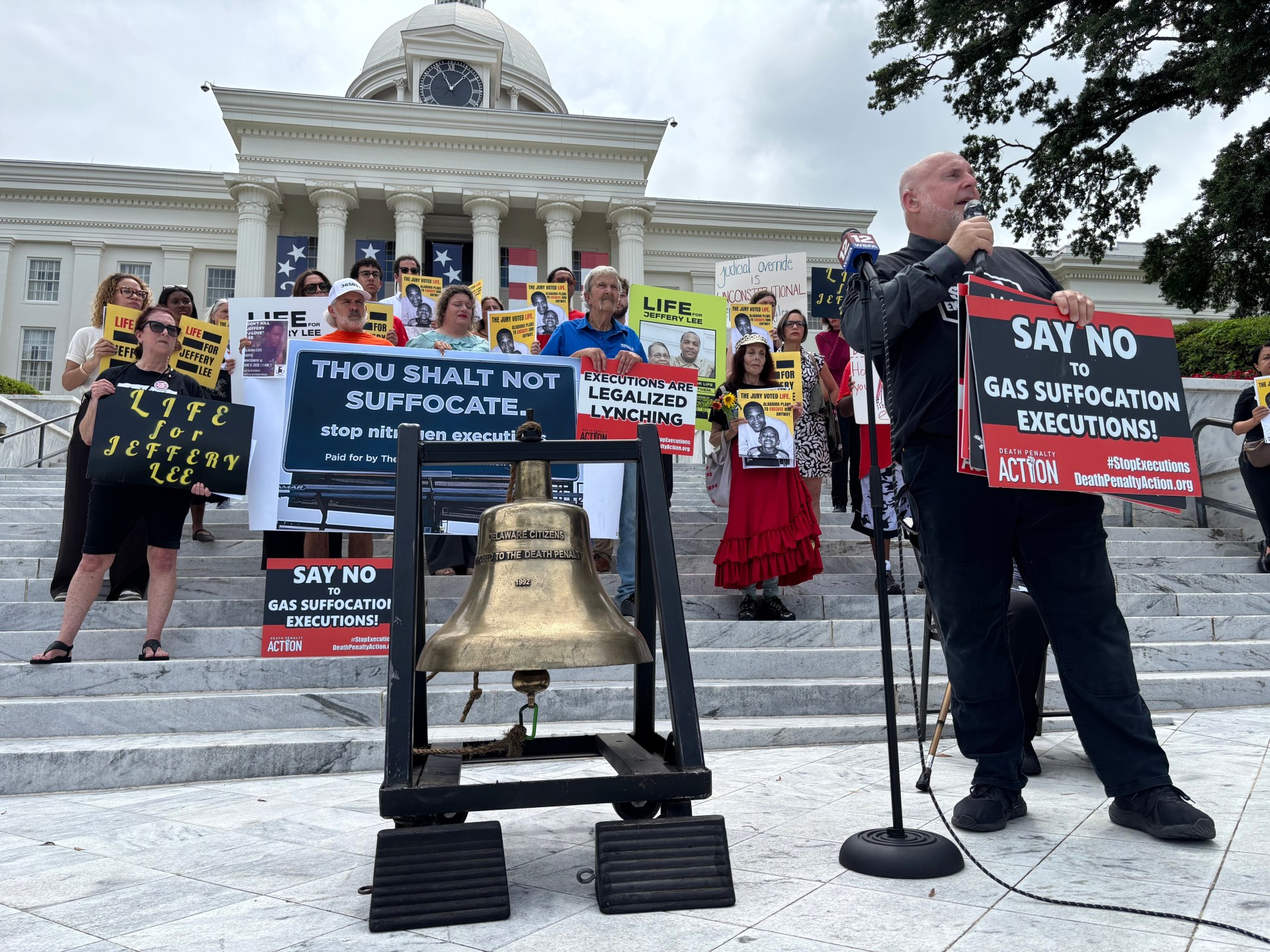
Key takeaways:
- US District Judge Emily C. Marks permanently barred Alabama from executing Jeffery Lee by nitrogen gas days before his scheduled Thursday execution.
- Marks ruled the method violates the Eighth Amendment ban on cruel and unusual punishment after an appeals court reversed her earlier finding that it was constitutional.
- Alabama still has lethal injection and the electric chair as authorized execution methods, and Marks said the state could use Lee’s preferred alternative of a firing squad.
A federal judge has permanently barred Alabama from executing Jeffery Lee with nitrogen gas, ruling that the method violates the Constitution’s ban on cruel and unusual punishment just days before Lee was scheduled to die.
US District Judge Emily C. Marks issued the order Tuesday, permanently enjoining the state from using nitrogen gas in Lee’s execution. Lee had been scheduled to be executed Thursday at an Alabama prison. He is housed at Holman Correctional Facility in Atmore.
The ruling came one day after an appeals court reversed Marks’s earlier decision that Alabama’s nitrogen gas method was constitutional. The case centers on the Eighth Amendment, which prohibits the government from imposing “cruel and unusual punishments.”
A spokesman for Alabama Attorney General Steve Marshall told The Guardian that the state is appealing the decision. Al Jazeera reported that the attorney general’s office said it was reviewing the decision and considering next steps, including an appeal. The case is likely to go before the US Supreme Court, which has previously allowed nitrogen executions to proceed.
A spokeswoman for Lee’s legal team said they did not have an immediate comment.
In her 26-page ruling, Marks wrote that legal challenges are a constant feature of death penalty cases and that no execution method is likely to be free from constitutional litigation.
“Were Alabama to adopt firing squad as a method of execution, that method would likely be challenged as well. Indeed, there is likely no method — no matter how humane — that would be immune to constitutional challenge,” Marks wrote. “But the Constitution does not guarantee a painless death, and human life cannot be purposefully extinguished without some risk of pain. The Court, the condemned, and the State must all confront that sobering reality.”
Marks noted that Alabama still has two other authorized methods of execution: lethal injection and the electric chair. She said Lee is “not entitled to an injunction barring the State from executing him using one of those methods.”
Al Jazeera reported that Marks also ruled the state could switch to Lee’s preferred method, a firing squad. Inmates who challenge execution methods are required to identify an alternative method.
“The State can readily obtain rifles, ammunition, and other materials necessary to carry out a firing squad execution,” Marks wrote, according to Al Jazeera. “Additionally, the State would be able to modify space at Holman to carry out executions by firing squad. The State is also able to source and train volunteers willing to carry out such an execution.”
The order blocks only Alabama’s use of nitrogen gas against Lee. It does not prevent the state from seeking to carry out his execution by another authorized or court-approved method, and the state’s appeal could send the dispute to the nation’s highest court.







Be First to Comment