Key takeaways:
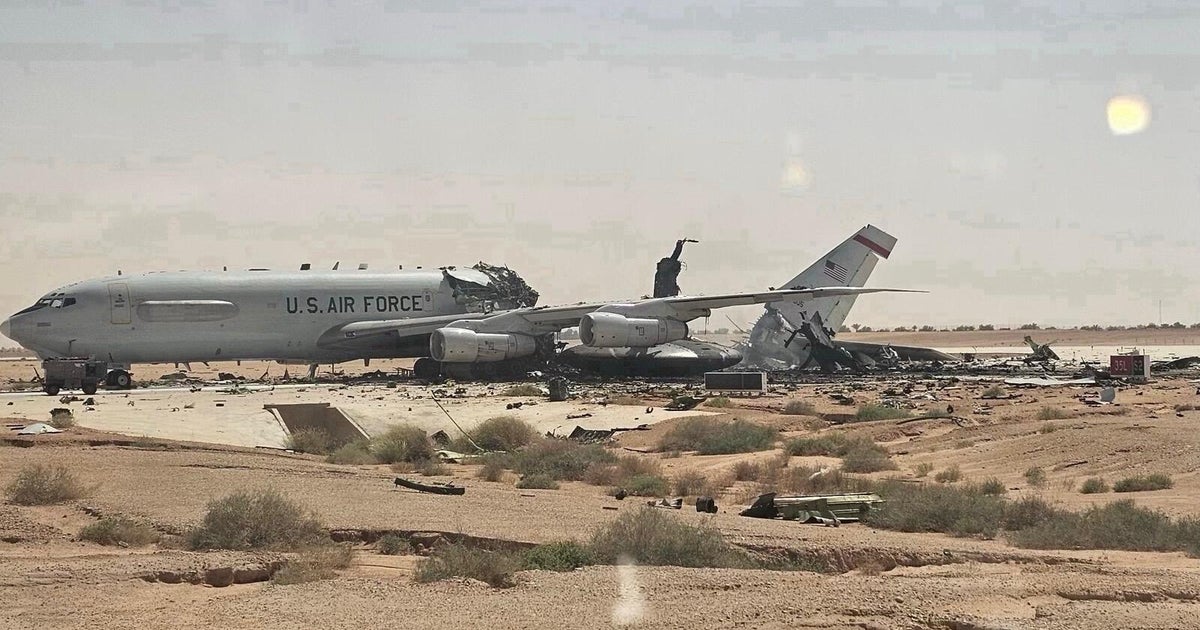
- Photos obtained by CBS show a severed Boeing E-3 Sentry aircraft at Prince Sultan Air Force Base in Saudi Arabia and damaged structures at U.S. sites in Kuwait.
- The Defense Department inspector general reported Iranian strikes damaged or destroyed hundreds of structures at U.S. bases in eight Middle Eastern countries.
- The Pentagon watchdog put equipment losses at up to $3.7 billion, including nearly 60 aircraft, while the CBO estimated battle equipment losses at $1.9 billion.
Newly published photos show extensive damage to U.S. military sites in the Middle East after Iranian missile and drone attacks, including a badly damaged radar aircraft in Saudi Arabia and destroyed structures in Kuwait.
The images were obtained by CBS News from active service members who spoke on condition of anonymity because of military media restrictions. The BBC, CBS’s U.S. partner, reported that it had not independently verified the photos, which are undated and were taken at U.S. bases and sites in Saudi Arabia and Kuwait.
“This is major damage to our bases that hasn’t been communicated to the American public,” one deployed service member told CBS. “We’re standing there with our eyes closed getting punched in the face.”
One photo taken at Prince Sultan Air Force Base in Saudi Arabia shows a Boeing E-3 Sentry aircraft hit in the rear, with its tail severed from a charred fuselage. The aircraft carries a rotating radar used to detect and track potential targets at long range and provide early warning of threats. The BBC reported that its verification team had previously confirmed a similar photo, apparently of the same radar aircraft, in March. At the time, a U.S. official told Reuters that 12 U.S. personnel had been wounded, two seriously, in an Iranian attack on the air base.
Other images from Prince Sultan show hollowed-out buildings and barracks beside intact concrete “T-wall” barriers, which were designed as protection against grenades and mortars but did not prevent damage from aerial attacks, CBS reported.
Photos reportedly taken at Camp Buehring in Kuwait, a major staging area for U.S. Army ground troops, armored vehicles and some aircraft, show crumpled trailers and a large tent-like structure shredded as smoke rose from the site. Another image shows a four-story building damaged at Camp Arifjan in Kuwait. The BBC reported that damage at Camp Arifjan, including to satellite communications hardware, was reported in March, though it was unclear whether the newly published image came from the same attack.
The photos were published shortly after the Defense Department’s inspector general released a mandatory report to Congress on the Iran war. The watchdog said Iranian strikes damaged and destroyed hundreds of buildings and structures at U.S. bases in Kuwait, Bahrain, Qatar, the United Arab Emirates, Saudi Arabia, Iraq, Oman and Jordan. It reported equipment losses of up to $3.7 billion, including nearly 60 aircraft, and said the U.S. had spent $33.4 billion on the war as of June 29.
The report said dozens of U.S. aircraft were destroyed or damaged in the months after the war began, including five refueling aircraft damaged or destroyed on the ground in Saudi Arabia by Iranian munitions.
A separate Congressional Budget Office report said the E-3 aircraft is no longer in production and would have to be replaced with the more modern E-7. The CBO estimated the E-3 alone costs $500 million and said total battle equipment losses, including planes, drones and a terminal high altitude area defense system, amounted to $1.9 billion. The CBO said its review was subject to “uncertainty” because the Defense Department did not respond to requests for information.
The Pentagon did not respond to CBS’s request for comment. The White House referred the BBC to U.S. Central Command, which did not immediately respond.
“These are not ‘squirters’ getting through,” the service member told CBS, referring to language used by Defense Secretary Pete Hegseth after a March 1 attack on Kuwait’s Port of Shuaiba that killed six U.S. troops. “We’re not defending these bases. We’re just watching them get destroyed.”
The conflict began Feb. 28, when the U.S. and Israel launched joint attacks on Iran, according to the BBC. Since then, Iran has repeatedly attacked U.S. bases, allied states in the Gulf and Israel. On Tuesday night, the U.S. House of Representatives voted for a third time to end the war in Iran, approving a measure that would force President Donald Trump to end U.S. military action without congressional approval. The measure faces an uncertain path in the Senate.









Be First to Comment