Key takeaways:
- Bernie Sanders and Steve Bannon are scheduled to speak at the “Pro-Human Assembly” in Washington, D.C., alongside lawmakers, advocates, religious leaders and entertainers.
- Anthropic CEO Dario Amodei called for a slowdown among frontier AI labs, a position CBS News said was echoed by OpenAI CEO Sam Altman and Elon Musk.
- A CBS News poll from May found 65% of Americans think AI will decrease jobs and 67% doubt the federal government will ensure AI is used appropriately.
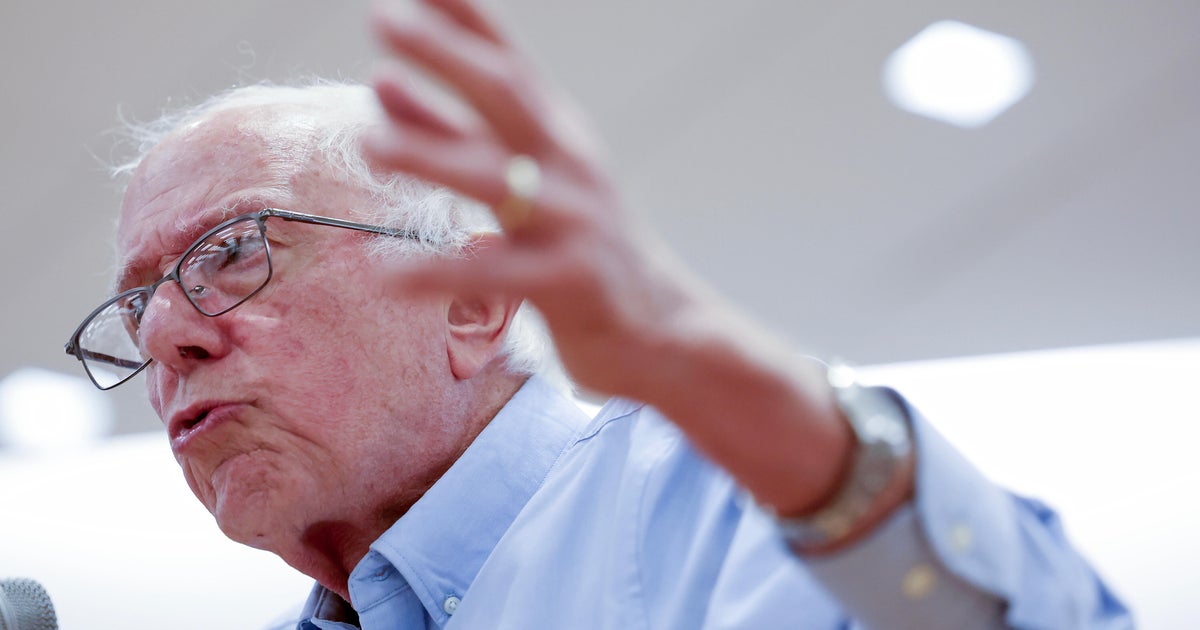
Sen. Bernie Sanders and Steve Bannon, figures from opposite ends of American politics, are sharing a Washington stage to press Congress and technology companies to put people first as artificial intelligence advances.
Sanders, the independent senator from Vermont, and Bannon, a former Trump White House adviser, are scheduled to appear Tuesday at the “Pro-Human Assembly” in Washington, D.C., an all-day gathering focused on curbing AI’s risks and keeping humans in control of the technology. The event brings together a bipartisan group of lawmakers, advocates, religious leaders, child safety campaigners and Hollywood figures, including Ashley Judd and Joseph Gordon-Levitt.
The assembly is organized by the Future of Life Institute, a nonprofit advocacy group that issued 33 principles in March for what it calls a pro-human AI movement. Those principles include keeping humans in charge of AI, preserving agency and liberty, and holding AI companies accountable.
The unusual Sanders-Bannon pairing reflects how AI concerns are reshaping political alliances. Lawmakers from both parties have increasingly warned about the technology’s potential effects on jobs, safety, energy costs, data centers and human autonomy.
Concern has also intensified inside the AI industry. Earlier this month, AI researcher Jacob Coxon publicly resigned from Anthropic, maker of the Claude chatbot, and said artificial intelligence is safe for people to use now but could one day threaten humanity as it becomes more powerful. “If you have a super advanced intelligence, it could — it will be smart enough to kill us,” Coxon told CBS News. He accused Anthropic and OpenAI, the maker of ChatGPT, of “gambling with our lives” by racing to develop more advanced AI models.
On Saturday, Anthropic CEO Dario Amodei called for a slowdown among frontier AI labs, a position echoed by OpenAI CEO Sam Altman and Elon Musk, CBS News reported.
President Donald Trump has pushed back sharply. On Monday, he posted repeatedly on Truth Social, calling fears over rapid AI development a “HOAX” and saying AI needs a strong president. On Sunday, he told reporters, “We’re leading China in AI, we’re the most sophisticated country in the world, and frankly, I want to keep it that way because whoever wins AI, wins.” He added: “And we can put guardrails, we can do this and that. But I think you have a lot of negative forces that are bringing it up that shouldn’t be bringing it up.”
House Speaker Mike Johnson, R-La., has said he supports some AI guardrails but believes companies, rather than Congress, should take the lead on safety. “We cannot put a moratorium on this because China will overlap us, and that’s the challenge,” Johnson told CNN over the weekend. “If Congress just races in and does some sort of emergency session to try to regulate AI, we will lose the race to China, and that is a threat to every single American.” Johnson told reporters Tuesday that he and AI company chiefs will meet with Trump at the White House “within the next week.”
At the assembly, Rep. Chip Roy, R-Texas, said constituent concerns go beyond partisan politics. He cited worries in Texas about data centers competing for water and creating noise, but said the anxiety runs deeper. “They raise questions about their future. They raise questions about what it means for their children, their communities,” Roy said. “So, the question here is, how do you harness the power of human-created technology to put — as we are here to discuss — humans first?”
Roy said AI policy should not treat people as “tools for data collection and technology.” He also questioned whether AI executives calling for caution might be “self-interested” and seeking “a monopoly environment.”
Rep. Greg Casar, D-Texas, framed the issue as one that crosses national and ideological lines. “We may be Americans or Soviets or Chinese, but we are still human,” he said. “No one can end the AI arms race. It’s up to us to end the AI arms race.”
Rep. Lori Trahan, D-Mass., highlighted bipartisan work on the issue, including the FRONTIER Act, which she introduced with Rep. Jay Obernolte, R-Calif., to require independent evaluators of frontier AI models, among other provisions. “Humans are not means to artificial ends,” Trahan said. “We are ends in ourselves.”
The House is expected to vote as early as Tuesday on the Ratepayer Protection Act, a narrower bill aimed at shielding Americans from energy cost spikes tied to data center construction, NPR reported.
A CBS News poll from May found 65% of Americans think AI will decrease jobs, while 67% said the federal government probably or certainly will not ensure AI is used appropriately. Vice President JD Vance acknowledged those concerns Monday, saying, “There are obviously risks to AI; there are some benefits to AI.”








Be First to Comment