Key takeaways:
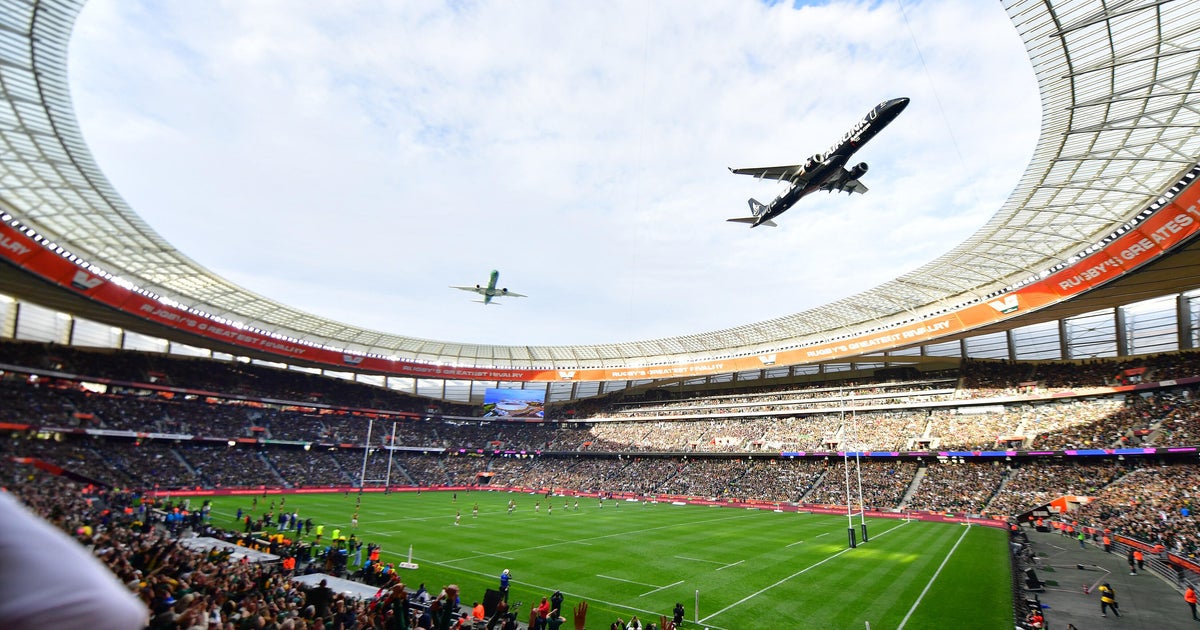
- Flightradar24 said the lead Airlink aircraft passed less than 50 feet, or 15 metres, above the top of Cape Town’s DHL Stadium.
- Airlink said the flyover was planned, rehearsed and conducted with guidance, approval and support from South African aviation authorities.
- More than 56,000 spectators were at the stadium before the South Africa-New Zealand rugby match when the two passenger jets flew overhead.
Two passenger jets swept just above a packed Cape Town rugby stadium before a South Africa-New Zealand match, thrilling many spectators while drawing questions about how low is too low for a civilian airliner over a crowd.
The Airlink aircraft flew one behind the other over DHL Stadium on Saturday as smoke flares rose before the rugby match between the fierce rivals. More than 56,000 people were inside the stadium, CBS News reported.
Video of the flyover spread widely after the planes appeared to pass only a short distance above the stadium roof. Flight-tracking website Flightradar24 said its analysis showed “the lead aircraft passed less than 50 feet (15 metres) above the top of the stadium,” the BBC reported. CBS News cited preliminary flight data estimating the planes cleared the stadium by only about 50 feet.
For Marcel Opperman, a spectator who recorded the aircraft overhead, the moment was memorable rather than frightening.
“I didn’t feel any danger from my side. I was just like, ‘Wow, this is insane,’” Opperman told CBS News. “It was amazing. Probably one of my top-five moments in my life.”
Others questioned the risk of flying two passenger jets at such low altitude above a full stadium. Airline captain Laura Einsetler told CBS News the aircraft were “really low and really tight for an airliner,” noting that full-size passenger jets are different from fighter jets often used in flyovers.
“It was just too low for this situation with this type of jet at those speeds and angles,” Einsetler said.
Airlink defended the display, saying it had been carefully prepared and conducted with official support. In a statement to CBS News, the airline said: “The flight demanded careful planning and rehearsal, as it required navigating at low altitude…. The South African Civil Aviation Authority (SACAA) and Air Traffic Navigation Services provided valuable guidance, approval and support to ensure a safe flyby.”
The airline said the pilots were senior and experienced and remained within the altitude and speed limits approved for the flypast. In a separate statement reproduced on a South African government news site and cited by the BBC, Airlink said the two aircraft were flown by highly experienced crews, “with each comprised of three senior captains operating in the roles of commander, co-pilot and safety/technical officer.”
It added that the flights were performed within the “approved and rehearsed safety altitude and speed limits for the flypast.” On social media, Airlink posted footage with the message: “Planning. Precision. Performance.”
Reaction in South Africa was divided. Some critics called the manoeuvre reckless, while others praised the skill involved. Sports Minister Gayton McKenzie wrote on X: “It’s a well known fact that we have the best pilots in the world, that was spectacular.”
Low-altitude flybys have been part of the build-up to some major rugby matches in South Africa for decades. The best-known example came in 1995, when a South African Airways 747 flew over a Johannesburg stadium before the Rugby World Cup final, where South Africa defeated New Zealand.
That match, later depicted in the film “Invictus,” came a year after South Africa’s first democratic elections. Nelson Mandela, the country’s first Black president, wore the jersey of the national side, which had been closely associated with the apartheid government and had previously excluded players who were not white.









Be First to Comment