Key takeaways:
- Officials said 384 tourists were missing after flooding along the Bhote Koshi River, including 291 foreign nationals and at least three Americans.
- Reuters and The Kathmandu Post cited police putting the death toll at 22, while NPR reported at least eight deaths.
- Nepal’s Electricity Authority said six major hydropower and transmission facilities were damaged, and rescue efforts were hampered by mountainous terrain.
A sudden wall of floodwater tore through Himalayan valleys in northern Nepal on Wednesday, killing at least eight people and leaving hundreds of tourists missing as rescue teams struggled to reach damaged villages near the country’s border areas.
Authorities gave differing death tolls as the scale of the disaster remained unclear. Reuters and The Kathmandu Post cited a police statement putting the toll at 22, while NPR reported that at least eight people had been killed. There was no immediate word on the nationalities of the dead.
Nepalese officials said 384 tourists were reported missing, including 291 foreign nationals. Nepal’s Tourism Board, citing tour companies, said at least three U.S. nationals were among the missing foreigners. The list also included 12 British citizens, 142 Indians, 17 Malaysians, four South Africans, eight South Koreans, one Australian and one Dutch national. Authorities said the nationalities of 111 others had not yet been determined.
The flooding began around 9 a.m. local time when the Bhote Koshi River surged in Rasuwa district, north of Kathmandu, and quickly affected neighboring Nuwakot and Dhading districts. Officials also warned residents in several districts to stay away from the banks of the Bhotekoshi, Trishuli and Narayani rivers.
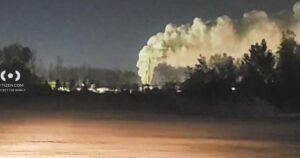
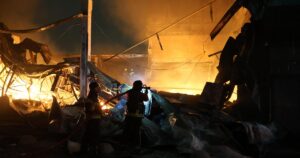
Videos broadcast by regional news outlets and posted on social media showed violent torrents ripping through mountain valleys, tearing down bridges and dams and sweeping away buildings. Officials said villages, roads, bridges, power plants, trucks and vans were damaged or buried under mud. The Nepal Electricity Authority said six major hydropower and transmission facilities were damaged.
“We do not exactly know the extent of damage, but the flood is big, and it could have damaged many settlements,” Nepal Police spokesman Abi Narayan Kafle told AFP. “We have alerted people who are staying near the riverside to relocate… and deployed all our resources.”
Officials and experts offered different accounts of what triggered the flood. Nepal’s Foreign Minister Shishir Khanal said the flash flood was caused by an earthquake that triggered a large landslide, blocking the Bhote Koshi River. NPR reported that climate experts at the Kathmandu-based International Centre for Integrated Mountain Development said an avalanche of ice and rock from a glacier likely blocked the river and released a sudden surge downstream.
“The Lhende Khola has flooded twice in fourteen months, this time triggered by an ice rock avalanche from a glacier on the Nepal side that blocked the river and released a sudden surge downstream,” said Saswata Sanyal, a disaster risk reduction specialist at the research group. “In a warming Himalaya, early warning is the first line of adaptation.”
Nepali President Ramachandra Paudel said he was “extremely saddened” by the “loss of lives and property caused by the sudden flood” and called on the government, political parties, agencies and the public to intensify rescue and relief efforts.
District administrator Narendra Pariyar urged people living along the Bhote Koshi River to move to higher ground. “There could be heavy casualties or loss of property,” he told Reuters.
Nepal’s steep terrain, deep valleys and narrow gorges complicated rescue efforts. Reuters reported that helicopters could not land in the affected areas of Syapru Besi and Timure. Government spokesperson Sasmit Pokharel said Nepal had asked both India and China to help with rescue operations.
“Work has started to take necessary steps in coordination with the medical team, scouts, and Red Cross,” Prime Minister Balen Shah wrote on social media.
Tourism officials said many of the missing were traveling with tour and travel companies. NPR reported that most were likely tourists from India and the Indian diaspora on pilgrimage to Mount Kailash in Tibet. South Korean officials said some of their citizens working on a hydropower plant in Nepal were among those missing, while Malaysia’s Foreign Ministry said its embassy in Kathmandu had received reports that travel agencies had lost contact with 11 Malaysians believed to be in hard-hit Rasuwa district.
India’s government ordered authorities in states along the Nepal border to remain on high alert.








Be First to Comment