Key takeaways:
- The Senate confirmed Dr. Erica Schwartz as CDC director by a 51-44 vote on Wednesday.
- Schwartz succeeds a series of acting leaders after Susan Monarez was fired in August 2025 after 29 days as director.
- Schwartz will oversee CDC responses to measles, cyclosporiasis and other outbreaks while facing questions over vaccine policy and scientific independence.
The Senate confirmed Dr. Erica Schwartz on Wednesday as director of the Centers for Disease Control and Prevention, installing the agency’s first permanent leader in nearly a year after months of turmoil over vaccine policy and leadership turnover.
Schwartz was confirmed 51-44. She takes over an agency that has been led by a series of acting directors since August 2025, when Health and Human Services Secretary Robert F. Kennedy Jr. fired Susan Monarez after 29 days in the role. National Institutes of Health Director Jay Bhattacharya had also been serving as acting CDC director since February.
Schwartz, a retired Navy rear admiral, served as deputy surgeon general during President Donald Trump’s first term and previously worked as a Navy physician and chief medical officer in the Coast Guard. CBS News reported that she will be the first Black woman to run the CDC. She holds a bachelor’s degree in biomedical engineering and an M.D. from Brown University, as well as a law degree from the University of Maryland. According to the Department of Homeland Security, she has experience responding to pandemics, including Ebola and H1N1 outbreaks.
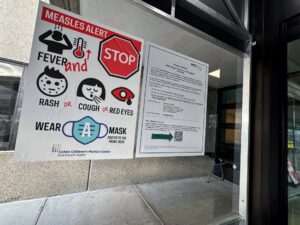
As CDC director, Schwartz will oversee the nation’s public health response, including approving vaccine recommendations and helping contain disease outbreaks. She inherits a measles crisis, with the United States recording its highest number of cases in 35 years, and a growing cyclosporiasis outbreak, a parasitic infection linked to shredded iceberg lettuce. NPR reported that the CDC is also responding to an Ebola outbreak in the Democratic Republic of the Congo and Uganda.
Her confirmation follows sharp questioning from lawmakers over whether she would challenge Kennedy, who has a history of anti-vaccine activism, if public health guidance conflicted with his views. At a July confirmation hearing, Sen. Bill Cassidy, R-La., a doctor who chairs the Senate Health, Education, Labor and Pensions Committee, pressed Schwartz on vaccines and scientific independence.
“We need a CDC director that will actually stand up to crazy, stupid things being said that undermine faith in immunization,” Cassidy said during her appearance.
Cassidy later supported her nomination after another conversation with Schwartz and discussions with people who had worked with her. “After speaking with Dr. Schwartz again after the hearing, reviewing the transcript and speaking to those who served with her and know her well, I’m confident that she knows what she is doing and will stand against those who do not,” he said on July 23.
Sen. Bernie Sanders, the Vermont independent and ranking member on the health committee, opposed her nomination. NPR reported that Sanders said he was impressed by Schwartz’s credentials and service but did not believe she was prepared to stand up to Kennedy’s false statements on vaccines and other health topics. “I think the American people are owed better than what President Trump has nominated,” Sanders said on July 30.
Schwartz said during her hearing that vaccines are safe and effective, but NBC News reported that she said she was unaware of some of Kennedy’s vaccine policy changes and avoided saying whether she supported them. She also said Kennedy would never ask her to commit in advance to approve particular vaccine recommendations.
“As CDC director, my sacred responsibility is to provide the American people with public health guidance that is clear, honest and evidence-based,” Schwartz said. “I will never betray the science.”
The National Public Health Coalition, an advocacy group of former CDC employees critical of Kennedy, said last month it would not support Schwartz’s nomination. “The public needed to hear clear commitments about how she would protect CDC guidance from political pressure. Too often, her stated commitments were incomplete, vague, or missing,” the group said.
Emily Hilliard, an HHS spokesperson, told NBC News last month that Schwartz’s “record speaks for itself,” adding, “Claiming that Dr. Schwartz was evasive because she declined to speculate on policy decisions outside the scope of her nomination is simply political theater.”





Be First to Comment