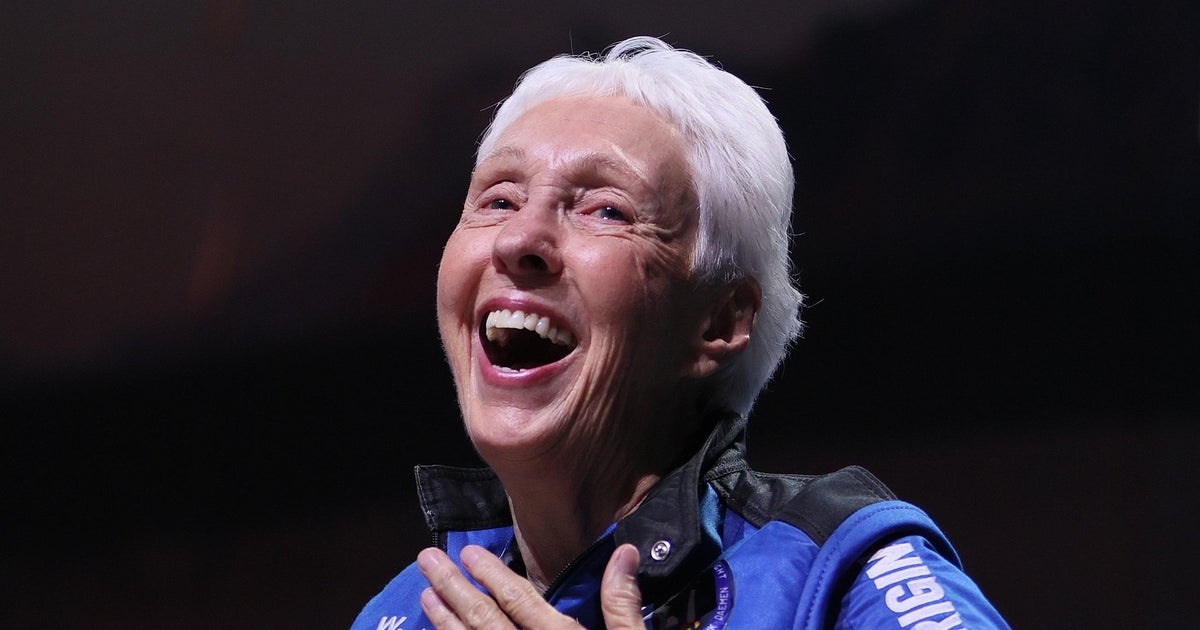
Key takeaways:
- Wally Funk died Wednesday evening in Grapevine, Texas, at age 87, according to the city and her close friend Duff O’Dell.
- Funk was part of the Mercury 13 program in 1961 but was not allowed to become a NASA astronaut because women were excluded at the time.
- In 2021, at age 82, Funk flew on Blue Origin’s New Shepard NS-16 mission, becoming the oldest woman ever to travel to space.
Wally Funk, the trailblazing pilot who was barred from becoming a NASA astronaut in the 1960s but reached space six decades later as the oldest woman ever to do so, has died. She was 87.
The city of Grapevine, Texas, where Funk lived, said she died peacefully Wednesday evening, surrounded by loved ones. Grapevine City Councilwoman Duff O’Dell, a close friend who described herself to The Associated Press as Funk’s caregiver, said Funk died at her apartment in an assisted living facility after recent falls and a leg infection. “It took its toll,” O’Dell said.
Funk, born Feb. 1, 1939, spent more than seven decades in aviation and became one of the best-known women in the history of flight. Grapevine described her as a “beloved” resident whose career inspired generations by breaking barriers in aviation and space exploration.
“Wally Funk’s unwavering determination proves that dreams have no expiration date,” O’Dell said in a statement. “Her courage, resilience, and groundbreaking achievements continue to inspire young people – especially girls – to pursue careers in science, aviation, and space exploration. Grapevine is honored to call Wally Funk one of our own.”
Funk earned her flying license at Stephens College in Missouri and later studied education at Oklahoma State University, drawn in part by its aviation team, the Flying Aggies. “As a Flying Aggie, I could do all the manoeuvres as well as the boys, if not better,” she told The Guardian in 2019.
In 1961, Funk joined the privately funded Women in Space program, whose 13 pilots became known as the Mercury 13. The women underwent the same demanding physical and psychological testing used for NASA’s Mercury 7 astronauts. Funk, the youngest woman to graduate from the program, ranked among its top performers and outscored many male counterparts on several tests. In one test, she spent 10 hours and 35 minutes in a sensory deprivation tank, outperforming astronaut John Glenn, The Guardian reported.
But women were not allowed to become NASA astronauts at the time, and the program was canceled after doubts were raised about whether women should participate. Glenn said including women in the space program “may be undesirable.” Funk later said she contacted NASA four times seeking to become an astronaut, but was rejected because she lacked an engineering degree. NASA did not admit female astronauts until 1978, when Funk was 39.
“I got a hold of Nasa four times, and said ‘I want to become an astronaut’, but nobody would take me,” Funk said, according to CNN. “They say, ‘Wally, you’re a girl, you can’t do that.’ I said, ‘Guess what? [It] doesn’t matter what you are. You can still do it if you want to do it.’”
Funk built a wide-ranging aviation career anyway. Grapevine said she became the first female flight instructor at Fort Sill in Oklahoma, the first female inspector for the Federal Aviation Administration and the first female air safety investigator for the National Transportation Safety Board. She trained more than 3,000 pilots. CBS News reported she logged more than 30,000 flight hours, while The Guardian reported more than 19,600.
Her dream of reaching space came true in July 2021, when she flew aboard Blue Origin’s New Shepard NS-16 mission with Jeff Bezos and other crew members. At 82, Funk became the oldest woman to travel to space and the only Mercury 13 member to do so. She was the oldest person to launch into space at the time, a mark later surpassed by William Shatner and Ed Dwight.
Funk recalled looking out the window as the rocket climbed and saying, “Wow! There goes the ground!” She described her minutes of weightlessness as “the greatest feeling” and said after the flight, “I want to go again, fast. I loved every minute of it. I just wish it had been longer.”
NASA Administrator Jared Isaacman wrote on X that Funk “never stopped believing that one day she would reach space.” Blue Origin called her “a pioneer in every sense of the word” and said, “We were humbled to be part of her journey. Her story will continue to inspire generations of future explorers.”










Be First to Comment