Key takeaways:
- Pope Leo visited Lampedusa, prayed at a migrant cemetery and celebrated Mass for residents and newly arrived migrants.
- The International Organization for Migration has recorded more than 35,000 missing migrants in the Mediterranean since 2014.
- Leo urged European leaders to combine immediate migration relief with long-term plans to receive, protect, support and integrate migrants.
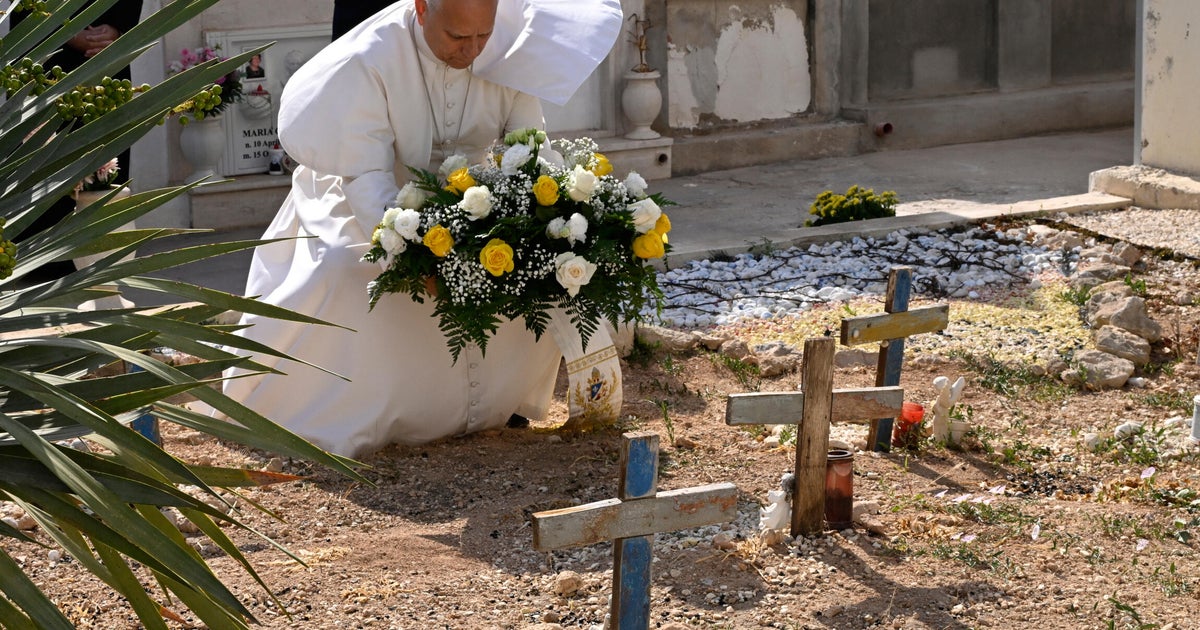
Pope Leo marked the United States’ 250th anniversary celebrations by traveling to Lampedusa, the small Italian island at the center of Europe’s migration debate, where he prayed for migrants who died trying to reach Europe and urged leaders to defend human dignity.
The U.S.-born pope arrived on the island Saturday and visited a migrant cemetery, laying a wreath of yellow and white flowers on graves marked with simple crosses made from splintered wood from shipwrecked boats. He later met migrants at the port, walked alone onto the rocky jetty as wind whipped his cassock and blew off his white skullcap, and blessed a plaque dedicating the dock to Pope Francis, who visited Lampedusa in 2013.
“This is a place where gestures speak louder than words,” Leo said. “But for gestures to be human, they need a heart.”
Lampedusa, a treeless strip of rock 5.6 miles long, lies closer to Africa than the Italian mainland and has long been a major entry point into Europe for people crossing the Mediterranean from Libya or Tunisia. The Guardian reported that the island has roughly 6,000 residents and that more than 182,000 people have passed through its reception center in the past three years, citing Vatican News and Italian Red Cross data.
At Mass, Leo thanked Lampedusa residents for what he called the “miracle of compassion” they have shown in welcoming migrants. Speaking from “this far-flung corner of Europe on the Mediterranean Sea,” he called on European leaders to address migration “in a comprehensive manner,” combining immediate relief with long-term plans to receive, protect, support and integrate migrants while improving conditions in their home countries.
“Indeed, before any intellectual consideration or ideological conviction, the encounter with those who lie before us, stripped of everything, calls us to be close to them,” he said.
He added: “Here you have seen not just one, but thousands of human beings fallen into the hands of robbers who have taken everything from them, beat them brutally and walked away, leaving them half-dead.” Others, he said, died at sea, “yet we feel their presence, which challenges us no less than that of those who have landed in need of attention and aid.”
The International Organization for Migration has recorded more than 35,000 missing migrants in the Mediterranean since 2014, though the actual toll is believed to be higher because some shipwrecks are never recorded. CBS News reported that Italy’s Interior Ministry counted 14,464 arrivals as of Friday, down from 30,598 in the same period last year and 26,202 in 2024. The Guardian reported that between January and early April, the IOM recorded nearly 1,000 people dead or missing in the Mediterranean.
Salvatore Sortino, the IOM’s head of mission for Italy and Malta, said the decline in arrivals has not erased the danger. “That speaks about the vulnerability that remains,” he said. “So the visit of the pope here, where all this happens, I think is a very important reminder of that element.”
Tareke Brhane, an Eritrean migrant and president of the Oct. 3 Committee, a nonprofit founded by relatives of victims of a 2013 Lampedusa shipwreck that killed 368 people, said Leo’s visit sent a “strong message” of solidarity. “It is a strong sign for our battle with Italy and with Europe in order to register the deaths, because as of today we still do not have a registry,” he told The Associated Press.
Leo also addressed Americans in a Fourth of July message and in remarks delivered from the Vatican to the National Constitution Center in Philadelphia as he received its Liberty Medal. He said America had become a “byword for freedom” because of its history of welcoming migrants and urged the country to remain faithful to its founding ideals.
“To receive them with compassion and generosity is not only an act of charity, but also a recognition of the dignity that belongs to every human person,” he wrote.
Later Saturday, Leo visited the residence of the U.S. ambassador to the Holy See, Brian Burch. The U.S. Embassy said Burch gave him a commemorative baseball, an apple pie and a U.S. World Cup jersey, and said the two discussed “American efforts to pursue peace, religious freedom and the need for moral clarity and courage around the world.”

Be First to Comment