Key takeaways:
- Khamenei’s body will lie in state at Tehran’s Grand Mosalla before burial next Thursday in Mashhad.
- Officials have said the funeral could draw up to 20 million mourners from across Iran.
- Khamenei’s son and successor, Mojtaba, has not appeared publicly since becoming supreme leader in March.
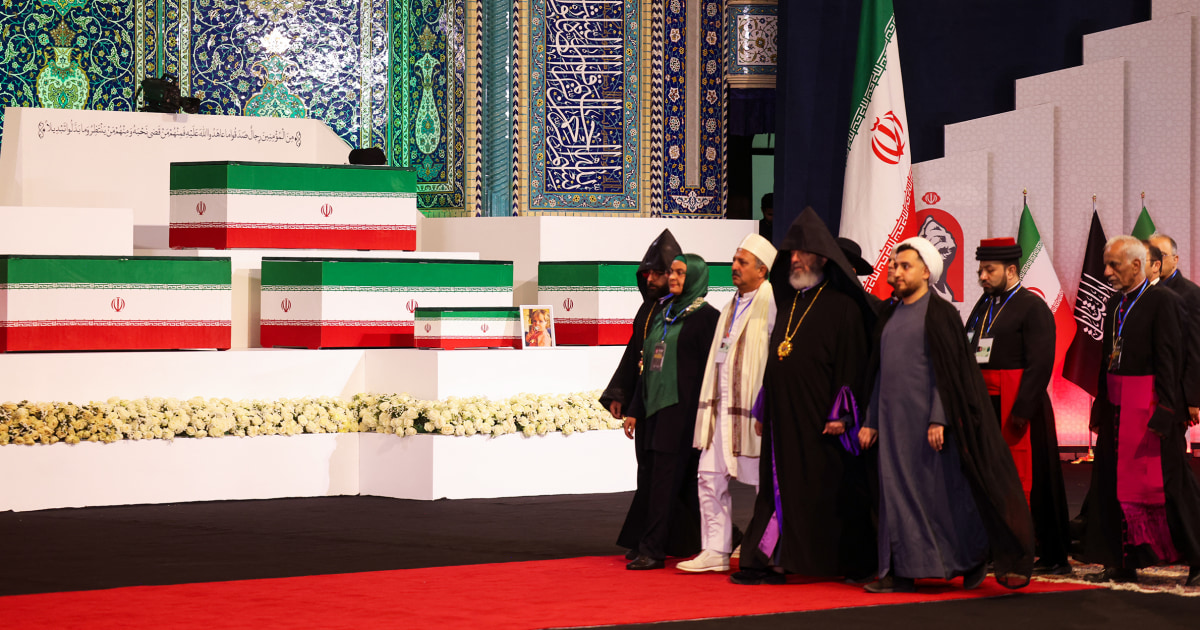
Iran has begun several days of public mourning for former Supreme Leader Ayatollah Ali Khamenei, staging a funeral that officials say could draw millions and serve as a major political display more than four months after he was killed in U.S. and Israeli strikes.
Khamenei, 86, was killed on Feb. 28 alongside members of his family in the opening salvo of attacks on Tehran, NBC News reported. His body is set to lie in state at Tehran’s Grand Mosalla, a large mosque and prayer complex in the capital, before his burial next Thursday in his hometown of Mashhad, home to Iran’s most prominent Shiite shrine.
It is only the second time Iran has buried a supreme leader. The 1989 funeral for Ayatollah Ruhollah Khomeini, founder of the Islamic Republic, drew millions to Tehran. This time, Tehran Mayor Alireza Zakani has said as many as 20 million people could attend, according to Iranian state-linked media cited by NBC News. The BBC, citing AFP, also reported that officials have said the funeral could draw up to 20 million mourners from across Iran.
Khamenei’s body will lie in the Grand Mosalla for three days, alongside the remains of family members also killed in the February strikes, the BBC reported. NBC News reported that viewings and prayers are planned for Saturday and Sunday, followed by a funeral procession through Tehran on Monday. The BBC said an official funeral ceremony is scheduled for Saturday.
Authorities have ordered public and private offices in Tehran to close from Saturday through Monday, while traffic restrictions will shut down most of the city center to private vehicles, AFP reported, according to the BBC. Tehran’s airspace will be partially closed from Friday and fully closed on Monday.
Funeral events are also planned beyond the capital. NBC News reported that ceremonies will be held in Qom, Iran’s center of religious scholarship, and in Iraq, home to two of Shiite Islam’s most important shrines. The BBC reported that Khamenei’s body will be taken to the Iraqi holy cities of Najaf and Karbala before burial in Mashhad. Representatives from multiple countries are expected to attend, including Pakistan’s Prime Minister Shehbaz Sharif, the BBC reported.
The funeral comes as Iran and the United States observe a fragile ceasefire after signing a preliminary deal in June to halt their conflict, according to the BBC. NBC News reported that the funeral date was confirmed only last month, days before the U.S. and Iran signed a memorandum of understanding intended to mark the official end of hostilities.
Several senior political and military officials were also killed in the attacks that battered Iran for more than a month in the war’s initial phase, NBC News reported. Khamenei’s son, Mojtaba, 56, was wounded in the same strike that killed his father and was appointed supreme leader in March, but he has not been seen in public or issued an audio statement since. The Iranian government has not confirmed whether he will attend the funeral events.
Analysts told NBC News the ceremonies are expected to carry heavy political significance. Sina Azodi, director of the Middle East studies program at George Washington University, said Iranian authorities would seek to present the funeral as “a signal of the Islamic Republic’s strength, ability to resist outside pressure, resilience.”
“They will try their best to show the loyalty of the quote-unquote people to the Islamic Republic,” Azodi said. “From whatever means possible, they will try to bring as many people as they can.”
Security is expected to be tight. NBC News noted that Khomeini’s 1989 procession turned chaotic, with his body jostled out of the coffin; at least eight people died and many were injured in a stampede. Funeral gatherings for prominent Iranian figures have also been targeted before, including a 2024 Islamic State attack on a gathering marking the anniversary of Gen. Qassem Soleimani’s death that killed at least 84 people in Kerman.
Ali Vaez, Iran project director for the International Crisis Group, told NBC News that Iran faces uncertainty after the ceremonies. “After war, leadership transition and the lingering trauma of a brutally suppressed uprising, the Islamic Republic enters a period of profound uncertainty,” he said.


Be First to Comment