Key takeaways:
- The U.S. and Iran are expected to sign a memorandum of understanding Friday in Switzerland to formally lift restrictions on Strait of Hormuz traffic.
- BBC Verify reported that only seven vessels appeared to have crossed the strait since Trump announced the deal, while as many as 580 ships appeared to be waiting in the Gulf.
- Shipping companies including Mitsui OSK Lines, Hapag-Lloyd and Maersk said they are not yet resuming normal operations through the waterway.
President Donald Trump says the Strait of Hormuz is open and safe after a U.S.-Iran agreement, but shipping companies, insurers and maritime analysts say traffic through the critical oil route is unlikely to return to normal soon.
The U.S. and Iran are expected to sign a memorandum of understanding Friday in Switzerland that would formally lift restrictions both countries imposed on traffic through the strait. Before the U.S. and Israel launched strikes on Iran on Feb. 28, about one-fifth of the world’s oil and gas supplies typically moved through the waterway.
Iran effectively closed the strait after the strikes, attacking or threatening commercial vessels and bringing traffic to a near standstill. The disruption drove global energy prices sharply higher. Trump announced the agreement Sunday on Truth Social, saying he had authorized the “toll free opening of the Strait of Hormuz” and the “immediate removal of the United States Naval blockade.”
“Ships of the World, start your engines,” Trump wrote. “Let the oil flow!”
A day later, Trump said tankers were “starting to move, many loaded up with Oil, out of the Strait of Hormuz,” and described a southern route as “totally safe, secure, and pristine.” But the Joint Maritime Information Center, a multinational naval operation that includes the U.S. military, warned Monday that the U.S. blockade of Iran’s ports and vessels would remain in effect until Friday, “pending execution” of the ceasefire. “The maritime security threat level in the Strait of Hormuz remains SEVERE due to blockade operations,” it said.
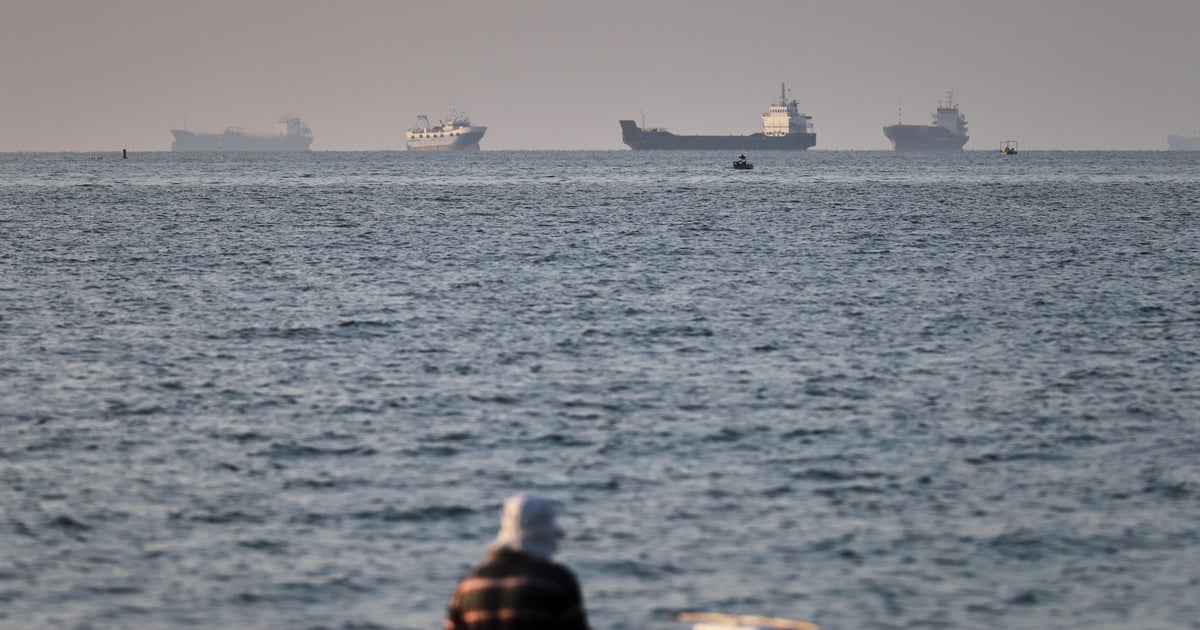
BBC Verify, citing MarineTraffic ship-tracking data, reported that just seven vessels appeared to have passed through the strait since the deal was announced, while as many as 580 ships appeared to be waiting in the Gulf. The data showed more than 250 tankers and more than 330 cargo ships inside the Gulf, with about 75% of the tankers stationary. CBS News reported that before the war, about 135 ships a day crossed the strait.
Shipping companies say they need firm evidence that the route is safe. “Due to lack of details and a history of overly optimistic reassurances, we believe the security situation for the shipping industry remains volatile, and we still consider it very risky for ships to commence transits at this point,” Jakob Larsen, head of safety and security at BIMCO, said Monday.
A spokesperson for Mitsui OSK Lines told CBS News the company sees “signs of movement toward a ceasefire,” but that its “policy remains unchanged: Operations will not be resumed until safety has been sufficiently confirmed.” Hapag-Lloyd spokesman Leon Schulz said a return to normal cargo flows would “most likely take around three to four months,” though the tentative deal gives “reason to hope” for an improved security situation. Maersk told Reuters it was “too early to assess” the impact and that there were “no changes to our operations in the region.”
Security is only one obstacle. Iran threatened early in the conflict to place sea mines in the Gulf if its coastline or islands were attacked, the BBC reported, citing Iran’s semi-official Fars news agency. The Joint Maritime Information Center and Oman’s Maritime Security Centre have warned about floating objects suspected to be mines, and U.S. Secretary of State Marco Rubio told a Senate committee that Iran had “mined large segments of Hormuz.” Reuters quoted shipping industry sources as saying mine clearance could take 40 to 50 days, while the BBC cited experts saying the process could take from 30 days to six months.
Questions also remain over fees. Trump said the strait would reopen “toll free,” but Fars reported that under the new deal the waterway would ultimately be managed by Iran in coordination with Oman, with possible “service fees” for ships. Analysts said the details of any payment system, enforcement mechanism and mine-free routes remain unclear.
Markets have responded to the prospect of reopening. CBS News reported that global equities rallied after Trump’s announcement and crude oil prices fell nearly 5% this week. But insurers have not yet moved to lower premiums. One maritime insurer in Singapore told Lloyd’s List rates are “quick to go up, slow to go down” and would change only after “solid evidence” that conditions had improved.






Be First to Comment