Key takeaways:
- Starship returned after 22 hours in space and was caught by mechanical arms at SpaceX’s Texas launch site.
- The Super Heavy booster was diverted offshore after a return-flight problem and exploded before reaching the water.
- NASA plans to use a Starship variant for a lunar landing, but orbital refueling and repeated recoveries remain to be demonstrated.
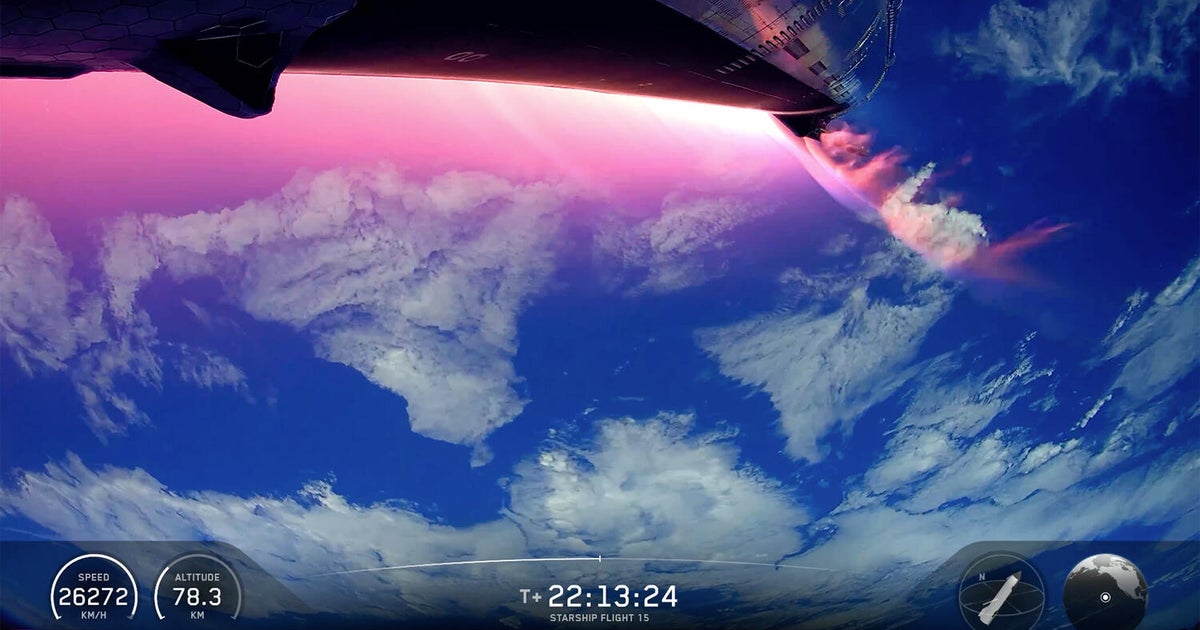
SpaceX caught a Starship spacecraft in the mechanical arms of its Texas launch tower Saturday, bringing it home after 22 hours in space. The first-ever catch of a Starship returning from orbit marked a major step toward the company’s goal of making its giant rocket fully reusable. But its first-stage booster exploded after a separate attempt to return to the launch site failed.
The 407-foot (124-meter) rocket lifted off Friday from SpaceX’s Starbase facility on the Texas Gulf Coast. Its Super Heavy booster separated from the upper-stage Starship, which continued into orbit. NPR reported that Starship released 26 advanced Starlink satellites, completed 14 laps around Earth and flew about 165 miles (265 kilometers) above the planet. It was the rocket’s 15th full-scale test flight since 2023 and its second trip to orbit, NPR said.
On its return, cameras on Starship showed the spacecraft glowing red as it passed through the atmosphere. It crossed the Baja Peninsula and northern Mexico, then descended near the launch site. Starship restarted three of its six methane-fueled Raptor engines, flipped upright and slowed almost to a hover before the tower’s arms closed around it. SpaceX employees watching nearby cheered.
“This is so incredible to see!” SpaceX commentator Jessie Anderson said. Fellow commentator Dan Huot called the catch “the missing link,” adding: “We caught a Starship, and now everything changes.” SpaceX reported that the spacecraft’s systems, including its heat shield, appeared to work well, according to NPR. Previous Starship test flights had ended with planned ocean splashdowns rather than a catch.
The booster did not make it back. SpaceX had caught boosters on three previous launches, but Friday’s Super Heavy was diverted toward an offshore splashdown after its guidance system detected that it was out of position. The vehicle ran out of fuel and exploded shortly before reaching the water, CBS News reported.
SpaceX’s Kate Tice said the booster’s engines stopped firing too soon during its descent and engineers were investigating the cause, according to NPR. Elon Musk described the problem on X as a “slight underperformance of engines.” He said the loss would not change SpaceX’s timeline for “high volume, fully reusable Starship flights.”
NASA plans to use a version of Starship to carry astronauts to the lunar surface. CBS News reported that the agency is aiming for a 2028 landing and is open to using Blue Origin’s Blue Moon Mark 2 lander, depending on which spacecraft is ready. NPR reported that NASA is targeting Artemis IV for a moon landing as soon as 2028 and plans an earlier orbital mission in which astronauts would practice docking with Starship and Blue Moon.
More tests lie ahead. CBS News reported that SpaceX must show it can repeatedly launch and recover both stages, refuel Starships autonomously in Earth orbit and prevent their propellants from boiling away there. Multiple tanker flights would be needed to fuel a Starship lunar lander before it heads to the moon, the outlet reported.






Be First to Comment