Key takeaways:
- Starship reached orbit on its 14th flight after one of its six upper-stage engines shut down early.
- The Super Heavy booster splashed down offshore instead of attempting a launch-tower catch.
- SpaceX’s planned NASA moon lander may require about 15 tanker launches for refueling, according to CBS News.
SpaceX sent its Starship spacecraft into orbit for the first time Monday, overcoming an engine shutdown during ascent on a test flight central to its satellite plans and NASA’s effort to return astronauts to the moon.
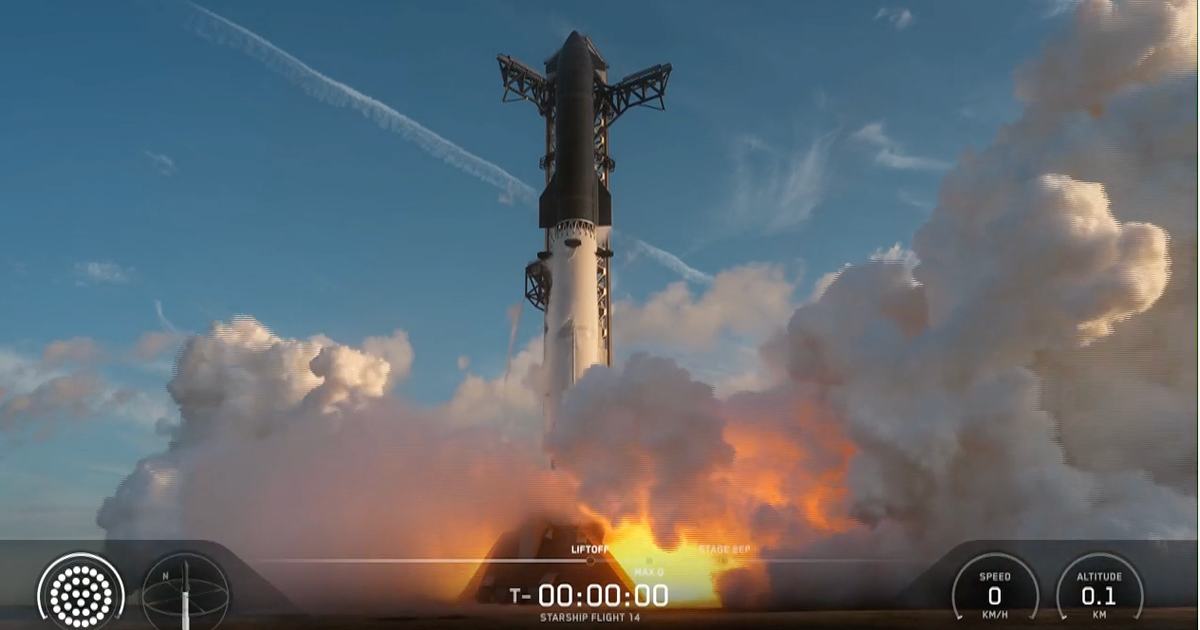
The uncrewed launch from SpaceX’s Starbase site on the Texas Gulf Coast was the rocket system’s 14th flight. Its 33-engine Super Heavy booster lifted the roughly 400-foot-tall rocket away from the pad, and the Starship upper stage separated about two and a half minutes later. Earlier Starship tests had followed suborbital trajectories.
One of Starship’s six Raptor engines shut down early during the climb. After reviewing telemetry, the flight team determined the spacecraft could continue. A later firing of a single engine put Starship into orbit, CBS News reported. NPR reported that the decision to proceed came about 22 minutes after liftoff.
The booster also experienced an early engine shutdown, according to CBS News, but reversed course and made an apparently normal vertical splashdown a few miles offshore. SpaceX chose an ocean landing to test hardware and software upgrades rather than attempt a catch at the launch tower, which has caught boosters on four previous flights. On the preceding test, engine problems had led to a hard splashdown.
The mission plan called for roughly six circuits of Earth before Starship fired an engine to leave orbit and descended for a splashdown off Chile. CBS News put the planned flight duration at nine hours and 50 minutes and the orbital altitude at about 180 miles. NPR described it as a roughly 10-hour flight at about 170 miles. SpaceX designed the trajectory to allow a safe return if the spacecraft could not complete the climb to orbit.
Starship also began releasing 26 third-generation Starlink internet satellites during the flight, CBS News reported. The outlet said each has 10 times the capacity of the preceding generation. NPR reported that three carried cameras to gather data on Starship’s heat shield, a key part of SpaceX’s effort to make the spacecraft reusable. SpaceX intends eventually to recover Starship itself rather than let it splash down.
The orbital flight is a step toward demonstrating refueling in space, which SpaceX needs for the Starship variant it is building as a NASA moon lander. Under the mission plan described by CBS News, as many as about 15 tanker launches could be needed to fuel the lander before it travels to the moon. There, it would meet an Orion crew capsule, take two astronauts to the lunar surface and return them to lunar orbit.
NASA is targeting its first such landing for 2028. Before then, the agency plans an Artemis III flight in which four astronauts aboard Orion would attempt to dock with prototype landers launched separately by SpaceX and Blue Origin. NASA is also funding Blue Origin’s alternative lander.
The test adds to the demands on SpaceX as it works to increase Starship’s launch rate and prove the systems needed for both moon missions and larger Starlink satellites. In a filing cited by NPR, the company warned that delays in achieving Starship’s planned launch cadence, reusability and capabilities could limit its growth strategy.














Be First to Comment