Key takeaways:
- The Guardian reported a trade-war pause through January 10; NPR said Beijing had not officially confirmed an extension.
- Xi urged Trump to oppose Taiwanese independence, according to China’s state news agency Xinhua.
- No breakthrough was reported on Iran, and the leaders announced no new AI safeguards.
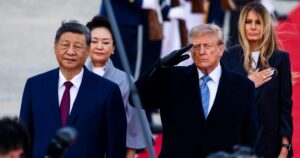
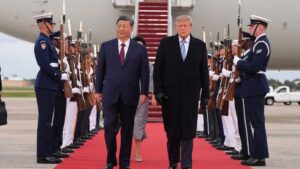
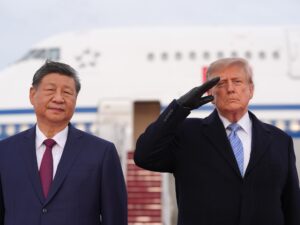
President Donald Trump and Chinese leader Xi Jinping struck a cordial tone at the White House on Thursday, but their talks produced no reported breakthrough on Taiwan, artificial intelligence or the war with Iran. A pause in the countries’ trade war remains in place, though the two sides have not announced a broader agreement.
“We had a great meeting,” Trump told reporters without elaborating. Xi urged the two powers to avoid the “Thucydides Trap,” a term for the risk of conflict between a rising power and an established one. Their competition, he said, should be “a race of catching up with one another, not a wrestle in which one either wins or loses.”
Accounts of the talks’ length differed: NPR reported that Trump and Xi met for around three hours, while The Guardian described a closed-door meeting of about 90 minutes. The visit also featured an elaborate welcome and a White House state dinner attended by technology executives including Apple’s Tim Cook, Amazon’s Jeff Bezos, OpenAI’s Sam Altman, Tesla’s Elon Musk and Nvidia’s Jensen Huang.
Trade offered the clearest sign of continued cooperation. The Guardian reported that the countries agreed to extend their trade-war pause until January 10. NPR reported that Treasury Secretary Scott Bessent announced an extension until January, but said Beijing had not officially confirmed it. The countries still impose substantial tariffs on each other’s goods. According to Congressional Research Service estimates cited by NPR, the average U.S. tariff on Chinese goods exceeded 36% in July, while China’s average tariff on U.S. goods was around 30%.
On Taiwan, China’s state news agency Xinhua reported that Xi urged Trump to oppose Taiwanese independence and handle the issue “prudently.” The White House had not released its own account of those remarks. China claims the self-governing island as its territory and has not ruled out using force to take control. Trump said after a May meeting with Xi that he would postpone final approval of an arms package for Taiwan worth about $14 billion, calling arms sales a “very good negotiating chip.” The Guardian reported that at least 19 Senate Democrats signed a statement urging Trump to deliver that package and $1.3 billion in approved security assistance.
The leaders also addressed AI. Trump wrote before the meeting that the technology would be a major topic but that he wanted to “leave it exactly where it is,” adding that China shared that position. Xi said both countries should ensure AI remains “under human control.” No agreement on new safeguards was announced.
Iran remained another point of tension. The United States and Israel launched a war against Iran in February, and the Strait of Hormuz has been closed, pushing up global energy prices, according to Al Jazeera. Trump has sought Chinese support for isolating Tehran economically and reopening the strait. Al Jazeera reported no breakthrough Thursday; Xi instead backed a return to an interim U.S.-Iran agreement that broke down shortly after it was announced in June.
The ceremony drew mixed reactions from U.S. lawmakers. Republican Senator Roger Wicker questioned the lavish welcome given the disputes with Beijing. Republican Senator Rand Paul welcomed the meeting, writing: “Diplomacy is key. Talk more, war less.”








Be First to Comment